
Warren Buffett was once asked about the management fads that seem to sweep through business schools and boardrooms every few years. His answer was typically understated:
“There are these fads in management… obviously, listening to your customer and things like that… nothing makes more sense. But it’s hard to write a 300-page book that just says, ‘Listen to your customer.’”
I love that line. It captures something true about many of the ideas that matter most in business: they are too simple to sell. Nobody builds a consulting practice around listening.
It also cuts against the way we tend to think about leadership. We expect our chief executives to be strong, bold and decisive, the person at the front of the room with the vision and all the answers. Boards hire on the strength of an interview. Analysts expect a plan from the outset. Markets reward confidence.
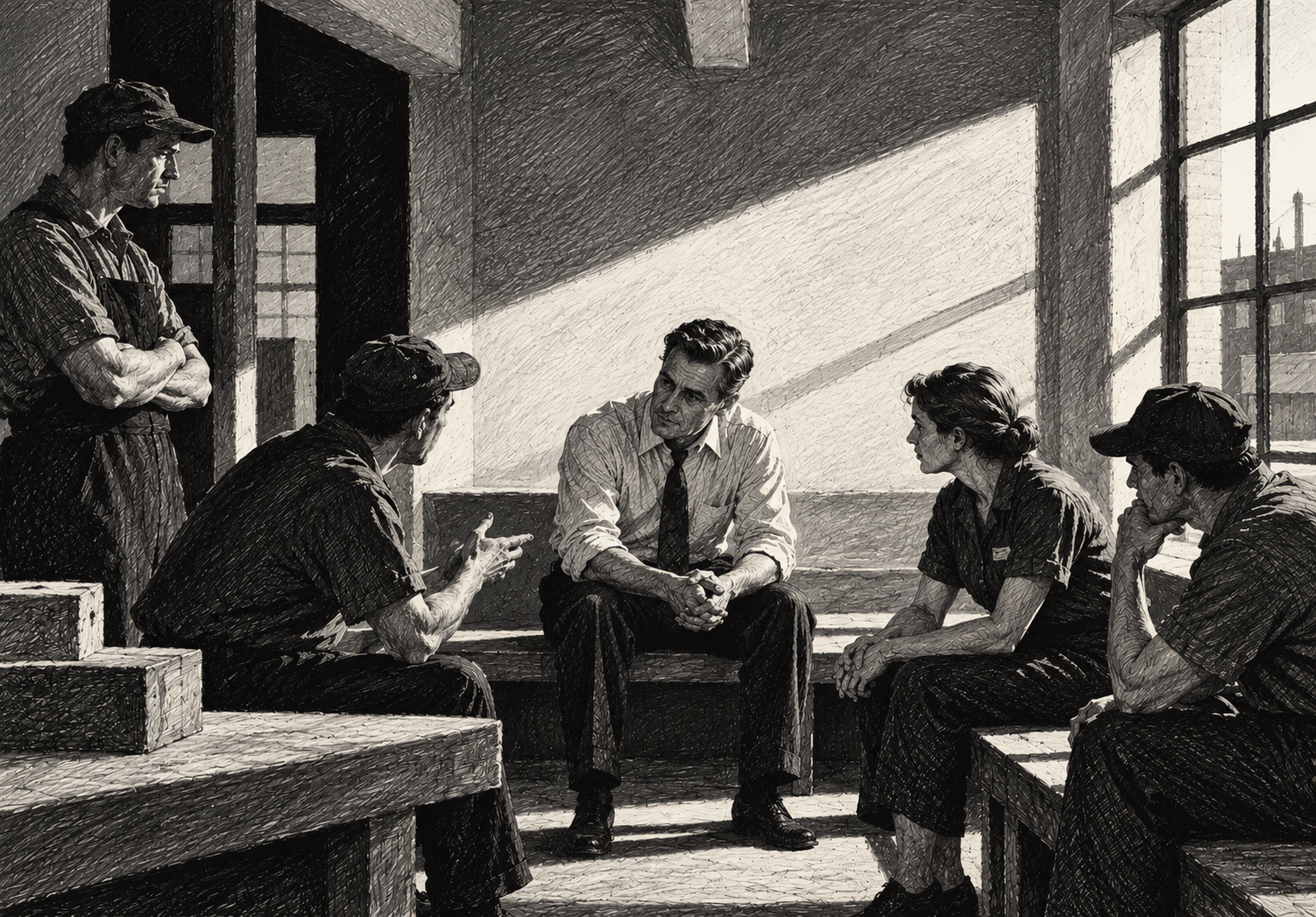
Yet when I go back over my notes on the hundreds of businesses I’ve studied, and on the coaches and captains who built great teams, something else keeps turning up. When the people who built them explain what made the difference, a surprising number don’t talk about vision or persuasion. They talk about listening. Not as a soft skill or a pleasant personal quality, but as a discipline, practised daily and built into the way the company runs. It shows up in how they treat customers, how they treat the people on the front line, who they keep around them, where they look for information, and how they spend their first months in a new job.
An Underrated Talent
John Malone is not someone you would naturally associate with keeping quiet. He spent half a century out-negotiating cable operators, programmers and regulators. Yet when he reflects on what taught him most, it isn’t the talking:
“Listening. A severely underrated talent in business. It should be a class unto itself in business schools. Most people in a conversation are waiting for their turn to speak. Everyone wants to be heard, but few people in business engage in listening to understand. I have learned an awful lot about business over the last sixty-plus years by asking dumb questions and then keeping my mouth shut, more than I ever learned by saying something.”
Ken Iverson, who built Nucor into the most efficient steelmaker in America, made almost the same argument, and added a point I think is easily missed:
“Listening is among the scarcest of all human skills, in and out of management. Listening requires concentration, skill, patience, and a lot of practice… Real listening enables managers not only to hear what people say to them, but to sense what may be behind what is said… Better still, their reputation for competent listening will encourage others to bring them information.”
That last sentence is the one that matters. A leader known to listen gets brought information. A leader known not to listen gets brought reassurance. Over ten or twenty years, the difference between those two flows compounds like everything else. One company finds out about its problems early, while they are still small. The other finds out from its customers, its competitors or its share price.
Bill Walsh, who built the great San Francisco 49ers teams of the 1980s, reduced it to a coach’s formula: “If someone told me that leadership is as easy as one, two, three, I’d reply, ‘Only if the one, two, and three are as follows: 1. Listen, 2. Listen, 3. Lead.’”
Two Ears, One Mouth
There is an old piece of anatomical wisdom that turns up in nearly every great salesman’s vocabulary. Henry Kravis of KKR puts it simply: “You’ve got more ears than you have mouth. Just remember that. For a reason.” Jim Clayton, who built Clayton Homes, later sold to Berkshire Hathaway, taught his salespeople the same arithmetic: “I taught my team to talk less and listen more.”
What separates the best from the cliché is that they treat listening as a craft rather than a personality trait. Dave Cote, who turned around Honeywell, built himself a simple rule:
“Too often people tend to think about what they’ll say next when someone else is speaking. I developed a practice of listening all the way through and waiting three seconds to respond — it’s amazing how that small change allows you to really hear what someone is saying… or not saying.”
Barnett Helzberg, whose jewellery business Buffett bought after a chance introduction on a New York street, was refreshingly unsentimental about it: “Listening is a discipline, and not an easy one! When I’m speaking, I’m learning nothing. I’m not always learning even when listening, but I have a better chance.”
For investors there is a sharper lesson here. Arthur Rock, who backed Intel and Apple, described listening less as a management skill than as his main tool for judging people:
“The first time you meet with somebody, everybody’s on their good behavior and everybody comes across as being good entrepreneurs. It’s not until you spend a lot of time with them that you figure out whether your first impressions were right or not. Some people tend to contradict themselves. They’ll tell you one thing in one meeting and another thing in another meeting… So I’ve spent a lot of time listening to people and figuring out whether I thought they were good people and whether I could get along with them.”
I find this one of the most useful passages on judging management I know. The first meeting tells you very little. Everyone is on their best behaviour and the story is well rehearsed. It is only over many conversations, listening carefully for what changes, what gets repeated and what is quietly dropped, that you begin to see the gap between stated and demonstrated values. As Bruce Lee put it:
“The most dangerous person is the one who listens, thinks, and observes.”
The Customer Explains the Business
Peter Schutz, who took over Porsche in 1981 at a difficult moment for the company, had perhaps the best single line on the subject: “We ask and listen. If you listen closely enough, your customers will explain your business to you.”
Carl Sewell, the Dallas car dealer whose Customers for Life remains one of the best books on service ever written, took this further than most. He refused to assume he knew what his customers wanted:
“We don’t have any rules that say all customers must be greeted in thirty seconds, or that the phone has to be answered by the second ring. Rules like that are created by people who assume they know what customers want. We don’t assume anything. Instead, we try to find out. If you give customers a chance to talk, and if you’re willing to listen, they’ll tell you exactly what’s important to them.”
Sewell also did something few businesses bother with. He went looking for the customers who had left, to find out why they had bought the Mercedes or the Lexus instead of the Cadillac. Most companies study the customers they have. Far fewer study the ones they lost, even though that is usually where the truth is.
Brunello Cucinelli has built an elegant version of this into his business. Alongside his own boutiques, he sells through independent multi-brand stores, and he trusts their verdict over that of his own staff:
“I never trust what our store managers say when they say, wow, it’s beautiful, it’s great. No, it’s up to the multi-brands to have a say… They have viewed 300 different collections… They’re true critics, but if you have the courage to listen, their criticism is always very constructive.”
Listening to praise takes no courage at all. The multi-brand buyer has seen 300 collections and has no reason to flatter you. If your product is ageing, they will tell you. The question is whether you want to hear it.
The cost of not listening is rarely sudden. It tends to show up slowly, as a business drifts away from its customers without quite noticing. Terry Leahy, who helped turn Tesco around in the early 1990s, described it well:
“If your business or organisation has lost its way, and you fail to ask the customer — or client or citizen — why they have lost trust in you, you will never get to the truth as to why you are failing. You may convince yourself that you have come up with a ‘strategy’, but the chances are that it will be the wrong one, based on cosy assumptions, not hard fact.”
David Kearns, reflecting on how Xerox lost so much ground to its Japanese competitors, wrote the epitaph: “We got into big trouble mostly because we stopped listening to the customer. Sooner or later, that sort of deafness can be fatal.”
Even Jeff Bezos, who has invented more than most, is clear about where it starts: “Much of what we build at AWS is based on listening to customers.”
The Answers Are Already In The Building
If customers are the first audience, the second is the company’s own people, particularly those furthest from head office. I have written about this at length before, so I will only touch on it here. Joe Coulombe of Trader Joe’s put it most simply: “In any troubled company the people at lower levels know what ought to be done in terms of day-to-day operations. If you just ask them, you can find answers.” Tom Crosby at Pal’s Sudden Service keeps a running list of every improvement ever made to the business, and describes his own share of the ideas as “such a small speck”.
What is easier to overlook is what listening does for the people being listened to. Joe Scarlett of Tractor Supply saw it as one of the building blocks of a strong culture. When employees know you are listening and that you care, he observed, “they are more likely to stick with your organization and go out of their way to help your business be successful.” David Novak of Yum! Brands went further: “The most powerful way to motivate people is to really listen to them with your full attention and an open mind.” People who know they'll be heard are more likely to speak up again.
No Yes-Men
Of course, listening only works if people are willing to tell you the truth. And the more senior you become, the less likely they are to do it. Ed Catmull of Pixar named the problem: “Societal conditioning discourages telling the truth to those perceived to be in higher positions.”
William Wrigley Jr., who built the Wrigley chewing gum business, put it more colourfully a century ago:
“One of the biggest pests in business is the carbon copy — the fellow who always says: ‘Yes, Mr Wrigley, you’re absolutely right.’ Perhaps meaning: ‘Have it your own way, you old buzzard, what do I care?’ Business is built by men who care — care enough to disagree, fight it out to a finish, get the facts. When two men always agree, one of them is unnecessary.”
He also understood where yes-men come from: “A few yes men may be born, but mostly they are made. Fear is a great breeder of them.” That puts the responsibility squarely back on the leader.
Buffett has seen what happens at the top of companies when this goes wrong:
“If you arrange your organisation so that you basically have a bunch of sycophants who are cloaked in titles, you are going to leave your prior conclusions intact.”
The best operators don’t just tolerate disagreement. They go looking for it. Reed Hastings calls it “farming for dissent”, and Netflix has built processes to make sure it happens. One of his exercises is beautifully simple: he asks his executives what they would change if they were CEO, and makes them name three things.
Robert Rosenberg asked a version of the same question when he visited Dunkin’ Donuts franchisees. He would say hello to the staff, have a coffee and a donut, and make it clear he wasn’t there to inspect the store. Then he asked two things. Knowing what you know today, would you invest in this franchise again? And if you were CEO, what would you do differently? The first told him whether the model was fair to the franchisee. The second told him how to improve it.
Charles Koch goes further, making challenge an obligation rather than a privilege:
“One of our top priorities is impressing on new employees that not only is it permissible to challenge their bosses respectfully if they think they have a better answer, but they have an obligation to do so. And supervisors have the obligation to create a culture that invites challenges.”
Andy Jassy says much the same at Amazon, adding that “‘I told you so’ has no currency” there. At Constellation Software, Mark Leonard tries to make sure that “sycophants, spin-doctors, and mercenaries don’t survive” in the senior ranks.
The cautionary tales are just as instructive. Paul Van Doren on what happened to Vans under his brother:
“Jimmy surrounded himself with people who had their noses so far up his derriere, even if they questioned him, their voices would have been too muffled to be heard. The problem really came down to ego, and when a company’s problem is ego in its leadership, it’s screwed.”
The same lesson turns up well beyond business. John Wooden, who won ten national championships at UCLA, did not want yes-men around him. His assistant Gary Cunningham remembered being encouraged to argue his point. Wooden’s advice: “Surround yourself with people strong enough to change your mind.” Michael Abrashoff, who turned the destroyer USS Benfold into one of the best ships in the US Navy, was blunter still: “Yes-people are a cancer in any organisation, and dangerous to boot.”
Henry Kaiser had the right instinct: “Bring me bad news. Good news weakens me.”
Complaints Beat Reports
If yes-men are the filter that stops bad news reaching the top, complaints are one of the few signals that get through unfiltered. Some of the best leaders make a point of hearing them first-hand.
Some companies have built this into the routine of senior management. Fred Reichheld, creator of the Net Promoter Score, documents several. At Charles Schwab, CEO Walt Bettinger listens almost every week to recordings of frontline teams calling back unhappy clients. At Discover, Roger Hochschild and his executives listen to hour-long samples of call-centre conversations twice a month, then set priorities based on what they heard. At MBNA, each senior executive spent four hours a month in a dedicated listening room, including on calls from customers who were cancelling their cards. Reichheld’s conclusion: “There is simply no substitute for having senior executives learn directly from defectors why the company’s value proposition is inadequate.”
James Dyson built a system to take this from the executive suite to the whole company:
“Listening to what our users say is gold dust and I really enjoy reading or hearing about complaints. We devised a system of reporting all remarks heard by customers in stores or by store salespeople from all over the world, so that everyone in the company can see this priceless intelligence.”
Paul Orfalea, the founder of Kinko’s, went looking for complaints from his own people, and wouldn’t let them hold back:
“I wanted to hear the complaints. Often a coworker would stop himself in mid-sentence and say, ‘I might get in trouble if I tell you about this.’ That drove me crazy! I never let a coworker get away with that excuse. Not only did I want to know, I needed to know.”
Jim Penman of Jim’s Group explains why it matters in three short sentences: “Complaints beat reports. Reports smooth problems. Complaints expose them.”
By the time a problem reaches a board paper, it has usually been summarised, put in context and softened several times on its way up. A complaint hasn’t. It arrives raw, which is exactly what makes it useful.
Wayne Rollins at Orkin took a complaint call ahead of any other call. Stew Leonard called the complaining customer his best friend. It is the customer who says nothing and never comes back who should worry you.
How the complaint is handled matters as much as hearing it. Horst Schulze gave every Ritz-Carlton employee, down to the newest busboy, authority to spend up to $2,000 to fix a guest’s problem. When he announced it, the owners of the hotel thought about suing him. His reasoning was simple. A business traveller will spend well over $100,000 on hotel rooms in a lifetime, and most unhappy guests want something far cheaper than compensation anyway:
“In well over 90 percent of the cases, the customers just want to get rid of their frustration. They often don’t want anything as tangible as compensation. They just want to be heard.”
Danny Meyer talks about writing “a great last chapter”, so that a guest leaves happier than if the mistake had never happened. Rory Sutherland makes a similar point: a customer whose problem is handled well often ends up more loyal than one who never had a problem at all. Charlie Munger described the simplest version of what to do with all of this:
“One of our directors said very simply, ‘We should make a list of everything that irritates the customer, and then we should eliminate those defects one by one.’ That is the way to compete in a service business.”
None of this matters if the complaint stops at the call centre. The real test is whether it reaches the people who can fix the cause, and whether the CEO actually wants it to.
The Listening Tour
The tension between the bold-leader myth and the listening reality is sharpest in a new chief executive’s first months. Everyone wants to know the plan. The best leaders resist the pressure to provide one too early. Adam Geha’s advice to anyone brought in to turn a business around: “The temptation is to rush. Do the exact opposite. For the first six weeks — only ask questions, ask lots of questions.”
Terry Leahy felt that pressure at Tesco, and admits that at first he gave in to it:
“I lost count of the number of times people popped into my office to ask me ‘What are you going to do, Terry — the board are keen to know?’ In those first few months I had not the faintest idea, but I nevertheless played my part by launching several initiatives. The problem, of course, was that they were all tactical rather than strategic and, as a result, they failed to make any impact at all. More peas shot at tanks.”
My favourite example is Tom Hennesy at Tractor Supply. He arrived knowing nothing about retail or farming, so he did something very simple. He went to the store managers and asked them one question: what’s wrong? Joe Scarlett, who later ran the company himself, still remembers the outcome:
“He talked to people in the field and he said, ‘What’s wrong?’ And he listened to what they had to say, listened for a month or two and then said to all of us, ‘We have two problems. We’re confused, and we don’t have any inventory to sell.’”
The fix was just as simple: put inventory back in the stores and become a farm store chain. It was the beginning of one of America’s great compounders, and of a culture in which everyone was expected to have ideas.
Once you start looking, the pattern is everywhere. When Don Washkewicz became president of Parker Hannifin, he spent 200 days of his first year visiting more than 200 of its locations around the world. He carried a blank sheet of paper and noted every pocket of excellence he found. Those notes became the Win Strategy. Hubert Joly spent his first three days as CEO of Best Buy not at headquarters but working in the St. Cloud store, wearing a blue shirt with a “CEO in Training” badge.
Guy Russo began the Kmart turnaround with a phase he called discovery, which he described as “just listen and shut up”. He invited all 30,000 employees to tell him what was wrong, then spent three hours at a time walking individual stores to check what he'd been told. While employees welcomed the approach, analysts were less impressed, wanting to see immediate action. Russo accepted the criticism, recognising that he needed to understand the business before he could fix it. Under his leadership, Kmart's operating earnings grew from $109 million in 2009 to $553 million in 2017, a fivefold increase.
It's a pattern that appears repeatedly in the careers of exceptional business leaders.
At GE, Larry Culp moved quickly on the debt but, as Nitin Nohria puts it, “refused to let urgency substitute for understanding”. He went to the factories, joined kaizen workshops and asked people on the shop floor to explain how processes actually worked. Ken Allen spent his first two months at DHL’s US business talking to as many frontline staff as he could. At Chili’s, Kevin Hochman ran listening sessions with restaurant teams, then went back to tell them what he had done with what he heard. The process also revealed who would be part of the future: “Those who are defensive and not acknowledging the situation are probably not going to make it.” How a management team responds to bad news often tells you more than how it presents good news.
Brad Jacobs, who has completed around 500 acquisitions, promised a listening tour in an open letter to the employees of Beacon Roofing Supply, written in the middle of a hostile bid. He would ask two questions: what has Beacon been doing so well that we’d be crazy to change it, and where can it improve? Tapping into employees’ ideas, he wrote, was “actually the most important secret of our success.”
And Buffett, advising Xerox as it faced crisis in 2000, gave perhaps the clearest instruction of all:
“You’re thinking the investors, bankers, and regulators are the people you need to survive. Put them aside and give priority to talking to your employees and your customers about what is wrong and what you have to do to fix it.”
Summary
Buffett is right. Nobody is going to write a 300-page book that just says “listen”. But the best businesses practise it every day.
Tom Peters and Robert Waterman put it most simply in In Search of Excellence: “The excellent companies are better listeners.” The best operators treat listening as a discipline rather than a personality trait. They get close to their customers and seek feedback from the people closest to the work. They surround themselves with people willing to tell them when they are wrong. They listen to complaints and ensure their boards and senior executives hear them firsthand. And when they arrive in a new job, they start with questions rather than answers.
Ultimately, a business that listens has an information advantage. It detects changes earlier, corrects mistakes faster, retains more customers and identifies opportunities others might miss. None of these benefits may seem particularly significant in isolation, but together, compounded over time, they can create a formidable competitive advantage.
For investors, this raises a few questions of our own. How did the CEO spend their first three months on the job? When did a senior executive or board member last hear directly from an unhappy customer? When did someone last tell the CEO they’d got it wrong, and what happened next? Where do the ideas for improvement come from? What systems are in place to ensure customers and employees are heard? Can management point to an important decision it changed because of something it heard from an employee or customer?
The answers rarely appear in an annual report. They emerge in conversations with customers, employees and management, often over many years. The challenge isn't always knowing what questions to ask. It's being willing to hear the answers.
* Visit the Blog Archive *
Learn more with us on Twitter: @mastersinvest
TERMS OF USE: DISCLAIMER