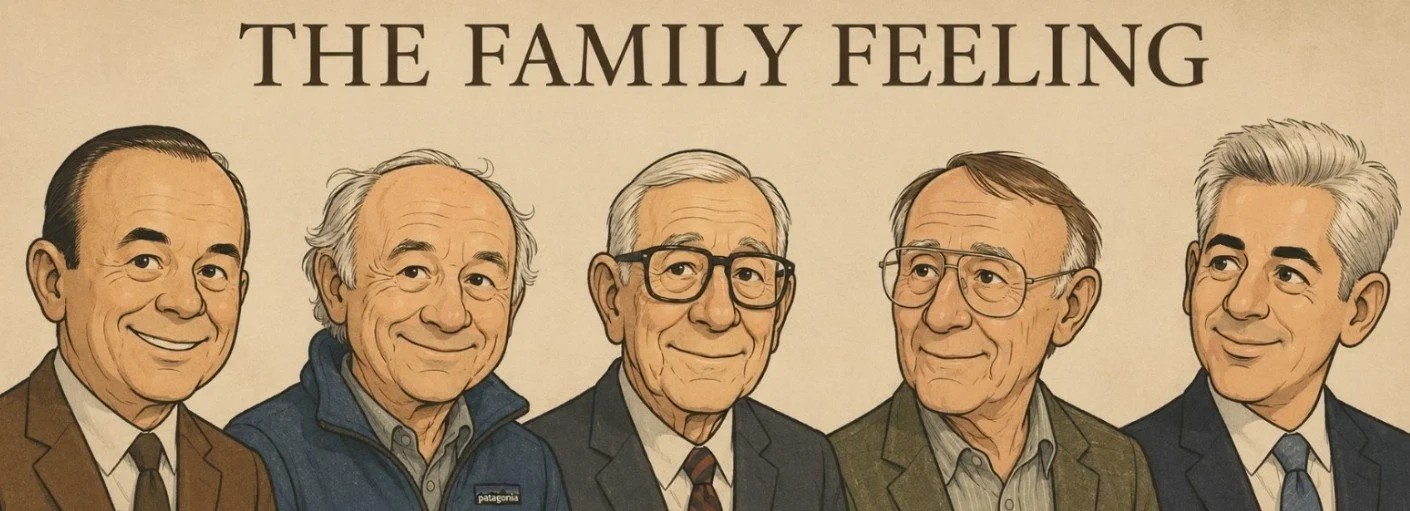
There is a word that appears, unbidden, in the writing and speeches of the founders of some of the greatest businesses ever built. It shows up in the memoirs of Ray Kroc, in the annual reports of Old Dominion Freight, in the founding philosophy of IKEA. The word is not "strategy." It is not "execution" or "competitive advantage" or "return on invested capital."
The word is family.
A pattern too consistent to ignore
When a pattern appears once, it's anecdote. When it appears across a hundred companies, spanning a dozen industries, over more than a century, it deserves serious attention.
Researcher Vicki Tenhaken spent years studying what she called the Century Club - companies that had survived and thrived for a hundred years or more. Her conclusion was striking: many of the Century Club companies' employees become lifelong, loyal members of the organisation and often compare their relationship with the company to being part of a family.
This wasn't sentimentality. These were businesses that had survived a century of disruption and competitive onslaughts. The family feeling wasn't incidental to their longevity. It may have been central to it.
Arie de Geus, the former head of strategic planning at Shell who spent decades studying long-lived companies, put it plainly: the feeling of belonging to an organisation and identifying with its achievements is often dismissed as soft. But case histories repeatedly show that a sense of community is essential for long-term survival.
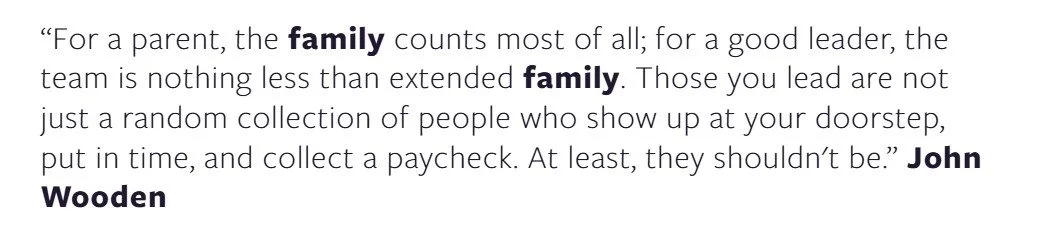
Soft, it turns out, is one of the hardest things to build. John Wooden - the preeminent basketball coach of his era, winner of ten NCAA championships in twelve years including seven consecutive titles and an 88-game winning streak, and a man Charlie Munger held in the highest admiration - compressed the whole idea into a single sentence: "Teams with a sense of family have uncommon strength and resiliency."
He wasn't speaking as a sentimentalist. He was speaking as someone who had proved it, repeatedly, against the best competition in the world.
Tom Peters, whose landmark 1982 study of America's highest-performing companies - In Search of Excellence - remains one of the most influential business books ever written, identified family culture as a defining characteristic of exceptional organisations decades before it became fashionable to say so. What Peters found was not a coincidence of personality or geography. It was a pattern, repeated across industries, embedded in the operating philosophy of the companies that consistently outperformed their peers.
More recently, Daniel Coyle spent years studying some of the world's most cohesive and high-performing groups - among them Google, Pixar, the US Navy SEALs, and the San Antonio Spurs. What he found echoed the same pattern, but from the inside out.

Coyle also noticed something else: many of the most successful organisations had created their own family-esque identifiers. People who work at Pixar are Pixarians. People who work at Google are Googlers. You might add Resmedians, Ikeans, Apaches, Hormelites and Nordies - each a small linguistic signal of something larger, a declaration that working here is not a transaction but a belonging. The name is the symptom. The culture is the cause.
What ‘family’ actually means in business
Before dismissing this as corporate speak - the kind of hollow language that fills employee handbooks nobody reads - it's worth being precise about what the best operators actually mean when they invoke the family metaphor.
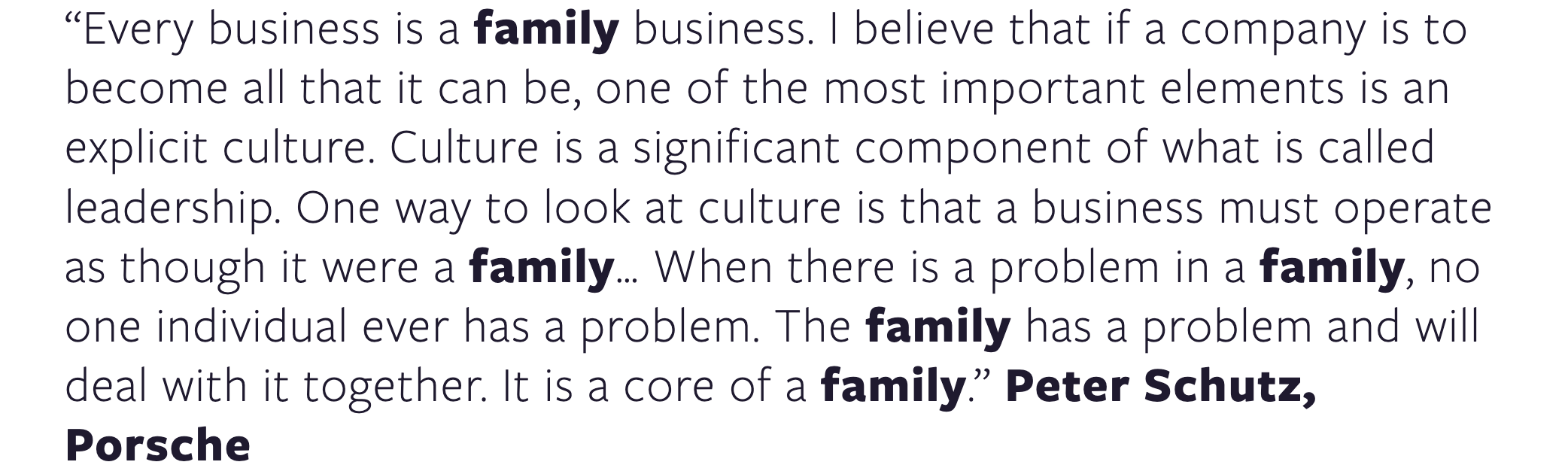
They don't mean unconditional love. They don't mean the absence of accountability. Peter Schutz, who ran Porsche through one of its most successful periods, offered one of the clearest definitions: a family consists of a group of people who have made a commitment to each other and to a set of shared values. When there is a problem in a family, no one individual ever has a problem. The family has a problem and will deal with it together.
Commitment that doesn't evaporate when things get hard. That is what separates companies that invoke family as a marketing slogan from those that actually live it.
The family metaphor, when genuine, also extends outward - beyond employees to the full value chain. Peters documented this vividly in his study of Caterpillar. "We have a tremendous regard for our dealers," said the company's former president and chairman. "We will not bypass or undercut them. Some of our competitors do and their dealers quit. Caterpillar dealers don't quit; they die rich." Caterpillar dealers, Peters noted, were treated like members of the family - not as a turn of phrase, but as an operating principle that shaped every commercial relationship the company held.
George Mecherle, founder of State Farm Insurance, cultivated a similar spirit. He saw himself as the benevolent father of a family, inspiring extraordinary loyalty among employees and policyholders alike. Customers proudly displayed State Farm medallions, recommended the company without financial incentive, and regarded membership almost as belonging to a fraternal organisation. Some reportedly sought membership despite not owning a car, simply to feel part of the family.
Jim McLamore, who co-founded Burger King, described the same logic with his franchisees: "We became a very successful company because we were able to help our franchisees do well. [We] viewed their success as our own success. They were a part of our family and we regarded them as such."
Howard Hawkins of Hawkins Chemical took it furthest of all, extending the circle to encompass everyone the company touched - employees, customers, suppliers and the community around them. Family, in his hands, became a way of thinking about the entire business system.

John Deere understood this distinction clearly. A family isn't unconditional - you don't support a crazy uncle who isn't behaving. Standards matter. Accountability matters. The family metaphor works precisely because it combines warmth with expectation.
Paul Ricard, who built one of France's great spirits empires, captured the reciprocal logic at its simplest: he felt clearly that it was important to treat his employees as part of a family. If he took care of their best interests, they would take care of his. There is no more compressed statement of what this philosophy actually is - not paternalism, but a recognition that the relationship between an organisation and its people is, at its best, genuinely mutual.

The science beneath the sentiment
Robert Cialdini, the psychologist who has spent a career studying influence and social behaviour, offers a framework for why this works at a neurological level. When people act in unitary ways, they become unitised. The resultant feeling of group solidarity serves society's interests well, producing degrees of loyalty and self-sacrifice associated usually with much smaller family units.
The neuroscience runs deeper still. Mark Bertolini, who led Aetna through a remarkable period of transformation, drew on research that connects the act of trust-giving to something measurable in the body:
"A neurologist discovered that when individuals were either given trust or they extended trust to others, their pituitary glands released a feel-good hormone called oxytocin. This created a biological virtuous cycle. When you trust someone their brain responds by making more oxytocin, which allows them to trust you in return. Reciprocity - doing unto others as they do unto you - seems to be a biological function; trust begets trust. I believe that to be true, and it's shaped my leadership of Aetna." Mark Bertolini, former CEO of Aetna
This is what Ricard intuited and Bertolini measured: the mutual relationship isn't just good philosophy, it is good biology. The virtuous cycle of trust is not merely a metaphor. It is part of the machinery of human cooperation.
For most of human history, survival depended on small groups that knew, trusted and sacrificed for one another. The family was the original organisation. Great companies do not fight that instinct. They build with it.

The companies that tap into this aren't being naive. They are being, in the deepest sense, strategic. They are building with the grain of human nature, not against it.
The founders who built it in
What's remarkable is how consistently this philosophy was baked in at the founding - not bolted on later as a PR exercise.
Ray Kroc at McDonald's. Howard Schultz at Starbucks. Ingvar Kamprad at IKEA. Yvon Chouinard at Patagonia. S. Truett Cathy at Chick-fil-A. Les Schwab at Les Schwab Tires. Les Schwab put it as plainly as anyone: "Our company is a large family." Seven words that contained an entire management philosophy.
Each built their company culture from the first day around a set of beliefs that prioritised belonging. Each understood, often instinctively, that people who feel ownership - emotional, not just financial - behave differently than those who merely show up for a pay cheque.
Tom Peters saw this pattern clearly among the founders he studied. Watson, Kroc, Marriott and their peers were pathbreakers in treating people as adults - inducing practical innovation and contributions from tens of thousands, providing training and development opportunities for all, and treating everyone as a member of the family. What united them was not industry or era but a shared conviction that the relationship between a company and its people was the thing worth building first.
As Keith Davies wrote of Don Plested and the early days of Mainfreight: Plested set out to make the company a family, a team, in which everyone would have a share in the riches. Join Mainfreight, and you joined a family.
The Snyder family at In-N-Out Burger carried the same conviction. In many ways In-N-Out was an employee-driven company - the Snyders displayed an uncommon respect for their workers, never looking at them as just employees but seeing them as part of their own growing, extended family. In an industry notorious for churn and indifference, that distinction showed up everywhere: in wages well above competitors, in promotion from within, and in a loyalty from staff that customers could feel the moment they walked through the door.
At Patagonia, Yvon Chouinard took it a step further — the family feeling was not merely cultural but literal. "Not only was the company like an extended family," he wrote, "but for many it was family, because we always hired friends, friends of friends, and their relatives." What began as a climbing gear startup built around a tight-knit community never lost that texture, even as it grew into a global brand. The culture didn't have to be constructed. It was simply preserved.
The Hartford brothers at A&P ran the largest retailer in America for decades on a similar premise: the Hartfords treated the company as their family, almost never dismissing employees, creating one of the first company pension plans, and shortening working hours simply because they could afford to do so.
This is the key distinction. Family culture isn't just a philosophy about how you treat people. It's a philosophy about what the company is for. The Hartfords shortened working hours not because consultants told them to. Because they could. Because their workers were family, and family shares in success.
The scaling problem — and how the best solve it
The obvious objection is that family culture doesn't scale. A founding team of ten can feel like a family. A company of ten thousand cannot. Can it?
The evidence suggests otherwise - if you're deliberate about it.
Ralph Roberts, who built Comcast from a small cable franchise into one of the largest media companies in the world, articulated the solution simply: how do you maintain that same culture? You do it by being warm and friendly. And instead of one big family, we have a lot of little families.
This is precisely the insight that explains why decentralised businesses with branch-level autonomy so consistently outperform their centralised competitors. Not just for operational reasons - though those matter - but for cultural ones. When a branch manager has genuine authority and genuine accountability, they can build a genuine family within their team. The thirty people in that branch can know each other, trust each other, cover for each other. They cannot do that if every decision flows up to a regional manager who reports to a national director who reports to a VP who has never visited the branch.

Po Chung, who built DHL into one of the world's great logistics networks, understood this as well as anyone. "Both internal and remote networks become like working with parents, siblings, cousins, uncles, and aunts. As DHL was built and organised like a large, extended family, this provided a model we could keep scaling and growing. In fact, it was the ideal model for building a global service network composed of a competent and caring team of high character." Family culture, in Chung's telling, wasn't the soft alternative to building a great business. It was the mechanism.
Wawa, the extraordinary convenience store chain, has lived this for decades. CEO Howard Stoeckel put it plainly: we're the Cheers of convenience stores, a place where you're known by name, and where the customers and associates all treat each other like family.
Carol Meyrowitz, who ran TJX Companies through years of remarkable performance, traced the company's ability to retain great people directly to its family culture: one reason TJX holds on to its best people is its culture - very family-friendly, encouraging people to balance work and home life. As a result, people tend to stay. Many of them for more than thirty years.
Retention is not a soft metric. It is the compound interest of organisational knowledge. Every person who stays another year carries with them another year of customer relationships, product knowledge, institutional memory. Every person who leaves takes that with them. As Joe Coulombe, founder of Trader Joe's, put it with characteristic directness: "Productivity in part is a product of tenure. That's why I believe that turnover is the most expensive form of labor expense."
When family culture meets financial discipline
The most sophisticated version of this idea recognises that family culture and financial rigour are not in tension. They are, in the best companies, mutually reinforcing.
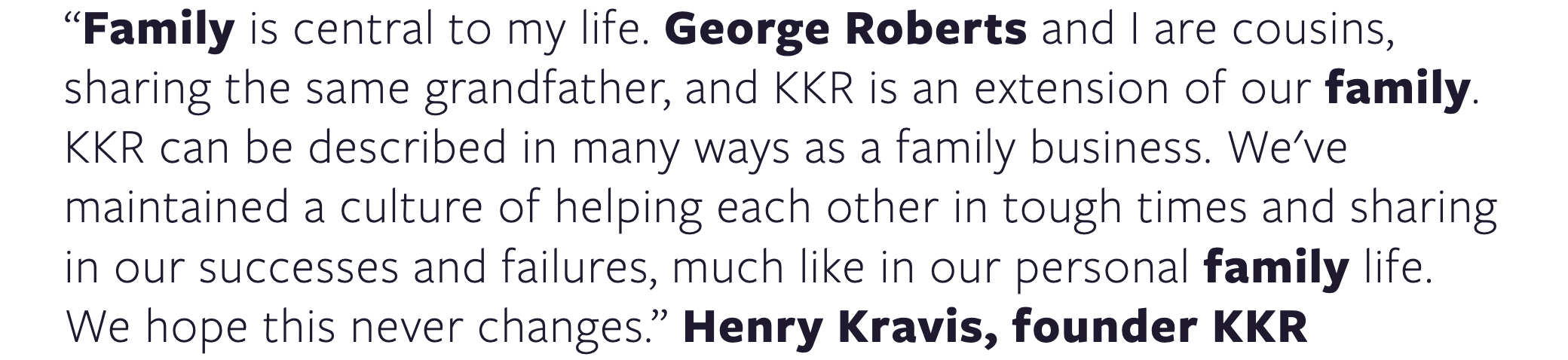
Henry Kravis at KKR - not an organisation typically associated with warmth - has spoken about it in exactly these terms: it's important to remember that KKR is our family business. We did go public and change our shareholder base in doing so, but George and I remain the largest shareholders to this day and our culture still has that family business mentality.
Marc Rowan, who built Apollo into one of the world's great alternative asset managers, goes further - and gets more specific about what living this philosophy actually requires at scale:
"The business ultimately runs on experience. That only lasts if your partners stay with you for their entire career. If they're going to stay with you for their entire career, we have to recognise they're going to have, outside their careers, a bunch of happy things that happen to them and a bunch of sad things. How we deal with people in these moments that matter — at 4,000 people, 6,000 people — it's really important. It's actually almost more important than anything else we do."— Marc Rowan, CEO of Apollo Global Management
This is the mechanism Bertolini's research describes playing out across a career. Every act of showing up - for a bereavement, an illness, a celebration - deposits a little more trust, extends the relationship a little further. At scale, across thousands of people over decades, that compounding is the business.
Bill Ackman at Pershing Square makes the connection between culture and outcomes explicit: the firm's unique family-oriented culture, the powerful economics of the business, and its widely dispersed economic ownership make it a special place to spend a career. A small scale and long-tenured employee base also reduce risks - particularly important in a regulatorily sensitive industry.
Long tenure. Reduced risk. Powerful economics. These are not accidents. They are the downstream consequences of culture built on belonging.
When the family includes the town
Sometimes the family feeling shows up not in words but in brick and mortar.
J. Irwin Miller ran Cummins Engine in Columbus, Indiana for four decades and used the company's profits to fund architect fees for public buildings - commissioning Eero Saarinen, I.M. Pei, Richard Meier to design schools, churches and civic buildings in a small Midwestern town. A town of 50,000 people with one of the most extraordinary collections of modernist architecture in the world. Not because it was good marketing. Because Miller believed that a company's family extended to the community around it, and that a family takes care of its home.
Implications for investors
So what does this mean for those of us trying to identify businesses worth owning for a decade or more?
Family culture is a moat. Not in the conventional sense of patents or network effects or switching costs. It is a moat because it is genuinely difficult to replicate and, once lost, extraordinarily hard to rebuild. You cannot hire a consulting firm to install it. You cannot acquire it. You cannot mandate it from a head office. It grows slowly, from the values of founders and the experiences of the people who live inside the business every day.
Look for low staff turnover. This is the most reliable observable signal of genuine family culture. Graco's average employee tenure of eleven years. TJX executives with thirty-plus year careers. Old Dominion drivers who retire with the company they joined as young men. These are not HR statistics. They are evidence of something real.
Look for founders or families still involved. The companies in this collection - Chick-fil-A, In-N-Out, Comcast, Wawa, Nebraska Furniture Mart, Cintas, LVMH, ABC Supply - are disproportionately founder-led or family-controlled.

This is not coincidence. Founders and families have a different relationship with the business. It is theirs in a way that a professional manager's company never quite is. They are willing to suffer short-term pain to protect something they intend to pass on.

As Katharine Graham observed, family ownership can also prevent the kind of disruptive takeovers that destroy what took decades to build. Quality, she argued, may be nourished most easily by families whose perspective extends beyond the immediate horizon.

Look also at how the best operators think about shareholders. Buffett's Owner's Manual asked investors to visualise their Berkshire stake the way they might think of a farm held "in partnership with members of your family" - not a piece of paper to be traded, but a permanent commitment. He didn't want a revolving door of shareholders any more than he wanted a revolving door of managers. Building an ownership base with the loyalty and permanence of a family is, it turns out, both a cultural achievement and a competitive one.
Be suspicious of rapid centralisation. When a company that built its strength through distributed, branch-level culture begins consolidating in the name of efficiency, the family feeling is usually the first casualty - and the financial results follow, often with a lag that deceives investors until it's too late. The culture breaks before the numbers do.
Listen to how leaders talk about their people. The language reveals the reality. Howard Stoeckel describing Wawa as the Cheers of convenience stores. Ralph Roberts of Comcast inviting employees to call him directly. David O'Reilly tracing O'Reilly Automotive's philosophy back to its founding family. Marc Rowan describing how showing up for his people in the moments that matter is almost more important than anything else he does. These are not PR statements. They are the visible surface of something much deeper.

Value what you cannot easily quantify. The discounted cash flow model will never capture the value of a culture that causes people to stay thirty years, to bring their children into the business, to feel genuine grief when a colleague leaves. But that culture is compounding, invisibly, every single day. And over a decade, over two decades, over a century - it shows up unmistakably in the numbers.
Paul Ricard's formulation stays with you for its simplicity: take care of their best interests, and they will take care of yours. Mark Bertolini confirmed it in the chemistry of the pituitary gland. It is not a management technique. It is a description of how trust actually works - slowing accumulated, easily destroyed, and worth more than any asset on the balance sheet.
The greatest businesses in history were not merely managed. They were loved. And the investors who recognised that love - not as sentiment, but as a durable economic asset - earned returns no spreadsheet could have predicted.
Follow us on Twitter : @mastersinvest
* Visit the Blog Archive *
TERMS OF USE: DISCLAIMER