
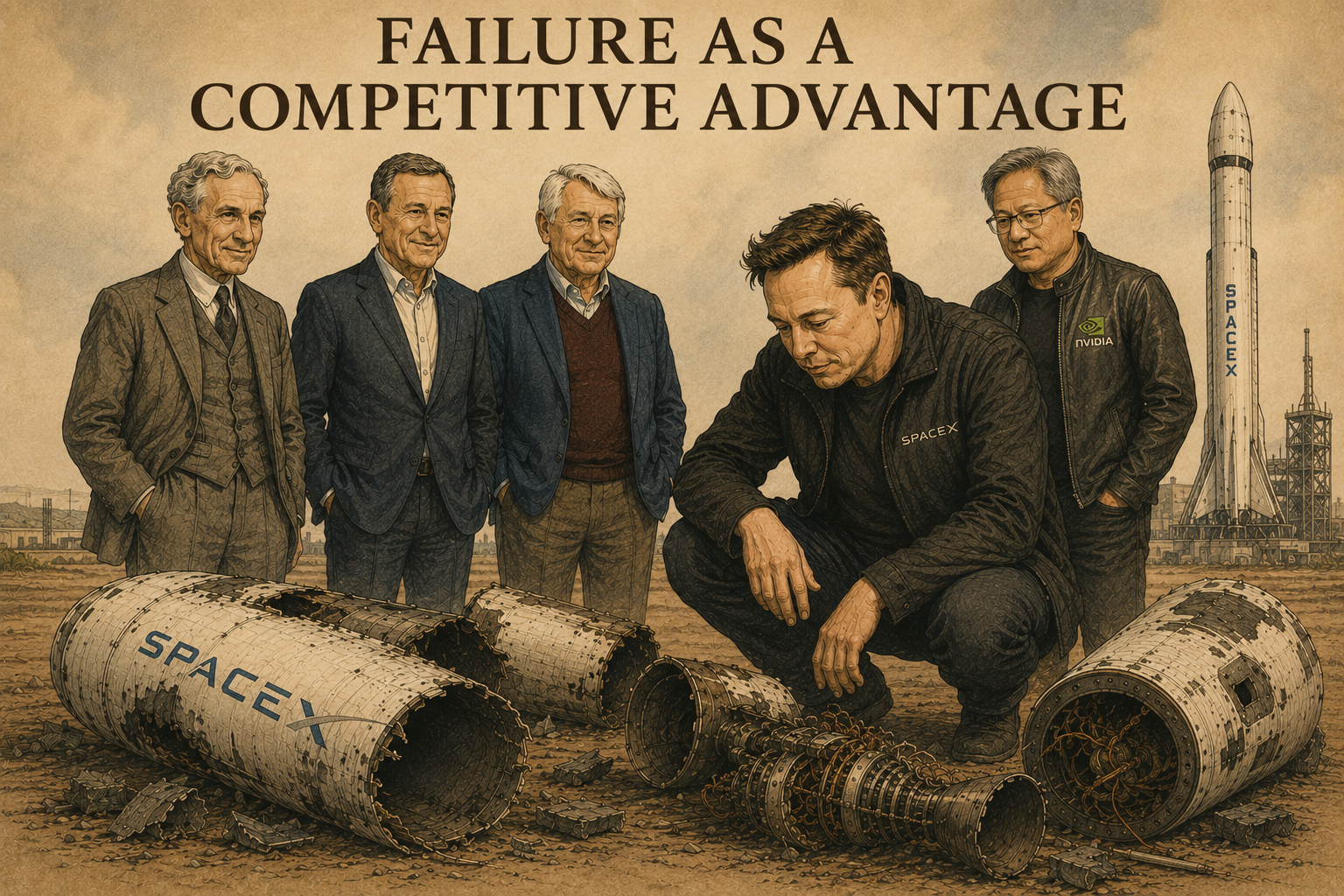
Spend enough time studying exceptional organisations and you begin to notice recurring patterns. They recruit differently. They decentralise decision making. They think about capital allocation differently. They stay unusually close to customers. They build cultures that seem to compound over decades.
Another pattern is less obvious, but it appears with remarkable consistency.
The world’s best organisations have an unusually high tolerance for failure.
At first glance, that sounds counterintuitive. Surely the best organisations make fewer mistakes than everyone else. Surely excellence is simply the result of consistently making better decisions.

But after reading hundreds of founder biographies, business histories and studies of successful organisations — from great companies to championship teams and military units — I have gradually come to a different conclusion. Great organisations are not distinguished because they avoid failure. They are distinguished because they have learnt how to convert it into learning.

That does not mean tolerating carelessness or poor execution. Quite the opposite — the best organisations are demanding, with exceptionally high standards. What they have recognised is that innovation requires a culture where people feel safe to experiment. If people become frightened of being wrong, they stop experimenting. Once experimentation stops, learning slows. And once learning slows, innovation rarely survives for long.

Elon Musk explained the mechanism plainly: punish failure too severely, and people respond accordingly — innovation becomes incremental, because nobody is willing to try anything bold. Henry Kravis reached the same conclusion from the other side of the table: a culture that does not admit failure is precarious.

Different leaders, different industries, the same finding — fear changes behaviour. People become cautious, defensive, less willing to challenge accepted thinking. Organisations that once adapted quickly can become prisoners of their own success.
Tom Peters Saw It Forty Years Ago
Tom Peters and Robert Waterman identified this pattern more than forty years ago in In Search of Excellence. One defining characteristic of excellent companies, they observed, was a high tolerance for failure — not for mediocrity, but for experimentation. The best companies, they found, experiment more, encourage more tries, and permit small failures.

As organisations grow, they can become insulated from reality. Planning increases. Analysis expands. Approval processes multiply. Meanwhile, customers change, competitors move, technology advances and the operating environment evolves. What looks like discipline can become disconnection. Small experiments are what keep a business learning.
The Palchinsky Principle
I read Tim Harford’s Adapt more than ten years ago, and one idea from it has stayed with me since. Harford describes the Palchinsky Principle, drawn from the work of Peter Palchinsky, a Russian engineer who studied why grand industrial projects so often failed.
His method was simple: seek out new ideas, test them on a scale where failure is survivable, gather feedback from the people closest to the work, and learn before committing significant resources.
It is a powerful model because it explains how great organisations actually operate. They are not reckless, and they do not celebrate failure for its own sake. They build systems that allow trial and error within sensible limits — testing before they scale, learning before they commit, and taking risk without ever making survival dependent on being right.
Eli Broad captured the risk-management side of this well: never bet the farm, or even half the farm. He believed the entrepreneur’s most common trap was the illusion of invincibility — optimism was essential, but so was a clear-eyed view of the downside. He always wanted to understand the worst case before committing to the best one.

Jim Collins made the same point more simply: the only mistakes you can learn from are the ones you survive. Failure is useful only if it is survivable.
That single idea explains a host of philosophies that otherwise look unrelated. Henry Ford was saying much the same thing more than a century ago: try everything in a little way first. Bruce Flatt, Thomas Bloch, John Malone and Barry Diller — operating decades later, in entirely different industries — arrived independently at the same rule: never risk the whole business on one deal. Halma applies the same logic to its acquisitions, entering unfamiliar markets cautiously through small, reversible bets rather than large ones.

What’s notable isn’t that these leaders knew each other. It’s that they didn’t need to. Progress requires experimentation, but the experiments have to be designed so that being wrong never threatens the survival of the business.
The Acquisition Trap
This is particularly relevant to acquisitions.
I have seen plenty of deals that looked wonderful on paper. The earnings were accretive, the synergies obvious, the strategic narrative compelling. Then reality arrived. The seller knew more than the buyer. The business had been dressed for sale. The customers were not as loyal as they appeared. The cultures clashed, the systems didn’t integrate, and the people who made the business special walked out the door once the cheque cleared.
A spreadsheet can make almost any acquisition look sensible. But acquisitions aren’t completed in spreadsheets — they’re completed in factories, branches, sales teams, incentive systems and cultures. That is where the assumptions meet reality.

The best businesses understand this and rarely bet the farm. They prefer bolt-ons and adjacent opportunities over grand transformational deals, and they preserve the ability to change their mind. The danger is magnified when a deal requires issuing a lot of equity, gearing the balance sheet, and relying on a debt paydown plan that assumes the future resembles the model. Often it doesn’t.
The better question is not simply whether a deal adds to earnings. It’s whether the company can digest the loss if the thesis is wrong. In capital allocation, brilliance matters. Survival matters more.
Small Experiments Produce Big Advantages
One of the most consistent traits of outstanding companies is that they rarely rely on one enormous bet. Instead, they build systems that allow hundreds of relatively inexpensive experiments every year.
Tom Peters called this “cheap learning” and quoted 3M’s philosophy approvingly: their people make hundreds of little bets. The same thinking shows up everywhere you look. Aldi runs a three-store test before any wider rollout. Costco trials new products in a handful of warehouses before committing to larger purchases. Chick-fil-A tested menu items across dozens of stores before going national. Raymond James deliberately let managers make mistakes while they were still cheap.
The purpose of these experiments is never to prove management right. It’s to learn something while the cost of being wrong is still modest. Most will never transform the company, but collectively they replace uncertainty with knowledge before meaningful capital is committed.
Jeff Bezos has made the inverse argument at Amazon: if the scale of a company’s failures isn’t increasing as it grows, it probably isn’t inventing at a scale capable of producing real breakthroughs.
Businesses as Organic Systems
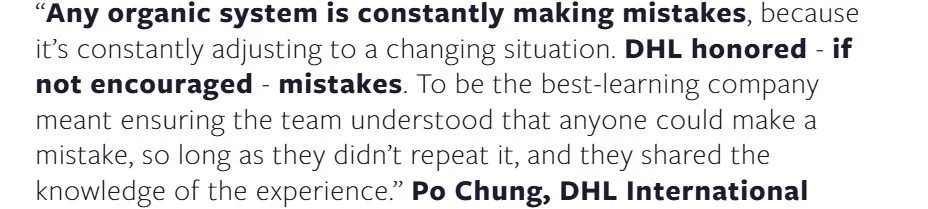
Po Chung, co-founder of DHL International, saw DHL as an organic system rather than a machine. The distinction matters. A machine operates in a fixed way. An organic system is constantly adjusting to its environment — and as Chung put it, anything that is constantly adjusting is constantly making mistakes. Mistakes are a byproduct of evolution, not a departure from it.
Jim Collins pushed this further in Built to Last. He argued that visionary companies make some of their best moves through trial and error, opportunism, and — quite literally — accident, and that they “mimic the biological evolution of species.” The comparison is worth sitting with rather than passing over.
In evolution, variation comes first. Organisms try slightly different things, mostly by accident. Selection comes second, deciding which variations survive contact with the environment. Companies that operate the same way generate many small variations — new products, new formats, new approaches — expose them to the real test of customers and competitors, and let the market do the selecting. What looks like brilliant foresight in hindsight is often just this process running for long enough.

A company that tries to remove every mistake can easily remove the variation that allows it to adapt. The goal isn’t to eliminate error — it’s to make errors visible, survivable and useful. The companies that endure aren’t necessarily the ones that make the fewest mistakes. They’re the ones that learn fastest, discard what doesn’t work, and keep moving toward what does.
A Culture Without Blame
Running experiments is only half the challenge. People also have to feel safe admitting when those experiments haven’t worked.
This may be the least appreciated trait of outstanding organisations. Many companies claim to encourage innovation, then respond to failed initiatives by searching for someone to blame — and employees quickly learn to conceal mistakes rather than discuss them.
Captain Michael Abrashoff built the opposite culture aboard the USS Benfold. His focus was never on finding someone to blame, but on making sure the accident never happened again. He also made the sharper point: show him someone who has never made a mistake, and he’ll show you someone who isn’t doing anything to improve the organisation — because organisations too often promote only the people who’ve never been wrong.
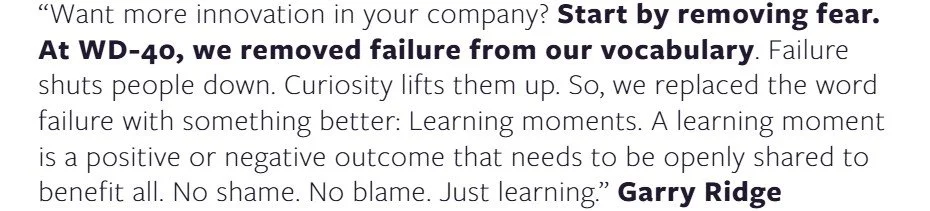
The pattern repeats wherever you look for it. Larry Culp describes Danaher’s philosophy as attacking the problem, not the person. Akio Morita wanted Sony to understand what caused a mistake rather than identify who made it. Garry Ridge removed the word “failure” from WD-40’s vocabulary entirely, replacing it with “learning moments,” because he wanted unsuccessful experiments shared rather than hidden.

Frank Perdue ran the same playbook at Perdue Farms — people were free to try something new, and if it didn’t work, the organisation learned from it and moved on. Some ideas were hare-brained. Some paid off wonderfully. That’s the trade-off: a culture that eliminates every bad idea usually eliminates the good ones too.
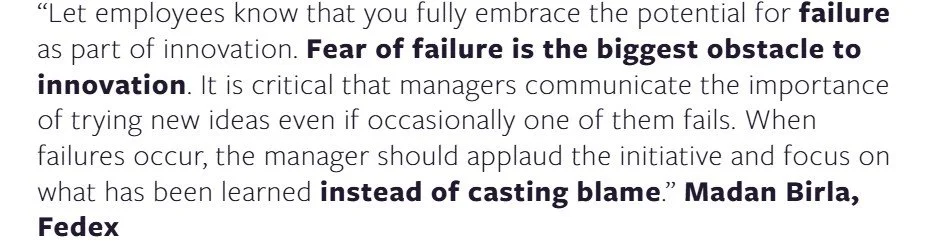
Marc Rowan makes the point most directly at Apollo. His view isn’t that poor decisions are acceptable — it’s that organisations learn almost nothing when people spend their energy protecting themselves instead of confronting reality. A wrong decision can usually be corrected. A mistake that’s denied or concealed becomes far more expensive. Michael Dell distills the whole idea into one sentence: you want to make mistakes, you just want to make them small, iterate, and fix them quickly.
The common thread isn’t a celebration of failure. It’s a determination to learn from it before it becomes expensive — and that requires honesty, humility, and an environment where people can speak openly about what’s gone wrong.
Make the Mistake Once
The best cultures are permissive, not indulgent.
Vitec’s philosophy was that it’s fine to make a mistake once. Po Chung described the same standard at DHL: anyone could make a mistake, so long as they didn’t repeat it — and the knowledge was then shared with others.
That is the line between tolerance and weakness. A hidden mistake is wasted. A repeated mistake is expensive. A mistake that is analysed, shared and embedded into the system becomes an asset. This is where failure becomes a competitive advantage — not because the company fails more often, but because it learns faster from the failures it has, and the lesson stops being trapped inside one person’s experience and becomes part of the organisation’s memory.
What Investors Should Look For
As investors, we spend enormous amounts of time looking for competitive advantages — brands, network effects, switching costs, economies of scale, reinvestment runways, capital allocation. Yet one of the most durable advantages is cultural.
The companies that keep adapting over decades have built cultures where people feel safe experimenting without threatening the survival of the business. They run small tests, listen closely to customers, remove blame from the learning process, and reallocate quickly away from what doesn’t work.

For investors, the question is never whether a company has made mistakes. Every company has. The better question is what it does with them. Does it hide them, deny them and repeat them — or surface them, learn from them, and adjust? Over long periods, that difference compounds.
In practice, this means being wary of companies that bet the farm on transformational acquisitions. It means listening for whether management talks openly about mistakes or only celebrates success. It means favouring businesses that test, learn and iterate before committing serious capital. An organisation’s error-handling system may matter as much as its strategy.
None of this shows up neatly in a screen or a set of accounts. Philip Fisher called this kind of work “scuttlebutt” — going directly to customers, competitors and former employees rather than relying on what management publishes. It remains one of the few qualitative edges that cannot be automated away, because whether an organisation learns from mistakes is usually revealed in behaviour long before it appears in the numbers.
Failure as an Edge
No organisation has eliminated failure. The ones that compound for decades have simply built a better relationship with it — one where mistakes are made small on purpose, surfaced rather than buried, and converted into something the whole organisation gets to keep.

That conversion, repeated across thousands of small decisions, is what a culture of experimentation actually buys a business: faster innovation, faster adaptation, less bureaucracy and more empowered people. People are more likely to stay because they are trusted. Products get better in small steps rather than rare leaps. Customers feel it before anyone reports it.
The companies that last are not the ones that fail less. They are the ones that evolve faster.
Follow us on Twitter : @mastersinvest
* Visit the Blog Archive *
TERMS OF USE: DISCLAIMER