
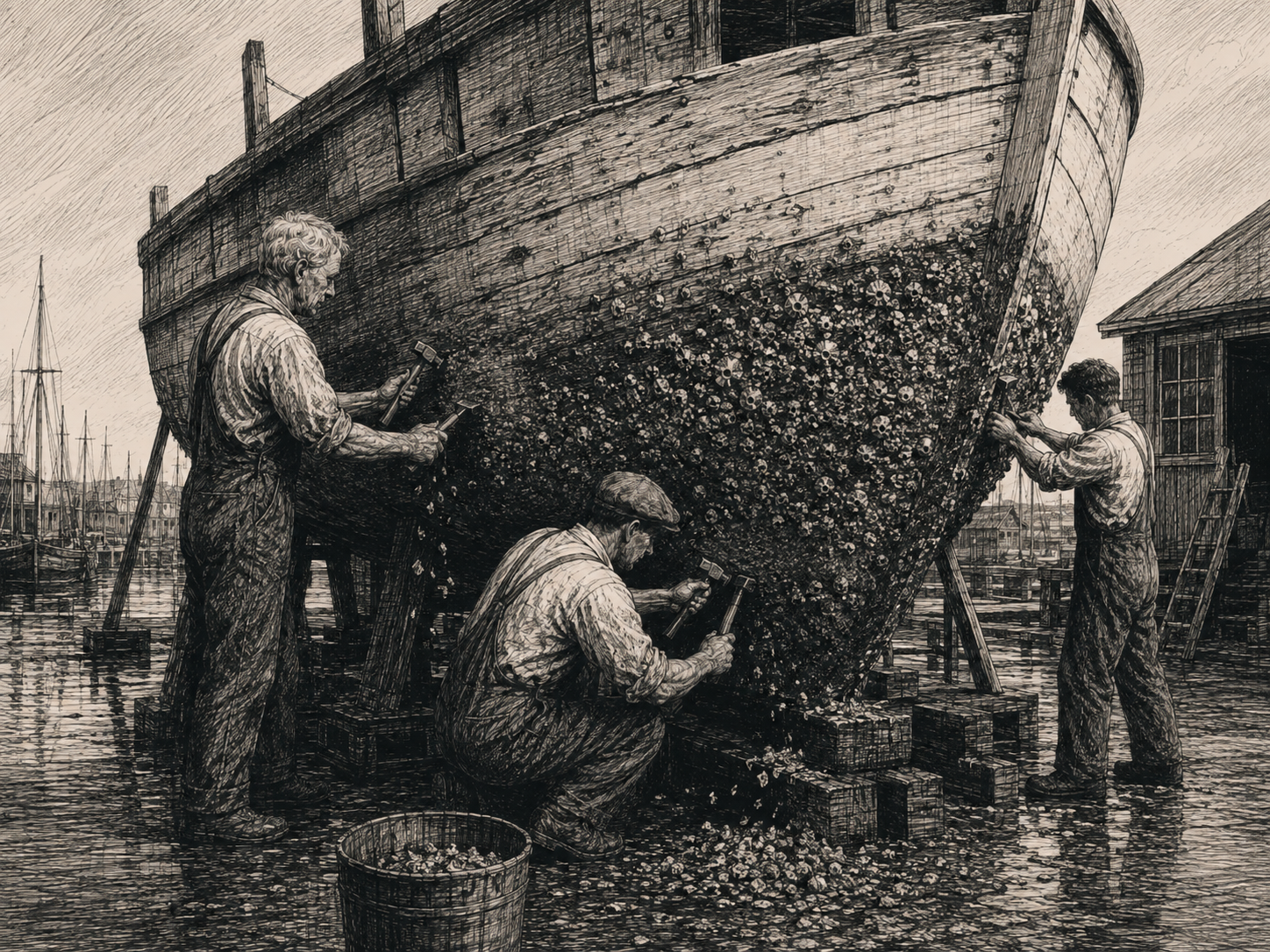
Richard Farmer had a favourite way of explaining costs at Cintas. He told his people to imagine a new ship entering the water.
“When a new ship is put into the water, it has a clean hull,” Farmer explained. “It moves fast and is highly manoeuvrable. Nothing is holding it back.”
Leave it in port for a year, though, and things change. “Barnacles accumulate on the hull. They slow the ship down, require more power to run, and reduce manoeuvrability because of the drag.”
“Whether we know it or not, we’ve got barnacles,” Farmer told his people. “Your job is to find those barnacles and scrape them off.” He would give examples: “buying things that you decided you needed 10 years ago and you don’t need them anymore. Or having somebody prepare a report that was very important to you five years ago, but now you no longer need it. But they’re still preparing it for you. That’s a barnacle. People we’ve outgrown or are occupying positions that are no longer needed—they’re barnacles too.”
None of these things is likely to sink the ship. That’s precisely the problem. They accumulate slowly. A report becomes a process, the process requires a person, the person eventually becomes a department, and the department creates meetings, budgets and reports of its own.
Before long, yesterday’s nimble company needs far more people, money and effort just to hold its speed.
Watching the Pennies
Warren Buffett once said that “a good manager must be a demon on costs.” Costco’s Jim Sinegal described the job as continual: “You have to continually find ways to reduce expense and to improve productivity.”
Some of the world’s great businesses have taken that idea to almost comical extremes.
François Michelin understood the signalling effect of small costs. Michelin famously turned envelopes inside out so they could be used again. “To save a million envelopes a year is important,” he insisted. But his real point was cultural: how could Michelin ask factory workers to save a gram of rubber per tyre if office workers weren’t also being asked to save a gram of paper?
That was why Michelin’s own frugality mattered. He reused defective road maps for internal memos and lived simply — wearing frayed suits, flying economy and taking the Paris Métro — “personifying the virtues he wished to apply to his managers and workers.”
Ingvar Kamprad took much the same approach at IKEA. Despite becoming a billionaire, he continued to travel standard class and lived with what biographer Bertil Torekull described as a “total lack of external finery” — no grand clothes, smart watches or luxury cars.
“Low price is written into our business idea as an essential condition for our success,” he wrote. Delivering low prices was impossible without low costs.
Hyundai founder Chung Ju-yung made frugality equally explicit. “Our company motto is ‘diligence, frugality, affection,’” he said. Like Michelin, Chung insisted employees use both sides of a sheet of paper, but his deeper concern was the example set at the top: “I’ve never come across a company that thrives under a luxury-loving, wasteful owner.”
Fastenal founder Bob Kierlin was similarly obsessive. He drove an Oldsmobile, furnished his office with used furniture, typed his own correspondence and had no personal secretary. Even his suits were second-hand. “Luckily, we’re the same size,” Kierlin told a reporter after buying six used suits from the manager of a clothing store for $60 apiece. “Either you do a good job of cost control in all aspects of your business, or you start losing it.” Eventually, Kierlin said, frugality became so ingrained that he didn’t even have to think about it. It became an attitude.
John D. Rockefeller carried the instinct throughout his life. “The world’s richest man never lost the thrifty boyhood habits that had made him the nonpareil of American business,” Ron Chernow wrote. Rockefeller could spend a ridiculous amount of time protesting bills both large and small, but his philosophy was captured in a much simpler instruction: “Save when you can and not when you have to.”
It’s easy to be frugal when circumstances leave no alternative. The more revealing test is whether the habit survives when the necessity disappears.
What Does the Customer Get?
The point of all this penny-pinching isn’t simply to accumulate more pennies.
J.C. Penney understood that from the beginning. “Our first customers were people who took the saving of so much as a penny seriously,” he recalled. “To save pennies for them I had to save them for myself.” He meant it literally: wrapping paper and string were reused, bent nails were straightened, and envelopes were opened carefully so their blank sides could serve as scratch paper.
But the savings weren’t intended simply to fatten the bottom line. “Savings — far from being used to line our own pockets — were passed on to our customers, in the real Golden Rule way.”
Don Keough found a broader version of the same test at Coca-Cola. To combat bureaucracy, he tried to reduce every expense, department and project to one basic question: “Will this help to create and serve customers?” If the answer wasn’t a ringing yes, whatever Coca-Cola was spending or undertaking had to go.
Keough’s explanation of what happened otherwise is even better: “Once you decide you have fifty things to do that are unrelated to your customer, soon you have fifty bureaucracies composed of individuals doing things extremely well that they shouldn’t have been doing because it didn’t serve the customers in any way.”
That’s the danger: the people may be talented, the department well run and the work performed exceptionally well. It just shouldn’t exist.
Buffett has made essentially the same point about Berkshire. Its managers don’t submit budgets to him, Berkshire doesn’t spend time producing consolidated monthly figures simply because large companies traditionally do, and Buffett’s explanation is wonderfully straightforward: “We don’t do unnecessary things around Berkshire. And a lot of stuff that’s done at big companies is unnecessary.”
Michael Moritz recalled Don Valentine applying a similarly brutal test to young companies. Valentine would clamp onto burn rates and circle G&A on the income statement in green. Moritz wrote that Valentine believed “anything not closely associated with either directly making, building, marketing or selling a product was a waste of money.” He would latch onto any function or person he thought impeded the rapid advance of the business and reserved particular scorn for bureaucracy and the people who created it.
Keough’s test forces the business back to first principles: Does it help create or serve a customer?
Never Add the Unneeded
People may be the most difficult barnacle of all, which is why the best companies seem particularly careful about adding them in the first place.
Buffett has long rejected the familiar corporate cycle of hiring enthusiastically when business is good, only to slash headcount when conditions turn. “We neither understand the adding of unneeded people or activities because profits are booming, nor the cutting of essential people or activities because profitability is shrinking.” Berkshire’s goal, he said, was simple: “Never to add the unneeded.”
Elsewhere he put it even more plainly: “I don’t think you can ever find a statement that Charlie and I have ever made, in terms of Berkshire’s companies or anybody else’s, where we said that there should be more people working than are needed in a company.”
Tom Murphy built much the same philosophy into Capital Cities: “In terms of culture, we told our employees that we hire the smartest people we can find and that we have no more of them around than necessary.” Sam Walton was blunter still: “We always ran a real tight organization. We had no excess people.”
Tom Peters and Robert Waterman captured part of the reason in In Search of Excellence: “As the number of people in a company goes up arithmetically, the number of possible interactions among them goes up geometrically.”
There’s a humane logic underneath the financial one. ServiceMaster’s Bill Pollard used to say the company would “rather buy a baby grand piano than hire or assign one unnecessary person.” If the piano was no longer needed, it could be chopped up. “But we cannot do that with people.”
The easiest time to accumulate unnecessary people is when profits are booming and nobody is particularly interested in questioning another salary.
Percy Barnevik had a wonderfully simple way of fighting this at ABB: don’t assume that someone leaving creates a vacancy that needs filling. “The replacement of employees who resign should always be examined closely, during financial boom times and recessions alike.” Each departure was an opportunity to ask whether the position would be created today if it didn’t already exist. If managers disagreed, Barnevik suggested leaving the job vacant for six months and seeing what happened.
If this position didn’t already exist, would we create it today?
Don’t add the unneeded in the first place.
Frugal Isn’t Cheap
But there’s another side to the argument. Some expenses deserve more money, not less.
Leonard Lauder was famously frugal. His wife liked telling stories about him complaining that she took taxis to visit Estée Lauder stores in Brooklyn. “Why can’t you take the subway?” he’d gripe. But the next part of Lauder’s explanation is what matters: “Because our overhead was so low, we could afford to use — in fact, we could insist on using — expensive ingredients.”
That’s the distinction. Cheap companies minimise expenditure. Great frugal companies spend as little as possible on things the customer doesn’t value so they can spend generously on the things they do.
Labour provides perhaps the most counterintuitive example. “It sounds like a good idea to minimise labour cost,” Fred Reichheld observed. “But in order to maximise the potential for value creation, a business must find ways to pay its best people more than the competition.” In fact, he argued, “one of the best ways to cut costs (as a percentage of revenues) is very often to increase compensation opportunities, counterintuitive as that may sound.”
Phil Fisher had made much the same observation back in 1958. He suggested investors pay close attention to wage scales. A company earning above-average profits while paying above-average wages was likely to have good labour relations. But when “a significant part of earnings comes from paying below-standard wages,” Fisher warned, the investor “may in time have serious trouble on his hands.”
James Lincoln had demonstrated the economics decades earlier at Lincoln Electric. His workers earned enormous performance bonuses, yet because they were so much more productive, Lincoln Electric spent proportionally less on total labour than its major competitors — even after bonuses that could exceed 100 percent.
Aldi discovered much the same thing. Karl Albrecht relentlessly preached two things: control costs and hire the best people. A former Aldi UK CEO recalled Albrecht’s instruction to “turn the penny three times before you part with it.” There was “no cost too small not to concentrate on,” but that didn’t mean avoiding investment.
Aldi deliberately paid higher salaries because better people required less supervision, exercised greater autonomy and produced more. “Investing in really good people was not a way to save money; reducing the salaries of people was never a way to save money.” Despite paying some of the industry’s highest salaries, labour consumed roughly 3 percent of sales against 7 to 8 percent at a typical supermarket.
Joe Coulombe reduced the whole idea to a sentence at Trader Joe’s: “Good people pay by their extra productivity. You can’t afford to have cheap employees.”
Les Schwab reached the same conclusion when lower-priced competitors appeared. He considered cutting benefits and salaries and pulling the savings back to headquarters. “Sounds good, but it doesn’t work that way.”
Schwab went the other direction. “We increased wages, we changed and improved our medical, dental and insurance programs. We increased our cash bonus.” The result was better people, better service and greater productivity. “I don’t think our percentage wage cost was any higher than our competition because our people just plain ‘put out more.’”
The important number isn’t what an employee costs. It’s what the business gets in return.
Good Costs, Bad Costs
Accounting doesn’t make that distinction particularly well. An unnecessary corporate meeting is an expense, but so is employee training. A private jet is an expense, but so is research and development. Another management layer is an expense, but so is advertising that strengthens a brand for decades.
Buffett has pointed to Coca-Cola as an example. Some of the enormous sums it spends on marketing and advertising are treated as current expenses, but economically part of that spending is creating a long-term asset, much as capital expenditure creates a factory.
David Packard understood the same distinction at Hewlett-Packard. “One of our most important management tasks is maintaining the proper balance between short-term profit performance and investment for future strength and growth.” HP routinely spent 8 to 10 percent of sales on R&D, sometimes more, because “good new products are the lifeblood of technical companies such as ours.”
The opposite mistake can be equally damaging. Panera’s founder, Ron Shaich, has described what happens when restaurants facing falling sales try to protect the P&L by “ripping out labor hours and cutting food cost.” He calls those savings “a tax on the customer.”
“Longer waits, dirty tables, slower service, and more frazzled team members all add up to a negative customer experience that will undoubtedly undermine already falling sales and intensify a cycle of decline.”
Fred Reichheld makes the broader point: “Managers should be skeptical of any cost reduction scheme that doesn’t include a credible strategy for the enhancement of customer retention — which means a credible strategy for improving customer value.”
The income statement calls all these dollars expenses. The customer knows the difference.
The Expensive Trappings of Success
Frugality is easiest when there’s no money. The harder test comes after success.
Tom Murphy said Capital Cities developed its bare-bones culture because the company nearly went bankrupt twice in its early years. “We had to go back to the original stockholders twice for additional money. As a result, we always ran the operation with a very limited number of people. We never had any more people than we absolutely needed. I think we had fewer people than we really needed.”
The remarkable part was that when the financial pressure disappeared, the behaviour didn’t. “Over time, that barebones culture stayed with us.”
Barclay Simpson carried much the same instinct into Simpson Manufacturing. Like many of the generation that came of age during the Depression, Simpson had internalised what his biographer described as a “stern frugality.” The shabby plant and office facilities in San Leandro reflected “his deep and continuing preference for substance over show,” while his battered, dusty cars and refusal to allow himself special luxuries became a source of amusement — and respect — among employees.
But there was a principle underneath it. As one colleague put it, “Barclay hates to waste a nickel of shareholder money.” Simpson was the sort of man who would take the bus from JFK into downtown rather than pay for a cab, and “that applies to all aspects of his leadership style.”
That’s an important way of thinking about corporate frugality. The money being spent isn’t really management’s money. It belongs to the owners of the business, and treating a corporate expense account differently from your own wallet is itself a small agency problem.
Kamprad understood the signalling problem too. He attacked luxurious company cars, first-class flights, separate executive dining rooms and other privileges not because eliminating them would transform IKEA’s economics, but because management couldn’t credibly preach cost consciousness while exempting itself. “No, this is a question of our credibility.”
Success normally works in the opposite direction. Profits rise, headquarters expands, travel improves, assistants acquire assistants and things previously considered luxuries slowly become necessities. The business hasn’t necessarily become badly managed; it has simply accumulated barnacles.
There is a deeper force at work here. Max DePree, the longtime head of Herman Miller, once described one of management’s hardest jobs as “the interception of entropy.” By entropy, he meant simply that “everything has a tendency to deteriorate.”
David Cote saw the same force at Honeywell: “Over time all organised systems evolve towards chaos. Unless you pursue change relentlessly, your efforts will eventually wither away.”
Farmer’s barnacles were another way of describing the same phenomenon. Left alone, organisations don’t naturally become simpler. They accumulate.
A Permanent Revolution
The worst time to develop a cost culture is when you suddenly need one.
Buffett put it beautifully: “Whenever I read about some company undertaking a cost-cutting program, I know it’s not a company that really knows what costs are all about. Spurts don’t work in this area. The really good manager does not wake up in the morning and say, ‘This is the day I’m going to cut costs,’ any more than he wakes up and decides to practice breathing.”
David Cote made the same point at Honeywell. His goal was not periodic cost cutting, but to keep fixed costs under control as the company grew. “Constant, sustained process improvement is vital for any company seeking to win today and tomorrow,” he wrote. The gains rarely came from one dramatic action. “It’s the habit of process change — the undertaking of numerous, sustained changes over time — that counts.”
Cote understood the compounding involved. A business improving productivity by 3 percent a year rather than 1 percent may not look dramatically different after twelve months, but over a decade the gap becomes enormous. At Honeywell, that meant hundreds of small changes to processes, repeated year after year, allowing more revenue to pass through an increasingly efficient cost base.
Costs compound quietly. So do improvements.
Marathon Asset Management expressed much the same idea: “Almost every firm engages in bouts of cost cutting. Exceptional firms, however are involved in a permanent revolution against unnecessary expenses.”
When cost cutting becomes urgent, the danger is that management cuts what can be cut rather than what should be cut — people, training, maintenance, R&D, customer service or marketing. Things that looked expensive on yesterday’s income statement but may have been creating tomorrow’s revenue.
Charles Schwab’s observation is worth remembering: “You can’t cut a company to greatness.”
The objective isn’t to periodically slash expenditure. It’s to prevent unnecessary expenditure becoming part of the organisation in the first place.
Necessity, the Mother of Invention
There is another benefit to keeping a business lean: constraints can make it better.
“Starting when you don’t have a lot of breathing room can breed a great culture of discipline,” Chris Davis observed. Sam Walton saw exactly that at Walmart. “Many of our best opportunities were created out of necessity,” he wrote. “The things that we were forced to learn and do because we started out under financed and undercapitalized in these remote, small communities.”
Dame Stephanie Shirley reached much the same conclusion building her software company. “Our lack of financial muscle was, on the whole, an advantage.” With little access to capital and next to no fixed assets, the company couldn’t afford to get ahead of itself. “We grew only when our market grew. I hired people only as I needed them.”
What looks like a disadvantage can impose a useful discipline. Abundant capital allows a company to hire ahead of demand, subsidise uneconomic products, add layers of management or solve problems by throwing money at them. Scarcity forces a different question: is there a better way?
Jeff Bezos has argued that this is precisely why frugality can drive innovation: “One of the only ways to get out of a tight box is to invent your way out.” Or, as William Walsh put it more simply in The Great A&P, “Necessity has always been the mother of invention.”
The objective isn’t deprivation for its own sake. A business starved of necessary investment eventually damages itself, just as one flooded with capital can lose its discipline. The advantage lies in having enough constraint that people are forced to think before they spend.
Sometimes the tight box produces the better answer.
The Investor’s Takeaway
Frugality doesn’t show up neatly in a discounted cash flow model. Margins offer clues, but sometimes the most frugal company deliberately passes its savings to customers. Headcount ratios help, but businesses differ. Corporate overhead can be compared, yet even that captures only part of the story.
The evidence is often qualitative. What does headquarters look like? How does management travel? Does headcount automatically rise with revenue? Does the company pay highly productive people more or simply search for cheaper people? Does management talk about costs only when earnings disappoint, or is cost consciousness simply part of how the place operates?
Most revealingly, what happens to the money saved?
At J.C. Penney, saving pennies inside the business meant saving pennies for customers. At Estée Lauder, low overhead paid for better ingredients. At Aldi, thrift elsewhere helped pay for better people. At Hewlett-Packard, today’s expense funded tomorrow’s products. And at Simpson Manufacturing, the nickel not wasted was understood to belong to the shareholder in the first place.
These companies weren’t simply minimising costs. They were trying to distinguish between expenditure that strengthened the business and expenditure that merely made the organisation larger, more comfortable or more complicated.
Which brings us back to Farmer’s ship.
Barnacles don’t arrive all at once. No captain wakes one morning to discover that a clean hull has suddenly become covered in them. They accumulate slowly beneath the waterline while the ship keeps moving. At first nobody notices the drag.
Businesses are much the same. Success creates resources, resources create comfort, comfort creates complexity, and complexity quietly attaches itself to the organisation until yesterday’s nimble company requires steadily more people, money and effort to keep moving at the same pace.
Farmer understood that the answer wasn’t an occasional voyage into dry dock. DePree understood it as the interception of entropy. Rockefeller understood it when he said to save when you can rather than when you have to.
The best businesses keep asking whether the people, projects, expenses and processes accumulated along the journey are still helping the ship get where it needs to go.
You don’t scrape the hull just once.