
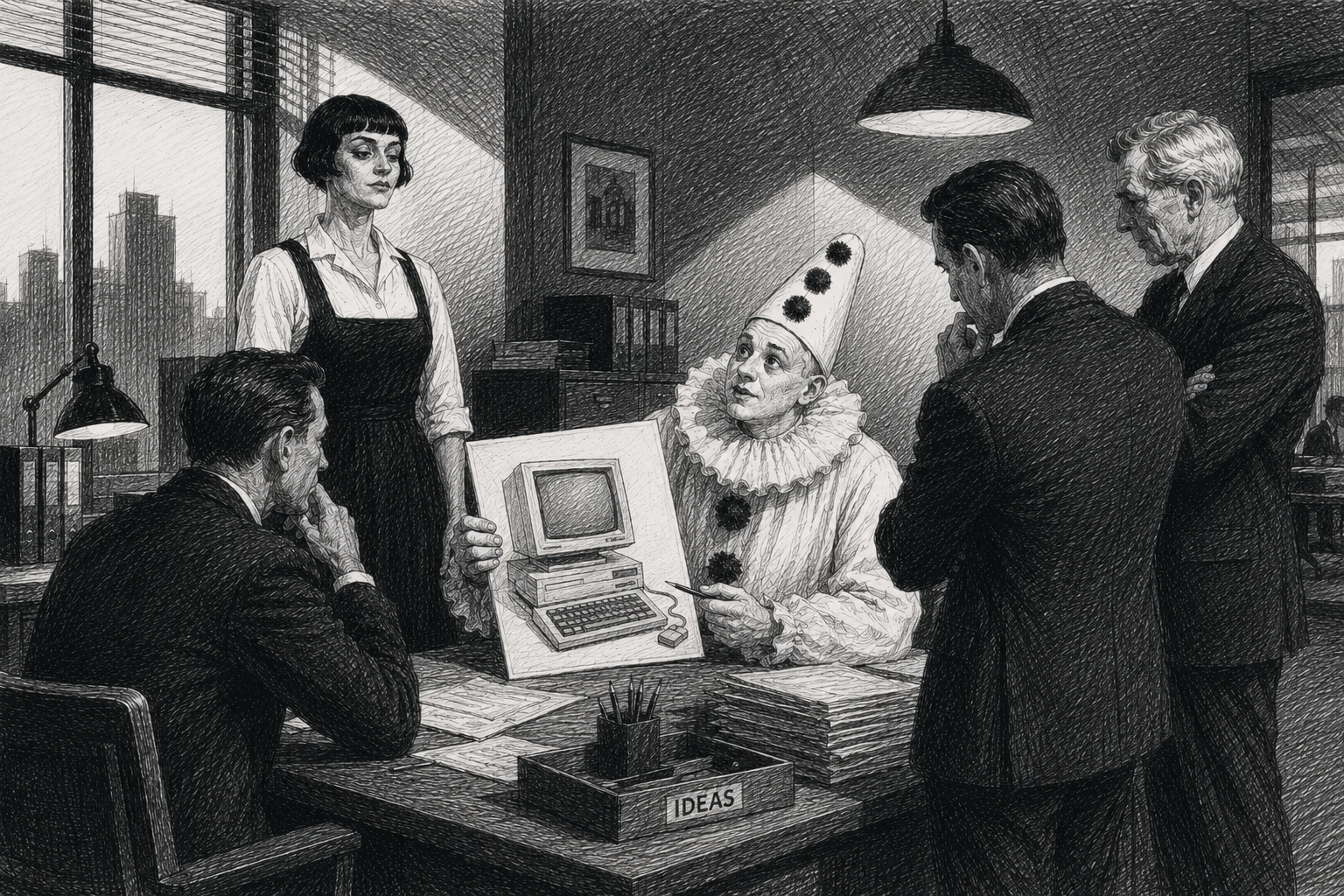

In early 1995, Don Gooding, a telecom analyst at the venture firm Accel, kept returning to a useful guide to the internet with a peculiar name. He thought it might make an interesting investment. Then, at a board meeting, the name came up.
"Yahoo?"
People around the table laughed. Gooding got cold feet and never made the pitch. Within weeks, Sequoia was tracking down the founders.
Some of the best ideas in business look ridiculous at the start. That is almost the point. If everybody immediately understands an idea, agrees it will work and can model it neatly in Excel, there is a fair chance the opportunity is already obvious. The interesting ideas arrive differently: too expensive, too cheap, too big, too small. Nobody will pay for it. The maths doesn't work. And occasionally, simply, that's stupid.
Tom Peters and Robert Waterman, in In Search of Excellence, had a phrase for the organisational capacity to entertain ideas like these: “the technology of foolishness.” It isn’t foolishness for its own sake, and it isn’t recklessness. It is a way of giving apparently foolish ideas enough room to survive until reality can decide whether they actually are.
The New Always Looks Odd
Reid Hoffman has observed that great businesses often look like bad ideas at first because business-model innovations, by definition, cannot point to an existing successful model to show why they will work. Chip Wilson, the founder of Lululemon, likes Peter Diamandis's line that "the day before something is a breakthrough, it's a crazy idea." If an idea could be quantified, Wilson adds, it would have been done already.
Arthur Blank remembers competitors walking through the early Home Depot stores and telling him precisely what was wrong. The stores were too big. Prices were too low. There was too much inventory and too many services. "The math isn't going to work."
Dollar Tree met an even simpler objection. Macon Brock recalled mall developers listening to the concept and laughing in their faces. "You're going to sell stuff for a lousy dollar?" The customers turned out to be less sceptical than the landlords.
FedEx's hub-and-spoke network was ridiculed as impractical. Howard Schultz heard that rolling out coffee stores was crazy. Sam Walton ignored the prevailing wisdom that discount retailing belonged in large population centres and went after small-town America instead. "If we listened to that sort of stuff," he said, "we never would have gone into small-town discounting in the first place."
Rory Sutherland has a nice way of framing it. Imagine pitching investors on a very expensive vacuum cleaner, a premium-priced drink that failed in taste tests, or coffee costing many times what people could make it for at home. Dyson. Red Bull. Starbucks. Described before the fact, some of the world's great businesses sound like terrible ideas.
Henry Ford understood this more than a century ago: "The new is always thought odd."
A Niche. A Laughingstock.
When ESPN went on air in 1979, cable television was still being wired into American towns and people were arguing about whether the medium had any future. A twenty-four-hour sports network was considered ridiculous. George Bodenheimer recalls the top brass at the three major New York networks watching ESPN's first broadcasts and shaking their heads. Nothing to worry about. A niche. A laughingstock.
Frank Perdue ran into a different orthodoxy. Conventional wisdom held that you never advertise a commodity, and pouring money into the thin-margin chicken business seemed dumb. Prudent men thought Frank had flipped. He advertised his chickens anyway and built one of the best-known brands in the country.
The pattern goes back further. S.C. Allyn remembered joining NCR when its founder, John H. Patterson, was roundly ridiculed, just as his product, "the cash register that nobody wanted," had been before him. Allyn's own father shook his head sadly when his son turned down Price Waterhouse to join NCR at $20 a week.
When Birkenstock introduced its new sandal, shoe manufacturers "heaped us with insults." Retailers thought the wide, beak-like sandal was behind the times, even indecent. In 2008, when Brian Chesky and his co-founders tried to raise $150,000 for 10% of Airbnb, most of the angel investors they were introduced to didn't even reply.
Sometimes even the founders aren't convinced. When the Crocs founders first saw the clog, they laughed at how ugly it was. Then they wore them. The first reaction to something new is often a verdict on its unfamiliarity rather than its merit.
The Wrong Measuring Stick
Part of the problem is that new things are judged by the standards of what they are replacing, and on those standards they often are worse. Rory Sutherland points out that early cars were in most respects worse than horses, early aircraft were insanely dangerous and early washing machines unreliable. Geoffrey Parker makes the same point about platforms: YouTube, Airbnb and Wikipedia were criticised at launch because they couldn't match the quality and reliability of their traditional competitors.
Carlota Perez takes the argument further. The possibilities of a radical innovation can be so difficult to picture before the new paradigm arrives that even the people creating it underestimate them. Edison thought the phonograph might be useful for recording the wills of dying people. In the 1950s, the boss of IBM thought a handful of computers would satisfy the world's total demand. Alexander Graham Bell struggled to be understood with his primitive telephone in a world that already had an efficient telegraph.
Contrast that with innovations inside the prevailing paradigm. Everybody understands them. Engineers, investors and consumers know what the product is for and how it might be improved. In a kitchen already full of electrical appliances, even an electric can-opener seems worth making.
That asymmetry sits at the heart of this essay. The incremental idea is legible, so it gets funded. The radical idea is illegible, so it gets laughed at.
Scott Cook lived it at Intuit. The big home runs, he says, are often totally new paradigms, and the problem with a new paradigm is that nobody believes it because everyone is locked in the old one. Venture capitalists all turned Intuit down. The bigger the eventual opportunity, the harder it can be to see at the start, because the world that will make it valuable doesn't exist yet.
Why Not?
Eli Broad built a philosophy around questioning the obvious. The first conventional wisdom he and Don Kaufman encountered in homebuilding was that nobody in Detroit would buy a house without a basement. They asked, "Why not?"
Basements had historically stored coal for winter heating. Gas heating had made that unnecessary, and builders elsewhere were already selling basement-less homes. Skipping the basement meant building faster and being able to sell $2,000 below the nearest competitor, low enough that a monthly mortgage payment could undercut rent for first-time buyers.
Broad's view was blunt: reasonable people treat conventional wisdom with respect; unreasonable people regard it as an expression of the herd instinct. The restaurateur Sean Feeney puts it more simply: when someone says "that's just the way it is," there's money to be made. Tom Monaghan of Domino's refused to reject an idea merely because it didn't make sense yet. If you wait for something to make sense before exploring it, he said, you'll never get anywhere.
A Computer Under Your Arm
One of my favourite examples comes from Xerox PARC. In the early 1970s Alan Kay described a machine he called the Dynabook, a notebook-shaped computer with a screen and keyboard that an individual could carry around and use to create, edit and store their writing, music and art. Today it sounds mundane. At the time it sounded ridiculous. One colleague remembered Kay painting a picture of people walking around with computers under their arms: "We all thought [it] was completely ridiculous."
Today you might be reading this on one.
PARC became one of the extraordinary concentrations of technological creativity in business history. The Alto personal computer, graphical interfaces, the mouse, Ethernet, the laser printer, object-oriented programming and other technologies that shaped modern computing emerged from an environment that gave unusually talented people considerable freedom. Much of it had little obvious relevance to Xerox's copier business. PARC gave people room to explore before somebody in finance demanded the three-year return on investment. Room, in other words, to look foolish.
Xerox famously failed to capture anything close to the economic value of everything invented at PARC. The ability to invent is different from the ability to commercialise. But before an idea can be commercialised, it has to be allowed to exist.
Peters and Waterman's "technology of foolishness" was an argument for mechanisms that permit this: small teams, experimentation, product champions, bootlegging, skunk works. They shield an idea from the immune system of the established organisation while it is still too weak to defend itself.
Fragile Things
Ideas are asymmetric. Once established, a great idea can become enormously powerful, but at birth it has very little going for it: no history, customers, earnings record, five-year CAGR or institutional supporters. Sometimes it has just one person saying I think there might be something here, opposite a room explaining why there isn't.
Bob Propst of Herman Miller described innovation in its early stages as toddling around. It doesn't know how to stand up or explain itself. The words aren't right and the facts aren't apparent. What are the test results? There are none. His colleague Hugh De Pree added the uncomfortable corollary: innovation is threatening, while organisations are built precisely so they won't be threatened.
Charles Brower put it beautifully: "A new idea is delicate. It can be killed by a sneer or a yawn." Ed Catmull at Pixar saw his job as protecting ideas from being judged too quickly. James Dyson called them "fragile things." Jony Ive said Steve Jobs understood better than anyone that ideas begin as "fragile, barely formed thoughts, so easily missed, so easily compromised, so easily just squished."
Baillie Gifford has written the same belief into its investment discussions. Ideas are fragile, so conversation focuses on building them up rather than knocking them down. Challenge is welcome, but with a view to strengthening the case.
This is where culture matters, because a bad reaction doesn't just kill the idea on the table. It changes what everyone else is willing to bring to the next meeting.
Killed by a Giggle
The Yahoo story comes from Sebastian Mallaby's The Power Law, and the detail that makes it is how close Accel came. Gooding wasn't idly browsing. He had been exploring the nascent internet while building the firm's first website, and he was preparing to propose Yahoo as an investment. One laugh around the boardroom table was enough to end that. There seemed little point pitching something that would be greeted with giggles.
Jason Fried observes that dismissing an idea takes no skill. The hard part is protecting it, letting it marinate, riffing on it and trying it. David Ogilvy recalled Albert Lasker being asked the best asset a man could have. His answer: "Humility in the presence of a good idea."
Michael Ovitz had a simple rule at staff meetings: "No idea is too stupid." George Mecherle, founder of State Farm, operated similarly. People could disagree, but nobody's opinion was ridiculed because workable plans had often emerged from the wildest ideas.
Mecherle knew the other side. A former farmer turned insurance salesman, he noticed that farmers were paying the same auto insurance rates as everybody else despite having fewer accidents. Charging less to those less likely to crash sounds obvious now, but it was new. His employer wouldn't entertain it and reportedly told him that if he didn't like the way things were run, he should start his own company. So he did.
Peters and Waterman found the same instinct at 3M. Among its values was an "eleventh commandment": "Thou shalt not kill a new product idea." The company might slow an idea down or decline to fund a venture team, but it didn't shoot its pioneers. Pioneers get shot at, so they need support. No support systems, no champions. No champions, no innovation.
Herb Kelleher understood that the real danger wasn't rejecting a bad idea. It was discouraging the next one. At Southwest Airlines, employees could submit ideas to anyone and expect a response within a week. A simple no was unacceptable; rejections came with explanations. "If you consistently turn down ideas, you won't get any more," he explained. The objective wasn't to approve every suggestion. It was to ensure that the person whose idea failed today would still bring forward the one that might succeed tomorrow.
The important distinction isn't between criticism and no criticism. It is between challenging the idea and humiliating the person. "What would have to be true for this to work?" is very different from "that's stupid." One invites another thought. The other ensures the next thought stays silent.
The Contrarian's Signal
Some founders came to read ridicule almost as a compass. Mallaby's The Infinity Machine describes Demis Hassabis testing his vision for an AI start-up on Patrick Winston, the revered head of MIT's Computer Science and AI Lab. Hassabis explained he was going to do reinforcement learning and deep learning. Winston said it was nonsense.
Hassabis thought this was kind of fantastic. If the establishment had embraced the idea, it might have signalled a lack of originality and rival entrepreneurs would soon be circling. When he founded DeepMind in 2010, fellow scientists rolled their eyes and almost every investor turned him away.
Others found the same signal. Bill Ackman was told it was a stupid idea to start a hedge fund straight out of business school, which, he says, is how he knew it was a good one. Brian Chesky noticed that big ideas can sound so stupid at the beginning that you can share them freely because people dismiss them. Alex Karp describes Palantir's early years simply: "We were the freak show."
But ridicule proves nothing. Plenty of ideas are laughed at because they deserve to be. Mallaby supplies the necessary caveat: "A contrarian with no following is merely an oddball." Mockery doesn't validate an idea. It tells you almost nothing about it either way.
Somebody Has to Believe
Jared Diamond tells a story about Columbus that is really about how many doors an idea needs. Columbus wanted a fleet to sail west across the Atlantic. His backers at home thought it stupid. So did the French. So did the king of Portugal. So did one Spanish duke, then another. The king and queen of Spain said no. On the seventh attempt they relented and gave him three small ships.
Diamond's point is that Europe was fragmented, so Columbus had many chances. In a single unified kingdom, one no might have been the end of it.
Organisations and capital markets work the same way. The more places an unusual idea can be heard, the more chances it has to find the one person willing to fund three small ships. It is the single door, the one committee, the one boss who sneers, that makes fragile ideas easy to lose.
Phil Knight's advice to founders was to let everyone else call your idea crazy and keep going. Henry Ford thought it no bad thing to be a fool for righteousness' sake: such fools usually live long enough to prove they were not fools, or their work does.
Seeing What Others Can't
This may explain why a small group of investors keep backing pioneers when everyone else passes. They aren't necessarily braver or more reckless. They are using a different measuring stick. Most investors judge a new business against the paradigm it is trying to replace, and on that measure it often looks worse. The pioneer investor asks: if the new paradigm arrives, what does this become?
Elon Musk is an obvious example. In 2003, by his own account, electric cars were regarded as the stupidest thing ever, little more than golf carts. Musk first came to Tesla as an investor, leading its early funding round when judging the company by the existing automotive industry made it look absurd. He wasn't underwriting the car Tesla could build that year. He was underwriting a world where the car itself had changed.
Hassabis found his believer too: when almost every investor turned DeepMind away, Peter Thiel was among the few who didn't. Baillie Gifford and Baron Capital built a large Tesla position years before the rest of the market came around.
The other side of the ledger matters. For every pioneer who reshapes an industry, many more are simply wrong, and imagination without discipline is expensive optimism. The lesson isn't that foolish-looking ideas are unusually likely to succeed. It is that appearance is a poor screening mechanism.
The investors who capture truly large outcomes can hold a new paradigm in their heads before it is visible to everybody else. If even Edison couldn't see what the phonograph would become, the investor who sees further than the market doesn't need to be right every time.
Crazy Ideas, Small Bets
Michael Bloomberg understood the organisational side of this extraordinarily well. When he started a business making financial information accessible by computer, everyone thought he was crazy. That's not the way the industry works, he was told.
He didn't want employees believing their jobs were at risk because something they worked on failed. He wanted as many new ideas as possible, including crazy ones: "If a concept is flawed, the blame and pain rest with me. The credit for whatever's right goes to them."
Think about the incentive that creates. You can take a shot or try something unconventional without attaching your career to the result.
Bloomberg wasn't advocating betting the company on every crazy idea. He has noted that his company's significant advances were mostly evolutionary, small earned steps rather than giant lucky hits. The two ideas fit beautifully. Think unconventionally. Experiment conservatively.
Most crazy ideas are not Yahoo. Most experiments fail, and most weird products don't become Red Bull. The answer isn't to fund every dream with unlimited capital. It is to create cheap ways to find out.
Marc Randolph, the co-founder of Netflix, describes entrepreneurship in almost exactly these terms: take the apparently bad idea, find a quick and inexpensive way to test it, watch what happens, adjust and try again. He can't think of a successful company that succeeded with its original idea. Netflix spent more than eighteen months and hundreds of failed experiments before settling on a model that worked.
It is very different from the traditional corporate approach. One asks a committee to decide whether something will work. The other asks reality.
Let Reality Vote
That may be the real secret. Instead of endless debate, create an experiment.
George Bodenheimer was often asked to describe ESPN's business strategy, the same ESPN the networks had dismissed as a laughingstock. His answer was disarmingly simple. We try a lot of things. The things that don't work, we stop doing. The things that do work, we keep improving. "That's our strategy."
Peters and Waterman thought this was the most important expression of the bias for action in the successful companies they studied. "There is absolutely no magic in the experiment," they wrote. "It is simply a tiny completed action, a manageable test that helps you learn something, just as in high school chemistry."
What struck them was how many large institutions had forgotten how to do it. They preferred analysis and debate and were paralysed by fear of failure. In the excellent companies, experimentation was cheap learning, often less costly and more useful than sophisticated market research or careful staff planning.
Jim Sinegal used this philosophy at Costco. If Costco wanted to try a product but didn't yet have the volume to buy it on the economics it ultimately expected, it might price the item as though it had bought it properly, put it in two or three locations, and see whether customers responded. The downside was tiny and the information valuable.
The question wasn't can we prove this idea is correct?
It was can we cheaply learn whether we're wrong?
Ingvar Kamprad hoped IKEA would never have two identical stores. The latest was bound to have several things wrong with it, but it would still be the best yet. "Why," he said, would remain an important key word.
Lots of Tries
The deeper lesson is about numbers. Peters and Waterman put it plainly: no matter how small the odds of any one thing working, the probability of something succeeding becomes high if you try lots of things.
3M didn't make a few big bets; its people made hundreds of little ones in specialised markets. McDonald's ran more experimental menu items, store formats and pricing plans than its competitors. Scott Cook made it an Intuit tenet: "Try more things than you know are going to work." Wait until you're sure and it's too late.
Against this stands what Peters and Waterman called the "home-run only" mentality: a misplaced faith in planning and large scale and an inability to manage organised chaos and lots of base hits. The adaptive company works in a Darwinian way. It fosters mutations, kills dumb ones quickly and invests heavily in what works. Jim Collins reached much the same conclusion: much of what looks retrospectively like brilliant foresight was really "Let's just try a lot of stuff and keep what works."
Jeff Bezos has said Amazon's success is a function of how many experiments it runs. In his 2018 letter he went further: as a company grows, the size of its failed experiments has to grow too. Amazon would be experimenting at the right scale if it occasionally had multibillion-dollar failures, because one large winning bet can cover many losers.
Experiments only work if failure is survivable for people too. Tim Cook describes Apple trying to fail internally rather than externally, developing things and deciding not to ship them. Kent Taylor went further. On his office wall at Texas Roadhouse he displayed artifacts from each of three stores he opened in 1994 and later closed. In cultures that punish risk-takers, failures get hidden. Taylor put his on the wall.
If It Ain't Broke
Foolishness isn't only needed at the beginning. Success creates its own conventional wisdom, and the loudest objections to the next idea can come from inside the company that proved the last one right.
John H. Patterson, once ridiculed for selling "the cash register nobody wanted," later warned his own company: "The business that is satisfied with itself … is dead." C. William Pollard of ServiceMaster called it the arrogance of success: believing what you did yesterday will be sufficient tomorrow.
When Ford's production reached one hundred cars a day, some stockholders were seriously alarmed. When he said he hoped soon to make a thousand a day, they were "inexpressibly shocked" and considered court action. The temptation to stop and hang on to what one has, Ford observed, is natural.
Bezos wrote in 2014 that Marketplace, Prime and AWS were each bold bets at first, and sensible people worried they couldn't work.
Eli Broad called innovation a permanent revolution. If Kaufman and Broad had remained simply the company that built homes without basements, someone would eventually have done it better. The best place to look for the next move, he argued, was the industry's most basic assumptions, precisely because they had gone unexamined for so long.
When Foolish Becomes Obvious
Once something works, we rewrite history.
The Walkman seems inevitable now, but it wasn't. Akio Morita recalled that Sony's own engineers and marketing people were dubious. He couldn't convince his own project team and was embarrassed to be so excited about a product others thought would be a dud. Morita took personal responsibility for pushing ahead.
The existing framework produced the wrong question: Why would anyone buy a cassette recorder that doesn't record?
The better question was: Would people value portable music?
Millions had already bought car stereos that couldn't record.
John Bogle encountered the same problem in investing. His great innovation was a mutual fund whose objective wasn't to beat the market. It would simply own it. The original First Index Investment Trust raised only $11 million and became known as "Bogle's Folly," derided for years and not copied for nearly a decade. Today index investing sits at the heart of global asset management.
William Osler captured it beautifully: "The foolishness of yesterday has become the wisdom of tomorrow."
Success removes the uncertainty that preceded it, and for investors that is dangerous. We study great businesses after their models have been validated and assume the attractive features were always visible. Usually they weren't.
The early investor had to hold two competing possibilities in mind at once:
This might be stupid.
And this might be enormous.
That is a much harder place to stand.
The Investor's Problem
Investing naturally pulls us toward certainty. We build forecasts, study comparable companies, calculate market sizes, analyse historical margins and construct valuation frameworks. All useful, but they can become anchors.
A genuinely new business may have no comparable company. The addressable market may not yet exist. Current margins may tell you little about mature economics, and the product may create behaviour rather than merely serve an existing one.
There is a psychological trap too. Howard Marks has written about Mistakes Were Made (but Not by Me) and cognitive dissonance: when new evidence challenges a position we already hold, unconscious mechanisms help us preserve it. Once an investor has decided an idea is silly, every stumble confirms it and every sign of traction becomes easy to explain away.
None of this means abandoning discipline. Plenty of unusual ideas are terrible ideas. The harder task is not confusing unfamiliarity with impossibility.
For an investor, perhaps a better starting question than does this fit the existing model? is:
What would have to be true for this to work?
Then look for evidence. Are customers responding? Are unit economics improving? Is management learning? Does the founder change the tactics while remaining stubborn about the core insight? Can the opportunity be tested without risking the company? Is the market really too small, or does today's market simply reflect the limitations of today's business model?
There is another implication. Markets tend to reward legibility. A company with a known market, known margins, comparable companies and predictable economics is easy to underwrite — which also means lots of investors can underwrite it.
A genuinely new model has a wider range of possible outcomes. Most may be poor. But where the downside is bounded and one branch of the distribution is enormous, certainty isn't necessarily required. You don't need high confidence when the payoff is sufficiently asymmetric and the cost of finding out sufficiently small.
That is as true for an investor as it is for the company making the experiment.
What I Take From It
The more I read these stories, the more a handful of ideas keep resurfacing.
New ideas are fragile. The status quo arrives with history, evidence, budgets and supporters, while the new idea often arrives with little more than a hunch and looks worse than what it hopes to replace. The biggest ideas are hardest to see because the world that will make them valuable doesn't exist yet.
Ridicule is more dangerous than disagreement. Strong organisations can debate fiercely without making people afraid to bring forward the next unconventional thought. And an idea needs more than one door; the single gatekeeper loses ideas that a more plural culture would keep.
The absence of precedent cuts both ways. Sometimes nobody has done something because it is a terrible idea. Sometimes nobody has done it because nobody has done it yet.
Experimentation is how you find out which.
Try lots of things. Keep the bets cheap relative to what you can afford to lose. Stop what fails. Keep improving what works. Failure should be survivable, for the company and for the person.
The technology of foolishness isn't the ability to know which crazy idea is right. It is the ability to remain uncertain long enough, and cheaply enough, to find out.
George Leonard tells the story of Jigoro Kano, the founder of judo, asking near the end of his life to be buried in his white belt, the emblem of the beginner. Leonard first read it as humility, then came to see it as realism: life makes beginners of us again and again.
His conclusion is one of my favourite lines on the subject:
"To be a learner, you've got to be willing to be a fool."
The same is true of organisations.
* Visit the Blog Archive *
Learn more with us on Twitter: @mastersinvest
TERMS OF USE: DISCLAIMER