
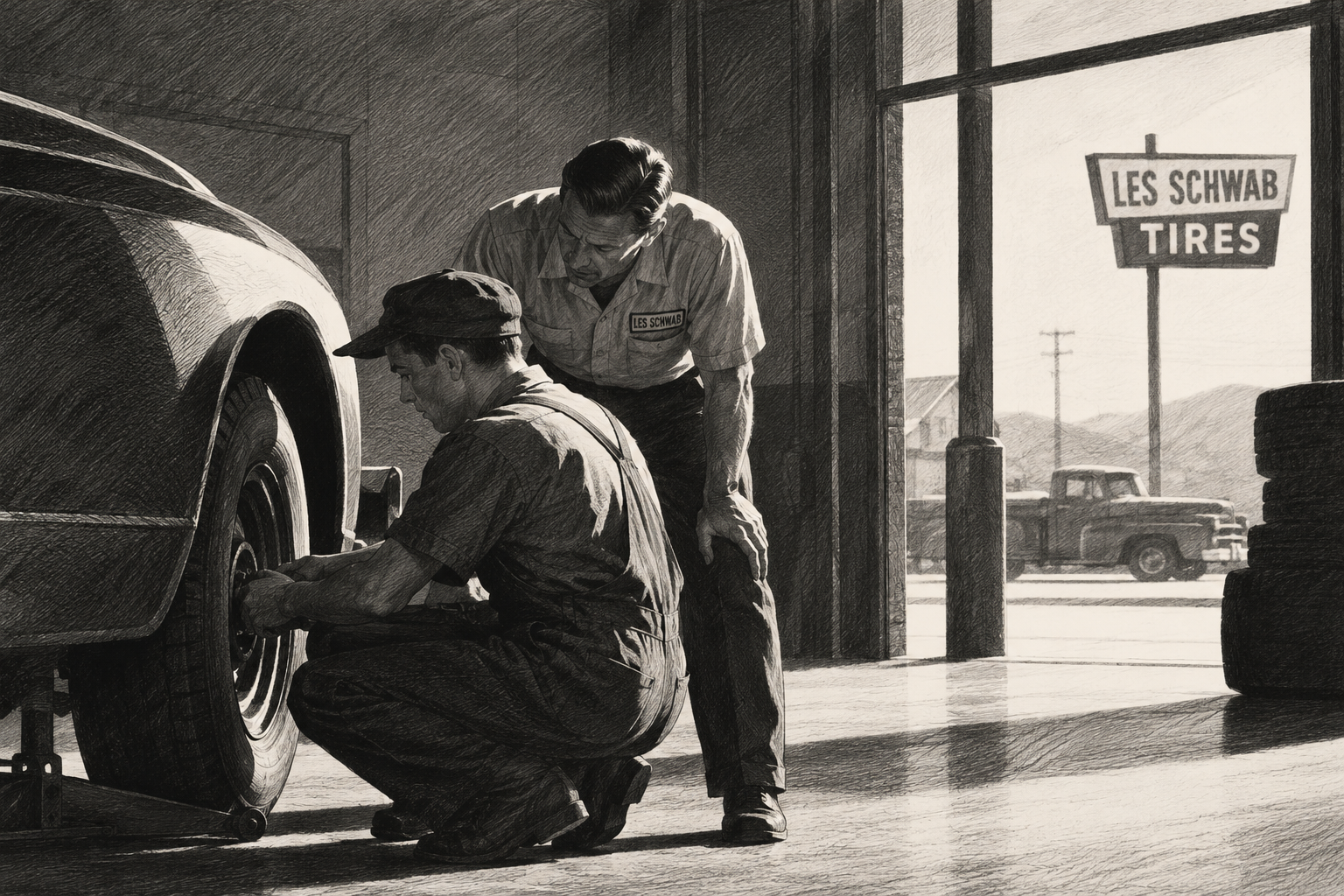
In 1952, Les Schwab bought a small tyre store in Prineville, Oregon. He knew very little about tyres. What he did know, or came to learn quickly, was that the business would only grow as fast as the people inside it. Decades later, with hundreds of stores across the western United States, he posed a question to his company and then answered it himself:
"What is the best route to follow to continue to be successful? What should our company do to build for the future? The answer is, as it has always been ... BUILD PEOPLE."
The capitals are his. It is not the answer most people expect from a tyre retailer. You might expect inventory, purchasing scale, locations or price. Schwab thought those things followed from something more basic.
He was in good company. Georges Doriot, the pioneer of venture capital, described his own work in five words: "I am building men and companies." The order matters. J.C. Penney, who began with a single dry-goods store in a Wyoming mining town, put it more bluntly: "Our plan was not solely to make money, but also to develop men by training. If we trained men effectively, profits would take care of themselves." Money, he said, "is properly a by-product of building men as partners."
Read enough business biographies and a common theme emerges: across industries and generations, exceptional business builders independently arrived at the same conclusion — building people is fundamental to building enduring businesses. Andy Taylor of Enterprise-Rent-A-Car said the difference between his company and its competitors was simple: "their business is cars and ours is people." Tom Crosby of Pal's Sudden Service says he is not in the service economy or the experience economy but "the growing-people economy." Jan Ryde of Hästens calls his bed company "a people factory."
The best businesses don't just employ people. They make them.
This is a post about that idea: what it looks like in practice, why it works, and why it should matter to anyone trying to identify businesses that will compound for a very long time.
The Untapped Potential in Everyone
Every people-building company starts from the same belief: that most people are capable of far more than they are currently doing, and far more than they themselves suspect. J.C Penney wrote that "there is in everyone more latent than developed ability; far more unused than used power," and concluded that no one "should be employed in any business institution to be left as he was when the institution found him."
John H. Patterson of the National Cash Register Company built a sales force on the same conviction. One of his salesmen later recalled Patterson's belief that "every man jack of us" had a large store of energy going to waste, and that left to our own devices we use perhaps 60 per cent of our real abilities. Patterson's self-appointed task was to find ways of putting the other 40 per cent to work. Patterson made hundreds of men successful, as the salesman put it, “in spite of themselves.”
A century later, a naval captain reached the same conclusion by a different route. Captain Michael Abrashoff took command of USS Benfold, then one of the poorest-performing ships in the US Pacific Fleet, and asked how much brainpower any organisation wastes because those in charge don't recognise "the full potential hiding at the low end of the hierarchy." His answer was to stop treating sailors as if they were stupid and start assuming they were talented. Benfold went on to win the Spokane Trophy as the most combat-ready ship in the Pacific Fleet. In Abrashoff's words, it became "the best damn ship in the Navy." "The timeless challenge," he wrote, "is to help less talented people transcend their limitations."
Peter Kaufman of Glenair has the most useful framing I know. He points to what he calls the Axiom of Freeway Design: you can't design a freeway to be navigable only by expert drivers. The real test of a freeway is how the average or below-average driver gets on. Most organisations, Kaufman argues, focus their attention on getting the right people on the bus, the expert drivers who can move the needle, while the bottom half of the organisation is left overlooked, unclear on goals and unmotivated. "Yet, the best opportunity to 'move the needle' usually resides exactly there — within 'the back half of the roster'." As Kaufman observes, "The typically untapped, latent potential of human beings is stunning, and can be unleashed by the right cultural framework."
This is not sentimentality. It is arithmetic. Ten stars can only carry so much. Lift a thousand ordinary employees by even 20 per cent and the gain dwarfs anything the stars can add.
Ken Hendricks learned the other side of that sum from his father, Joe, a Wisconsin roofing contractor who worked 12-hour days, six days a week. The business was profitable but never grew, because Joe didn’t believe anyone could be trained to do the job as well as he could. It was capped at the size of one man. Ken built the opposite. He founded ABC Supply in 1982 and grew it at 25 per cent a year into the largest roofing and siding wholesaler in the United States, on a very different premise: “Every person has within themselves the ability to do great things.”
C. William Pollard described the founding dream of ServiceMaster as "building a business with ordinary people — motivated, trained, and excited about accomplishing the extraordinary."
Teach People to Succeed
Belief in people is the starting point. Teaching is how that belief becomes something real.
On 4 April 1894, John Patterson opened what is often described as the first sales training school in American business, in a small cottage on the lawn of the old Patterson homestead in Dayton. It was not built primarily for new recruits. It was built to retrain the salesmen already in the field, and within two years every man selling for NCR had been through it. "If the agents can sell registers by their present methods," Patterson reasoned, "they can sell twice as many if properly trained." His company history records that the natural-born salesman went out of NCR with the coming of the school. Patterson's summary of his own career was a single sentence: "The success of our business has been in proportion to our efficiency in teaching."
The cottage under the elm tree has a great many descendants. In 1961, McDonald's opened Hamburger University with a class of about 15 in a restaurant basement in Illinois. More than 275,000 people have since graduated, and around 40 per cent of the company's global leadership has passed through it. Rich Snyder began training In-N-Out's managers near the original store in 1977, and in 1984 gave the program its own building, In-N-Out University, on the spot where his parents' Baldwin Park home had once stood. Kiewit, whose training is regarded by many in construction as the industry's gold standard, began formal programs shortly after the Second World War and formalised them as Kiewit University in 2007. Brown & Brown University was set up in 2004 by Powell Brown to give the insurance broker's producers a broad base of technical knowledge, and later became central to acculturating the people who joined through acquisitions. TJX built TJX University to grow the buyers it needed to reach its revenue ambitions. Wawa has Wawa University, which Howard Stoeckel described simply as "a way to reinvest in our associates."
Fastenal runs the Fastenal School of Business, with more than 500 courses spanning leadership, products, manufacturing, sales and operations. Founder Bob Kierlin said its curriculum "reflects our belief in the potential of people." His successor Will Oberton was more direct about why it matters: "It's not about the products we sell or the industry we're in. We're in a boring industry. We are successful because of our people."
A formal university is not the point, though. Some of the most intensive teaching cultures run on habit rather than buildings. At Pal's, every leader is expected to spend around 10 per cent of their time teaching, and to identify a target subject and a target student every single day. "All leaders are teachers, whether they realize it or not," Crosby says. "So we have formalized a teaching culture." He treats people a little like precision instruments: "People go out of calibration just like machines go out of calibration. So we are always training, always teaching, always coaching." And when someone isn't doing the job well, the assumption at Pal's is that it's a problem with the training, not the person.
The logic is competitive as much as cultural. "If you want to outperform the competition," Crosby says, "you have to out-train them." Panasonic founder, Konosuke Matsushita, made the same argument half a century earlier: skill and wisdom are not commodities you purchase but qualities you nurture, and "the firm that aggressively develops its employees has a significant advantage over the corporation that simply exploits existing abilities."
One small detail separates training that matters from training that is a line item. When David Cote took over Honeywell, he and his staff began taking every training program themselves before it was rolled out. Some were modified as a result. Some were cancelled entirely. When the people at the top sit in the classroom, the classroom gets better.
Give People Room to Grow
Training builds capability. Responsibility is what turns it into judgment. The fastest way to learn how to run a business is to be handed one.
Enterprise was built on that idea. Young managers were given real authority over their branches: hiring, pricing, how to fix a customer's problem, and a stake in what the branch earned. Decisions sat with the people closest to the customer, not with head office. A graduate who joined on the counter could, within a few years, be running what was in effect a small business of their own. The company's future leaders learned their trade one branch at a time, by doing the job rather than watching someone else do it.
Ken Iverson took the same approach at Nucor, in an industry not known for it. "The job of a manager," he said, "is to help the people accomplish extraordinary things. And that means shaping a work environment that stimulates people to explore their own potential." Nucor ran with a head office of a few dozen people and very few layers between the mill floor and the chief executive. Plant managers ran their divisions like their own businesses, and the people on the floor were paid on what their teams produced. Authority went where the work was.
This kind of trust has a cost. People given real decisions will make some bad ones. The companies that do this well treat those mistakes as tuition, and judge leaders less by whether they avoided every error than by whether their people are better at the job a year later. The alternative, keeping every important decision at the top, produces fewer visible mistakes and far fewer capable people.
Autonomy of this kind only works if head office sees its own job differently.
Serve the People Who Serve
If the purpose of the company is to build people, then the job of management changes. It is no longer to command the people below. It is to support the people in front.
A surprising number of great businesses have drawn the same picture to make the point: the organisation chart turned upside down. At Nordstrom, customers sit at the top of the inverted pyramid, then the salespeople, with executives and the board at the bottom. Employees promoted into management are said to be "moving down the pyramid." The buyers work for the salespeople, not the other way around. Ed Stack put himself at the bottom of Dick's Sporting Goods' triangle as "the least important player, because I'm the farthest from day-to-day contact with our customers." Herb Kelleher described Southwest's general office the same way: its job was to supply the resources the frontline needed, "not there to glorify us or make us look good, which would be impossible anyhow."
Some companies wrote it into the architecture. The sign above the entrance to Home Depot's headquarters reads Store Support Center. Paul Orfalea called Kinko's head office the Kinko's Service Corporation. At Chick-fil-A, every headquarters employee works in a restaurant at least one day a year. Alain Bouchard told Couche-Tard that "you and I are at the service of the stores. Not the other way around." At Tractor Supply, Jim Wright tied his own pay to the frontline: if the people in the stores and distribution centres don't earn a bonus in aggregate, neither does he.
The small courtesies matter as much as the slogans. Rich Snyder was careful never to ask an In-N-Out manager "What store do you manage?" He always referred to them as your stores. He wanted them to feel the pride of ownership, and In-N-Out could boast one of the lowest turnover rates in a high-churn industry.
Robert Greenleaf gave this way of leading a name, servant leadership, and Hugh De Pree of Herman Miller gave it its most elegant line: "To lead the people, walk behind them."
The inverted pyramid is not simply a matter of humility. It changes who gets developed. When the head office exists to serve the frontline, the frontline becomes the place where the company's best people are made, and where its future leaders learn the business. That brings us to the most important multiplier of all.
Build Leaders Who Build Leaders
A leader who develops ten people has done well. A leader who develops ten people who each develop ten more has built something that can outlast them. The best people-building companies don't stop at training. They make developing others the route to the top.
Terry Leahy did this deliberately at Tesco. Whenever someone was considered for promotion, one of the first questions asked was "Who have you developed?" Word went around quickly that if you wanted to get on, you needed a record of spotting and growing talent. Managers were soon on the lookout for new talent in their own ranks. One question, asked consistently, changed the behaviour of an entire management layer.
The most complete version of this idea I have come across is the one Monty Moran built at Chipotle. Moran was a trial lawyer before he joined the company, and he tells the story of how his own ambition changed. He had wanted to be the most sought-after lawyer in his firm. Then it occurred to him that it was "much better to help others to be strong and needed. Rather than being the strong one, it was more effective to be a catalyst who leads others to be strong."
In his first speech to Chipotle's area managers, he said two things that became the foundation of the culture. The first was that "the restaurant general manager is the most important position in the company." The second was a line he had never said quite that way before, and repeated slowly so it would land: "Each of us will be rewarded based on our effectiveness in making the people around us better."
Moran then built a career path around that sentence. A general manager who assembled a team of top performers and ran an excellent restaurant could be promoted to Restaurateur, a title awarded only after an interview with Moran or co-founder Steve Ells. Remarkably, it came with no raise. What moved people was the recognition. A Restaurateur whose store was running well could then mentor a second restaurant and become an R2. If they developed a crew member into a general manager who could run another nearby store, and both stores stayed excellent, they could become an R3, then an R4. From there, they became eligible to oversee up to eight restaurants. The path to becoming an executive ran through making other people better, one restaurant at a time.
One of Moran's practical habits is worth stealing. Each time he found himself about to teach someone something, he would stop and ask instead: "Is there anyone else on my team who I can ask to teach this lesson instead of me?" Doing so showed confidence in the person asked to teach, gave them a chance to see their own value, taught the lesson, and strengthened the bond between teacher and student. Over time it set an expectation that everyone should be looking for chances to teach and help others.
Moran also offered a warning about the alternative: "If everyone at Chipotle is pulling for you, then you have thousands of people on your team. But if each of you is trying only to advance your own agenda, then you have only one person on your team: yourself!"
The same thread runs through every serious definition of leadership in this collection. Charles Koch borrowed his from the rugby coach Jack Clark: leadership is "the ability to make those around you better and more productive." Bill Campbell, the coach to Silicon Valley's founders, believed the primary job of each manager was "to help people be more effective in their job and to grow and develop," and that leadership accrues to people from their teams over time.
IKEA founder Ingvar Kamprad agreed, writing in his 1976 Testament of a Furniture Dealer, “For those of you who bear any kind of leadership responsibility, it is crucially important to motivate and develop your co-workers.” Percy Barnevik, the ex-CEO of ABB, said the most important feature of leadership is making others perform so that the team becomes the best team.
Lee Kuan Yew added a useful corrective: "I do not yet know of a man who became a leader as a result of having undergone a leadership course." Leaders are built by leaders, through responsibility, example and practice, not by classrooms alone. Mark Leonard of Constellation Software describes the recipe as plainly as anyone: work hard, treat people fairly, share the credit, keep learning and keep teaching, "then pretty soon you have followers."
What If They Stay?
The standard objection to all of this is that it is expensive, and that the people you develop will simply leave and take their training with them. Crosby has heard it many times. People ask him what happens if Pal's spends all that time on training and someone leaves. His reply is a question of his own:
"What if we don't spend the time and money and they stay?"
It is one of the best questions in business. The cost of training is visible on a budget. The cost of not training is invisible, spread across years of mediocre service, slow decisions, avoidable mistakes and good people quietly going elsewhere. And the evidence suggests the people who are developed are the ones who stay. Pal's frontline turnover has been reported at around a third of the industry average, and turnover among its assistant managers at 1.4 per cent a year.
Jeff Rodengen, writing about Kiewit, put the dynamic precisely: "People want to stick around because they're given opportunities for growth where they are, and do not have to look elsewhere. Companies that do not understand this see their best people leave, and the ones they would like to leave, stay." Ken Moelis makes the same point about his investment bank. His people all have ambitions, and "if you don't give them that path, they will find somewhere else to do it." So he spends much of his time building that path rather than chasing the next big deal.
For investors, this is where the idea stops being a matter of culture and starts being a matter of returns. A business that builds people has a few characteristics that tend to show up in the numbers over long periods:
Lower turnover, which means lower hiring and training costs, more experienced staff and more consistent customer experiences.
A deep internal bench, which allows the company to open new stores, branches or business units without importing strangers or diluting the culture.
Successors who already know the business, which makes the transition from founder to the next generation far less dangerous.
A capacity to grow that is constrained less by capital than by people, and that keeps expanding because the people keep expanding.
That last point is the subtle one. Many businesses discover that their real limit on growth is not money or demand but the supply of capable managers. Enterprise, Chipotle, In-N-Out and Brown & Brown all grew at rates that would have been impossible had they needed to hire their leaders from outside. They grew their leaders instead.
Charles Koch describes the mechanism in a single line: "We recognize that virtuous cycles start with employees before spreading to the business." People who are developed take on more. The business grows. Growth creates new roles, which become the next round of opportunities for people to grow into. Run long enough, the cycle compounds in the same way capital does.
There are some practical questions an investor can ask. Where did the senior team come from? How many of the company's managers started on the frontline? Is there a training system that has survived a downturn intact, or is it the first thing cut? Is promotion based on developing others, or on pleasing the boss? Do leaders spend time teaching? The answers tend to say more about the next twenty years than most of what appears in an annual report.
A Legacy Measured in People
Ask the leaders of these companies what they are proudest of, and the answer is rarely a product, an acquisition or a share price. It is usually a person, or a great many of them. As Pierre Bellon, founder of Sodexo, put it: "For me, helping people to succeed, is success in itself."
Paul Orfalea notes that more than 100 of his earliest coworkers and partners at Kinko's became millionaires because of what they built together. Mark Bertolini says that when Aetna was sold to CVS, the company created 2,000 new millionaires. Chester Cadieux started QuikTrip for his own financial success, but found his motivation quickly shifted: "We had great people who deserved to succeed." Publix managers, according to the company, are most likely to say their greatest satisfaction as leaders is helping people grow successful careers.
Pat Parker, the former CEO of Parker Hannifin, measured his own tenure the same way. What he was proudest of was not a deal or a result but a team: young people he had developed, promoted from within, and then stepped aside for so they could run the company. "It was developing the talent," he said, "and then getting out of the way and letting the good players play."
Ken Allen, the former CEO of DHL Express, offered a test that every leader could apply to themselves: "the test of a leader's performance should be not what they've achieved in the past, but the foundation that they've laid for the future." Marshall Goldsmith reduced it further: "As a leader, your legacy is not about what you achieve — it is about what you help others achieve."
Monty Moran ended his time at Chipotle believing that the greatest legacy any of us can leave is to have made others in some way better. "Over and over again," he wrote, "I learned and relearned the lesson that the most powerful thing any of us can do in this lifetime is to help others shine as the most authentic and powerfully positive version of themselves."
John D. Rockefeller Jr., speaking about industrial relations in 1916, proposed a standard that many businesses would still fail today: "The test of the success of our social organization is the extent to which every man is free to realize his highest and best self."
It is easy to read all of this as soft, the kind of thing written in annual reports and forgotten by Monday. But the companies in this post are not soft. Enterprise, Fastenal, IKEA, In-N-Out, Kiewit, Koch, Brown & Brown, Constellation and QuikTrip are some of the most demanding and most consistently successful businesses of the past half century. Their leaders did not build people instead of building businesses. They understood that, over a long enough period, the two are the same thing.
Les Schwab asked what his company should do to build for the future. The question is worth asking of every business we study, and of every business we run.
The answer is, as it has always been ... build people.
* Visit the Blog Archive *
Learn more with us on Twitter: @mastersinvest
TERMS OF USE: DISCLAIMER