
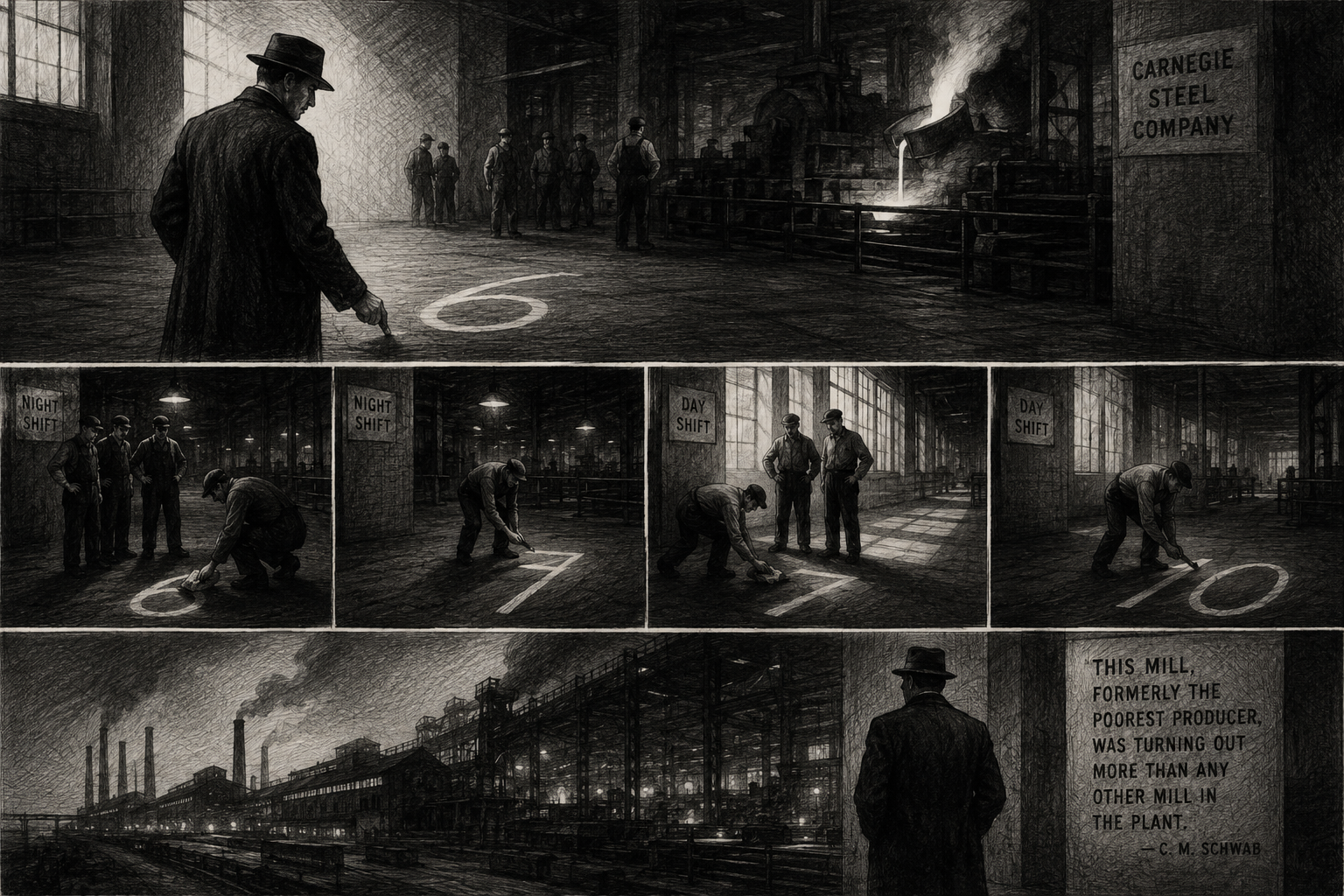
There’s a story from the early days of Charles Schwab — the steel man, not the brokerage founder — that tells you almost everything you need to know about internal competition.
Schwab, running a mill for Andrew Carnegie, walked into one of his worst-performing plants and asked the day shift foreman a simple question: how many “heats” — furnace runs — had they completed that day. Six, came the answer. Schwab didn’t lecture anyone. He took a piece of chalk, wrote a giant “6” on the floor, and walked out without another word.
The night shift came in, saw the number, and asked what it meant. When they found out the boss himself had chalked up their production count, they didn’t need to be told what to do. They rubbed out the six and wrote a seven. The next morning, the day shift saw the seven and erased it for a ten. Back and forth it went, chalk mark by chalk mark, until — in Schwab’s own words —
“this mill, formerly the poorest producer, was turning out more than any other mill in the plant.”
No bonus was announced. No memo went out. Just a number on a floor and two shifts who refused to be shown up by each other.
People Aren’t Just Motivated by Money
Schwab understood something that a lot of management theory still underrates: make a number visible and people will move heaven and earth to change it — often for reasons that have nothing to do with a paycheck. As Schwab himself explained it, he’d come to believe there was an innate competitiveness in most people that could be stirred to remarkable output, given the right kind of challenge.
Jack Stack, who spent decades running Springfield Remanufacturing Corp. on exactly this principle, gets at the root of it. Work, he argues, is boring — but people love the idea of playing a game or competing, and that instinct is one of the most powerful tools a manager has. People only get beyond the baseline of work when the motivation is coming from inside them. You can set any goal you like — building the best company, hitting a production record — but if people don’t want it for themselves, it isn’t going to happen. Real management, in his view, is about instilling the desire to win —
“Instilling self-esteem and pride, that special glow you get when you know you’re a winner. Nobody has to tell you. You just feel it. You know it.”
It’s an old truth, not a new one. Napoleon Bonaparte, of all people, understood it as well as anyone. Aboard the ship carrying him into exile after Waterloo, he told his British captor as much — that a soldier will fight long and hard not for money, but for —
“a bit of colored ribbon.”
It’s why he’d created the Legion of Honor over a decade earlier: a system of medals and recognition costing the state almost nothing, yet capable of driving men to risk everything. The same principle runs through nearly every story in this piece — the reward isn’t the point. Being seen to win is.
Carl Sewell built an entire philosophy of auto-dealership management on the same instinct. He liked to point out that people are naturally competitive — they’ll try to beat whatever target is put in front of them whether or not there’s extra money attached. His go-to comparison was racquetball: nobody’s paying you to play, but you’re still diving across the court trying to win. Sewell’s practical application was to post results everywhere — delivery times, receivables, customer satisfaction scores — all personalized, so “everybody understands how the game is played and who’s doing the best.”
The Research Backs It Up
This isn’t just a collection of good anecdotes. When Tom Peters and Bob Waterman researched In Search of Excellence over four decades ago, they found the same pattern surfacing again and again in America’s best-run companies. As they put it, “there is little place in the rationalist world for internal competition” — a company isn’t supposed to compete with itself. And yet, they wrote, “throughout the excellent companies research, we saw example after example of that phenomenon.”
The mechanism, in their words, was “the use of social comparison” — “regular peer reviews,” performance data “made widely available,” and internal rivalry “purposefully induced” rather than accidentally tolerated. The costs are real — duplication, cannibalization, wasted development spend. But the payoff, harder to put a number on, shows up in commitment, innovation, and a relentless focus on the top line.
You Can’t Compete Without Data — And You Can’t Have Data Without Transparency
None of this works without one non-negotiable ingredient: the numbers have to be visible. Schwab’s chalk mark was the entire intervention — it wasn’t a threat, it wasn’t a target handed down from above, it was information, made public.
Jack Stack built his entire management philosophy — open-book management — around this idea, and he came to it the hard way. Early in his career, he decided that secrecy was, in his words, baloney — and resolved that from then on he would give his people everything he had. That decision eventually grew into a whole system for teaching employees how a business actually makes money. His broader principle was this —
“The more people know about a company, the better that company will perform. This is an iron-clad rule.”
Stack also made the case for why you measure things in the first place — not simply to rank people, but because nothing matters more than an environment where people feel they’re making a difference. You can’t feel good about your work, he argued, unless you can see the difference it makes — which means measurement isn’t a control mechanism. It’s what lets people see themselves winning.
You see the same logic at ABB under Percy Barnevik, who ran roughly twenty power transformer factories across fifteen countries and compared their monthly performance data against each other, naming a winner every time. No factory, Barnevik found, wanted to end up at the bottom — and every factory got better because of it.
Even John D. Rockefeller, running the closest thing to a true monopoly American business has seen, understood the danger of getting too comfortable. Standard Oil’s committee system circulated performance figures deliberately to stir up rivalry between its partially-owned subsidiaries, with top units competing for records and prizes. The logic, as one biographer put it, mattered enormously —
“monopolies, spared the rod of competition, can easily lapse into sluggish giants.”
John Patterson, founder of National Cash Register, was doing the same thing on an even grander scale before the turn of the last century. He put the sales results of every one of his agents into a company bulletin, The N.C.R., along with whatever they were willing to share of their own methods — turning individual technique into shared company knowledge. A salesman who put up a good number got his photograph printed alongside an account of what he’d done, which Patterson candidly admitted served two purposes —
“partly to reward the man and partly to challenge all the other men to go and do likewise.”
Anyone who hit their full quota became a member of what Patterson called the Hundred Point Club — an honor that came with an invitation to the annual convention in Dayton. The club even had its own hierarchy, with the first people to hit quota assigned honorary leadership positions. The entire mechanism was recognition, rank, and public comparison — and by Patterson’s own account, the club’s conventions only grew more prestigious with each passing year.
Engineering the Instinct
You’ll find it deliberately built into some of the world’s most successful companies — because it’s one more way they get the best out of their people.
Brown & Brown, the insurance brokerage, calls it a “survival of the fittest” culture by design. As J. Hyatt Brown put it, the company’s success can be traced directly to its internal competitive posture — profit center managers are given real autonomy and full responsibility for their results, then measured both against each other and against their own past performance. Andrew Watts doesn’t dress it up —
“We are a performance based culture. It is very competitive. There are leaderboards everywhere. If you like being ranked you will like it here.”
Ken Kirk frames it in athletic terms — even the company’s highest-performing profit centers keep improving because of the rivalry, not despite it, sharing information as they chase the same goals. Just as athletes lift their game with stronger competition, he argues, Brown & Brown’s teams do the same, vying for top positions rather than settling once they’re already ahead of the pack.
Enterprise Rent-A-Car takes the transparency piece further than almost anyone. Frederick Reichheld noted that Enterprise openly shares financial results and customer satisfaction scores for every branch and every region, so employees can see for themselves which offices have stumbled onto a winning practice — a van driver handing out free soft drinks in the summer heat, an assistant manager who started letting customers return cars after hours. Because branch and assistant-branch manager pay is tied directly to branch profit, managers have every incentive to study what their peers are doing and steal it. The rivalry stays friendly — Reichheld describes competing branches wagering a dinner on whose monthly profits come out ahead — but it keeps everyone hunting for small, real ways to build customer loyalty.
David Cote at Honeywell went further still, publicizing internally the top ten and bottom ten performing teams on a key operational metric. Leaders loved landing in the top ten. They hated the bottom ten so much that Cote found the tactic accelerated improvement faster than almost anything else he tried — and he recommends it as a go-to lever whenever you’re trying to change an organization’s behavior.
Perhaps the most literal example comes from 3G Capital’s ownership of the Brazilian railway América Latina Logística. Drivers, it turned out, varied enormously in how efficiently they braked, accelerated, and routed trains — and diesel was the company’s single biggest cost. So the company built onboard computers that tracked every trip and ranked every driver on fuel efficiency and safety. They called it the Diesel Cup. Top performers got badges for their uniforms and had prizes handed to them by famous soccer players. The result: fuel consumption fell 30%, and the railway became the safest in Brazil. The idea, notably, wasn’t invented in-house — it came from an executive who’d spent weeks studying how Anheuser-Busch ran its own internal sales competitions.
The Common Thread
Strip away the industries and the decades, and the pattern is always the same three moves: make the number visible, let people compare themselves to each other, and trust that most people would rather win than be paid to lose quietly. In the best examples, the rivalry stays friendly — a chalk mark, a leaderboard, a wagered dinner, a badge on a uniform. Nobody’s threatened. They’re just being watched, and given the chance to be the one who comes out ahead.
What Investors Should Look For
As investors, we spend a lot of time hunting for competitive advantages — brands, network effects, switching costs, scale. Internal competition rarely makes that list, but it should. It’s one of the few advantages a management team can build using information the company already possesses.
What separates the companies in this piece isn’t the tactic itself — a scoreboard, a bulletin, a badge — it’s the discipline behind it. Branch results, factory output, driver efficiency, sales per store: posted, compared, and left for people to react to on their own. It costs almost nothing, and it’s remarkably hard for a competitor to copy, because it isn’t a system so much as a culture of transparency that has to be built, often over years.
For investors, the tell is usually in how a company talks about its own units. Does management know — and share — which branch, plant, or team is outperforming, and why? Do employees have the data to compare themselves to their peers, or only to a budget set from above? A business that can answer these questions in detail has quietly built its own internal market — capturing the benefits of competition without needing an outside rival to provide them.
Schwab needed no elaborate incentive scheme. He needed a piece of chalk, a floor, and two groups of people who could see the score.
Further Reading:
‘The Great Game of Business - The Only Sensible Way to Run a Company’, Jack Stack, 2012
* Visit the Blog Archive *
Learn more with us on Twitter: @mastersinvest
TERMS OF USE: DISCLAIMER