
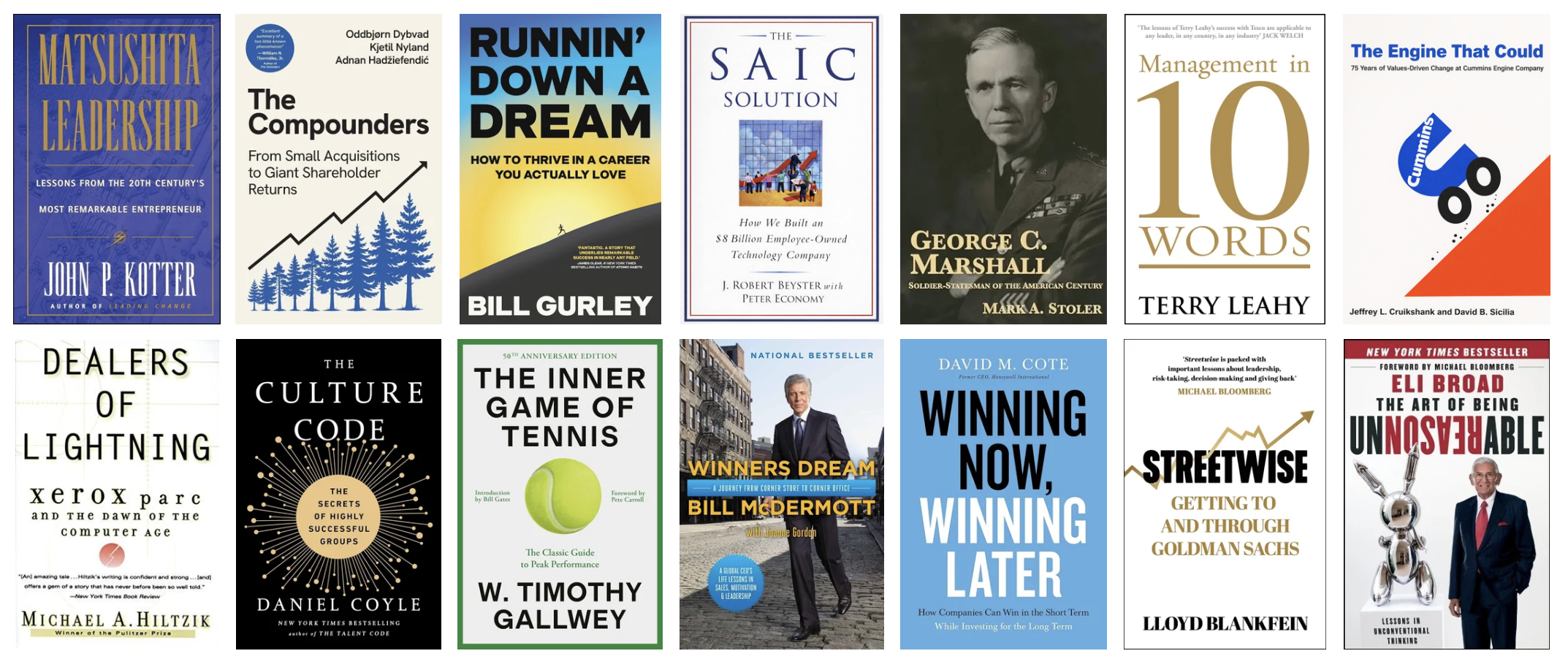
Top 14 [Ranked Top to Bottom]
By the time I closed the last page of The Invisible Billionaire — Jerry Shields' biography of Daniel Ludwig — I had read thirty-five books this year. A meatpacker from Austin, Minnesota. A five-star general. A Japanese electronics founder. Two advertising brothers who broke every rule in London. A tennis coach. A Dutch-Austrian who bottled an energy drink nobody asked for. A graffiti artist whose work became a hundred-million-dollar market. A shipping magnate who reshaped the global oil tanker industry and then blew a billion dollars in the Amazon jungle.
On the surface, none of this belongs together. But six months and thirty-five books in, I keep closing them with the same sensation I had at the end of eight days on the road earlier this year: different rooms, same conversation.
Here's what that conversation keeps coming back to.
Where The List Comes From
At the start of the year, I didn't know I'd read most of these books. They arrive through serendipity more often than design.
Bill Gurley's Runnin' Down a Dream was picked by a member of our four-person lunch reading club — I've followed Bill for years, and it's become my go-to recommendation for anyone starting a career or weighing a change; I bought copies for both my sons, who are just starting out. Three other books on the list trace back to his recommendations, Carl Sewell's among them — one of the most successful car dealers in America.
Some books I send straight to investee company management teams. Ten copies of The Compounders went out to serial acquirers. David Cote's book landed with a company that stands to gain enormously from managing costs into a revenue tailwind and the operating leverage that comes with it. The Cummins books were ordered after a conversation with MSA Safety, who pointed me toward other businesses worth visiting on the Indianapolis leg of our recent US trip.
I found the Frank Perdue book after a Forbes profile left me wanting more. The Big Store, on the crisis at Sears, has been on the list a while — Bernie Marcus recommended it, and said it had such an effect on him that for years he insisted every Home Depot executive read it. Hopper, Basquiat, and de Kooning kept me moving down the art rabbit hole I've been in for the past few years.
Most of the rest came from secondhand bookstores. The Tragedy of United Fruit caught my eye because I'd loved The Fish That Ate the Whale. Hormel, the Saatchi brothers, Apache Corporation, and the John Lewis story were bookstore finds. The Brattle Book Shop in Boston and Jackson Street Booksellers in Omaha are both worth the detour if you're ever in either city.
Innovation Is Not an Event, It's a Habit
J. Irwin Miller wrote it down in 1956, before most of his competitors had bothered to think about it at all: "It is the Corporation's responsibility to obsolete its own products with new developments. If it doesn't, someone else will." Frank Perdue arrived at the same place selling chickens instead of engines — a business that doesn't change is a business that's going to die — and Carl Sewell put a number on the same idea from the Cadillac showroom floor: customers don't give you points for being first, they leave the moment somebody offers more.
Eli Broad, founder of KB Homes, called it "a permanent revolution": conventional wisdom abhors innovation, and the comfortable case for waiting — return to fundamentals, focus on next quarter, keep doing what you do best — is really just a recipe for stagnation. David Cote ran Honeywell on the same premise turned into operating discipline, "perpetually restructuring" the business to keep fixed costs constant as it grew — restructuring that only worked, he was careful to note, because it was tied to permanent improvement of the underlying processes, not a one-off cut. Bill McDermott's version is the sharpest: no company can ever declare absolute victory. Winning, at SAP, was a process and not a destination — a state of mind that meant looking for the next idea again the day after the last one worked.
What struck me reading Hormel's history alongside Cummins' is how early this instinct shows up, and how little it cares about industry, era, or geography. George Hormel's answer to every problem, repeated to his organization for decades, was a single word: originate. Not compete, not cut costs — originate. Thomas McCann, writing about United Fruit's slow collapse, describes the disease that sets in when a company forgets this: "habit becomes more important than innovation, and how things get done takes precedence over why." Renewal is available to a company in a way it isn't to a person, McCann adds, but only if the people at the top can recognize the senility before it becomes incurable. United Fruit never did.
Xerox PARC takes the same failure a step further — the company didn’t even have the excuse of not seeing it coming. Its own engineers were inventing the future of computing while Xerox squeezed another cycle out of the same tired copiers. Xerox had the future in its own building and stood glumly on the sidelines while everyone else built it.
It's worth noting that the histories of both Hormel and Cummins were written and titled around the same milestone — Dougherty's In Quest of Quality subtitled Hormel's first 75 years, Cruikshank and Sicilia's The Engine That Could the same 75 years at Cummins. Today Hormel is 135. Cummins is 107. Both are reminders that longevity isn't the result of standing still — it's the reward for renewing yourself without losing the original DNA.
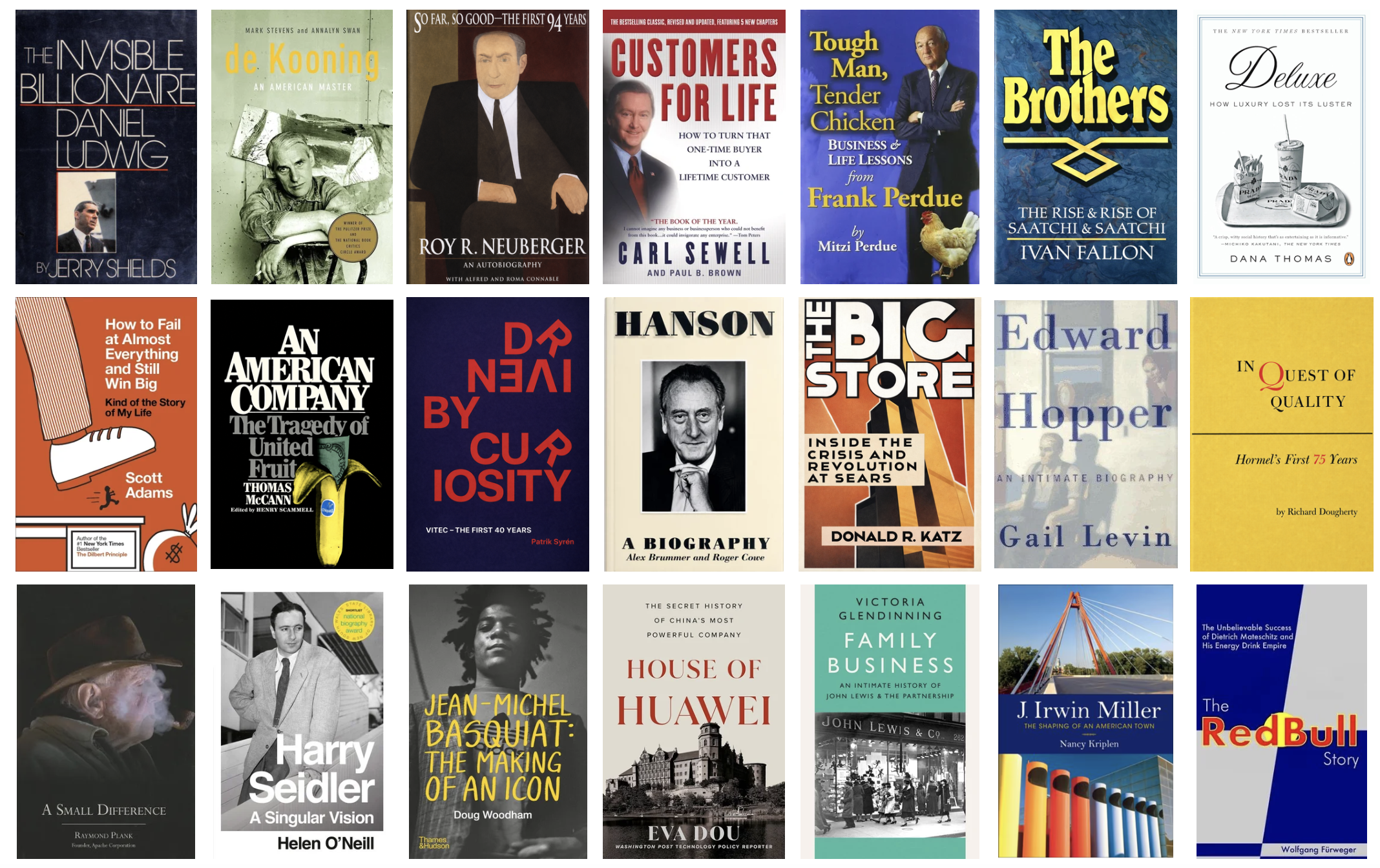
Books 15-35 [Ranked Top to Bottom]
No Substitute for Quality
Frank Perdue's whole business rested on a claim he never softened: "There is no substitute for high quality. Quality is the one absolutely necessary ingredient of all the most successful companies in the world." George Hormel said the same thing to his own workforce a half-century earlier, in language with no room for interpretation: "Every last man of us must care enough to make our products the best we know how." Bob Beyster built SAIC on the identical premise from the opposite end of the economy — government contracting — calling it "an uncompromising commitment to quality."
What ties the three together is that none of them treat quality as a department or a slogan. Hormel's version of it was two separate scales at the plant, just to check livestock weight against itself — nobody writes a case study about a second scale, but it's why the company is still standing. Panasonic’s founder, Kōnosuke Matsushita's version was a hard rule: a new product had to be 30 percent better and 30 percent cheaper than what already existed, or it wasn't worth launching.
Who a Company Decides It Exists For

Jackson Street Booksellers - Omaha - Est. 1993

Brattle Book Shop - Boston - Est. 1825
Matsushita said it as early as 1932: "The mission of a manufacturer is to overcome poverty, to relieve society as a whole from the misery of poverty and bring it wealth." J. Irwin Miller ran Cummins on the same conviction, formalized into seven named stakeholders — community, labor, government, vendors, distributors, customers, shareholders. Miller wanted Columbus, Indiana to be not the cheapest place to do business but the best place of its size in the country, and treated that as a competitive advantage, not a cost.
Set that against United Fruit, which earned the nickname “El Pulpo” — the Octopus — for a reason, and against Daniel Ludwig, who treated the Amazon’s ecosystem, his workers, and his tax obligations the same way — costs to be minimized, laws to be evaded. Both companies were as disciplined as Cummins in the parts of the business they cared about.
Miller and Matsushita answered the stakeholder question before anyone asked it of them. United Fruit and Ludwig never asked it at all — and both paid for it twice over: first in how they treated the world outside their walls, then in a culture of fear inside them, where people learned early what happened to those who spoke plainly and stopped taking the risk. Eventually the only voices left were telling them not the truth, but what they wanted to hear.
Nobody Builds Anything Alone
Matsushita called it collective wisdom — not democracy, he was careful to say, but decisions made only after everyone affected has had a say. Jim Perdue's version is more useful to anyone running something today: nobody knows more about a job than the person doing it in their own twenty-five square feet, so go ask them. Lloyd Blankfein's version is sharper and funnier, a joke that's really a confession about how rarely leaders act on what their people already know: "Tell me what you should do, because then I'm going to tell you to do it."
David Cote's Honeywell plants ran their own efficiency drives without a consultant in sight, because people are simply more committed to fixing a problem they diagnosed themselves. Robert Beyster put it as plainly as it can be put — the secret sauce was never a strategy, it was an environment where one person could make a difference and be recognized for it. It's the line that holds up across every biography on this list: success never happens alone.
Delegation Is a Form of Respect, Not the Absence of Control
George Marshall — widely ranked among America's most consequential military leaders, architect of the Marshall Plan, and the only career soldier to win the Nobel Peace Prize — had a rule for his own generals that was almost insultingly simple: "give them the bare tree, let them supply the leaves." He made a point of not questioning a subordinate's method unless it failed.
Bill McDermott, thirty years and an entirely different industry later, arrives at the identical instinct: prescribe too many solutions and you're merely insulting people's intelligence and stifling their potential. Lord Hanson built an entire conglomerate on this formalized into policy — tight financial control from the center, and management "left, and motivated, to get on with that job" everywhere else.
None of them say it outright, but it's there underneath Marshall and Hanson and McDermott alike: delegation only works as a strategy once you've done the harder work of hiring and trusting well in the first place. It isn't a technique you bolt on. It's what's left over when the people question has already been answered.
Say It Again. Then Say It Again.
Terry Leahy, running Tesco, gave the funniest and most honest confession I read all year — fourteen years of speeches on the same values, which "bored me to death," and which worked precisely because he never once stopped repeating them. Bill McDermott's discipline was the same idea stripped to three words: "Customer. Customer. Customer." Carl Sewell reached for church as the analogy — you don't read the Bible once and understand it, and you don't state your values once and expect people to live by them.
Daniel Coyle found the data behind the instinct: when Inc. surveyed executives at six hundred companies, they guessed nearly two-thirds of their workforce could name the company's top three priorities. When Inc. asked the employees, the real number was 2 percent. Coyle's conclusion was that leaders are wired to assume everyone already sees things as they do — which is exactly why the best ones plaster priorities on walls, emails, and speeches until the message becomes, as he put it, "part of the oxygen."
David Cote's Honeywell ran on the identical premise, pushed even further: talk about the culture until you're sick of repeating it, Cote wrote, "and then talk about it some more." Anything worth communicating, as McDermott puts it, is almost always under-communicated.
Nobody on this list discovered a new idea about repetition. They just believed, correctly, that saying it once was never going to be enough.
Optimism Is a Load-Bearing Wall, Not a Personality Trait
Matsushita wrote through the Depression that gloomy assumptions about human potential are crippling if your task is to build something, because "negative philosophies that appeal narrowly to self interest or hate never inspire cooperation over a sustained period of time." Terry Leahy's version trades the philosophy for a plain bet on people — give them confidence and opportunity and they're capable of incredible things — and he's honest enough to call it idealistic and better anyway. Lloyd Blankfein's contribution is the least sentimental and the most useful of the three: we overvalue whatever crisis we're living through because it's still unresolved, and it's hard to fear something that's already been filed away on the shelf of history.
Every crisis in this year's reading — the Depression for Matsushita, Casablanca for Marshall, near-collapse for more than one of these companies — reads as survivable in hindsight. None of them had that hindsight while it was happening. They proceeded anyway.
Blankfein had a second point about how that belief gets carried in the room: "I'm like a flight attendant during turbulence. Smile like you're enjoying yourself. If you look afraid, the passengers will freak out." David Cote's version draws the same line more explicitly — convey confidence in your decisions publicly, because organizations don't handle uncertainty well, but question yourself all you want in private.
Neither is arguing for false optimism. They're arguing that doubt has a time and a place, and the front of the room during a crisis isn't it.
The Unconventional Ones Weren't Trying to Be
Eli Broad put it plainly: "Most successful businesses have to begin by bucking conventional wisdom. Invention and innovation don't happen without it." Alan Kay got laughed out of a room at Xerox PARC for describing a computer you could hold in your hand. Maurice Saatchi made twenty-five cold calls a day to companies that already had agencies, breaking an unwritten rule of the entire industry. Prudent men thought Frank Perdue had flipped — nobody advertised a commodity, and pouring money into chicken, with its razor-thin margins, seemed dumb to just about everyone. He did it anyway.
Broad's own example was more mundane and just as telling: the firm belief in Detroit that nobody would buy a house without a basement. He'd read enough industry magazines to know builders in Indianapolis and Dayton were already selling houses without them — basements had only ever existed to store coal, and gas heating had made that obsolete. Dropping the basement meant building faster and pricing the house for a first-time buyer who wouldn't move out of an apartment unless the mortgage came in under the rent.
None of them set out to be contrarian — they set out to solve the actual problem in front of them, and the fact that nobody had tried it that way before was incidental. Raymond Plank, who founded Apache Corporation, put his finger on why it works: what he didn't know turned out to be an advantage rather than a liability, because he'd never fallen victim to how everyone else had already learned to do things, and it let him "countermand the adage, 'Beaten paths are for beaten men.'"
Reading the Field Is Not Optional
Bill Gurley's writing on reading describes exactly what this list of thirty-five books is trying to be — "external learning," on your own time, outside the walls of whatever you're actually paid to do.
Eli Broad reads for the same reason he interviews for it: his standard question to any candidate is what they learned this past year that they didn't know before, and a blank stare is disqualifying. He put the habit itself in blunter terms elsewhere — four newspapers a day, a discipline he credited as the source of most of his ideas, sharpening over time into something like "a hound dog's sense of smell" for opportunity hidden in plain sight. David Cote ran the same regimen at Honeywell, five newspapers plus a stack of business publications, and treated it as a long-term investment as real as any capital allocation call, even when the daily pressure of the job made the time hard to justify.
George Marshall told a room of Princeton students that nobody could think with full wisdom about the present without first understanding the past — that a grasp of history was what gave conviction its weight. Lloyd Blankfein tells young people heading into finance to study history over math, because an awareness of historical cycles is what keeps you level-headed when things go wrong and keeps you from getting cocky when they go right.
None of these people were reading the same list. But put them all in a room and they'd recognize each other instantly, because each had independently landed on the same conclusion — the field is bigger than the job, and the only way to see the whole of it is to keep reading long after the workday ends.
Thirty-five books, and the through-line was never the industry. It was the temperament. Originate instead of imitate. Give people the bare tree. Say the important things until you're tired of hearing yourself say them. Believe today's crisis won't be the last one humanity survives. Keep reading beyond your own field.
None of those ideas is new. The remarkable thing is how often the people who built enduring businesses arrived at them independently.
That's not a conclusion. It's a discipline.
Further Information - 2026 Reading List
* Visit the Blog Archive *
Learn more with us on Twitter: @mastersinvest
TERMS OF USE: DISCLAIMER