
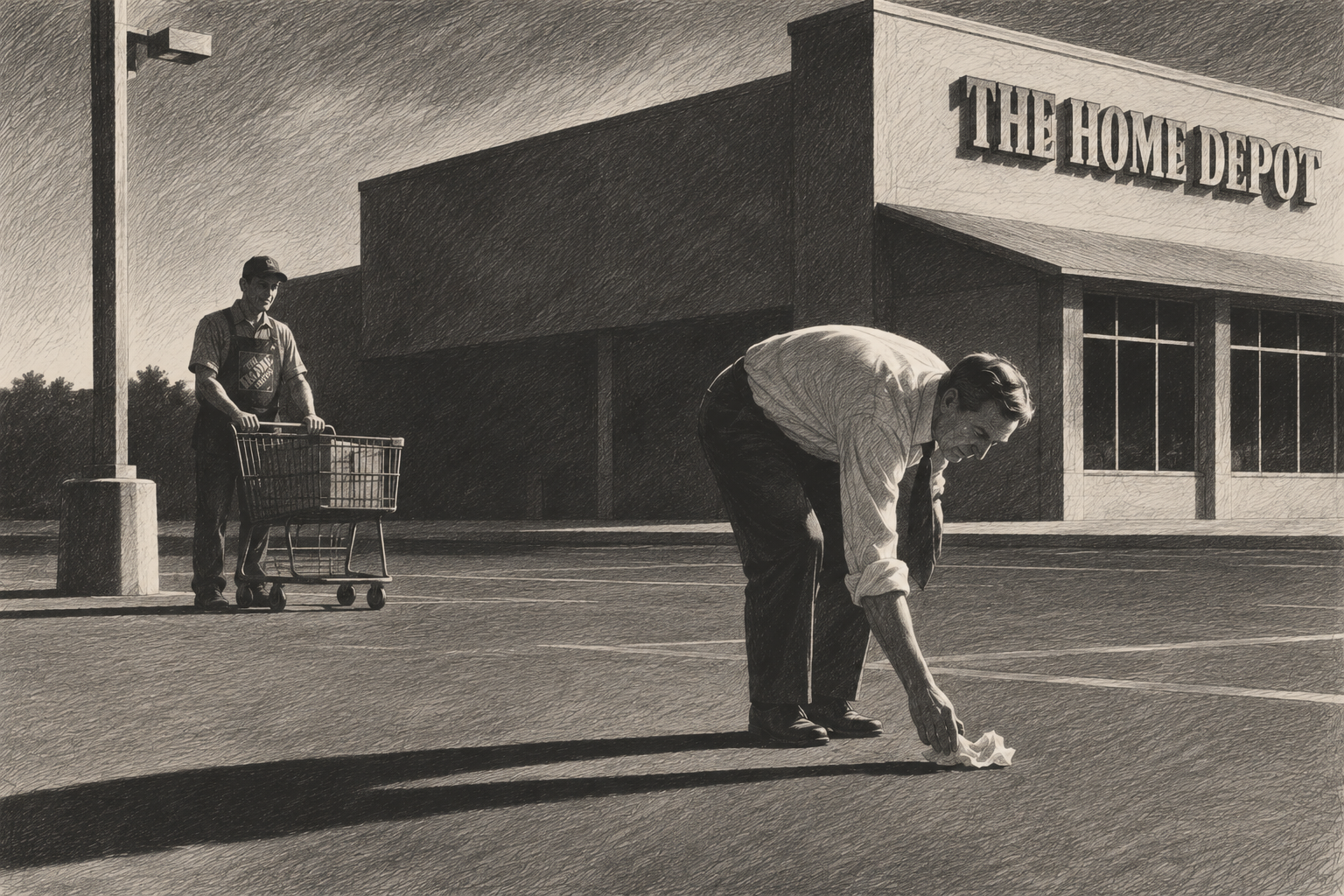
In the mid-1960s, UCLA's basketball team was in the middle of one of the greatest runs in sport: ten national titles in twelve years. Franklin Adler, the team's student manager, saw something he never forgot. The coach, John Wooden, was picking up rubbish in the locker room.
“Here was a man… who had created and was in the middle of a dynasty — bending down and picking up scraps from the locker room floor.”
Whatever Wooden said about standards, this needed no speech. Every player who walked past learned more about what UCLA expected from that one habit than from any rule pinned to the wall.
That is a lengthened shadow at work. After reading hundreds of business biographies, I’ve come to think it is one of the most reliable patterns in business, and one of the most useful things an investor can look for.
The Lengthened Shadow
In Self-Reliance, Ralph WaldoEmerson wrote that an institution is the lengthened shadow of one man. Charlie Munger borrowed the line and turned it into an investment method:
“We are, in part, engaged in the business of trying to invest in the lengthened shadows of the right sort of people.”
The phrase that matters is “the right sort of people.” Munger wasn't hunting for clever strategists. He was hunting for people whose character, copied thousands of times by those who work for them, would produce a business worth owning for decades. Warren Buffett described the other side of the coin:
“If you set the wrong example at the top, you've got a real problem.”
Michael Moritz, who led Sequoia for nearly two decades, holds the same belief and says so without apology:
“I'm a great believer in the great person theory of history. Extraordinary individuals can have an enormous influence on the world. There are certain people who possess the determination, imagination and ability to persuade others to accomplish things that previously seemed impossible.”
Tom Peters and Robert Waterman reached the same conclusion from the outside. Studying dozens of companies for In Search of Excellence, they found the great ones had usually “taken on their basic character under the tutelage of a very special person,” often early in their life. And they found that character was carried by behaviour, not memos:
“Organisational values and purpose are defined more by what executives do than by what they say… they are acted out minute by minute and decade by decade by the top brass.”
Publix is as clean an example as I know. It has been said that the things done there “flow from the character” of the late George Jenkins, and that he “built Publix entirely on his own personality.” That is Emerson's line, observed in a supermarket chain.
A shadow is long in two directions. The first is reach: how far one person's example travels through an organisation, down to the cashier or forklift driver at the furthest site. The second is time: whether it outlasts the person who cast it. Reach is what makes one leader matter so much. Time is the final test.
That is why Munger searched for people rather than plans. A strategy must be communicated. A shadow travels through example, habit and the stories people tell.
Everyone Is Watching
Most leaders underestimate how closely they are watched. Michael Abrashoff learned it commanding a US Navy destroyer, where a crew of 300 read his every move:
“Leaders need to understand how profoundly they affect people, how their optimism and pessimism are equally infectious, how directly they set the tone and spirit of everyone around them.”
Moritz saw the same pattern across Sequoia's companies, and again when he wrote Leading with Sir Alex Ferguson:
“The tone of an organisation is established at the top. The character, behaviour and standards of the leader have a profound influence on everyone else. Whether it's an investment firm, a technology business or a football club, people take their cues from the individuals in charge.”
The pattern is old. T.J. Stiles, in The First Tycoon, describes Cornelius Vanderbilt running his railroads:
“Any corporation has an internal culture shaped by the demands, directives, and expectations that rain down from above. The Commodore created an atmosphere of efficiency, frugality, and diligence, as well as swift retribution for dishonesty or sloth. Every employee knew he was watching.”
Macon Brock, who co-founded Dollar Tree, had a better image for it. The person at the top, he said, is “the cross between a car's hood ornament and its driver.” They give the business its face and steer it at the same time.
What makes the shadow powerful is that it can be cast by accident. Peter Schutz, who ran Porsche in the 1980s, noticed that people drew conclusions from decisions he barely registered making:
“A leader's impact is often the result of the little things they do and the small decisions they make, decisions they may not even realise have resonance beyond the immediate issues at hand.”
Bennett Helzberg, who built Helzberg Diamonds before selling it to Berkshire, put it more bluntly: “You always set an example whether or not you want to!” There is no off switch. A leader who has decided not to set an example has simply chosen which one to set.
In a large business, most employees rarely see the person at the top. They hear about them. A story about the boss pushing trolleys, flying economy class or turning down the corner office travels to stores and depots well before the boss does, retold by people who weren't there. That is how one person's habits reach a workforce of tens of thousands: through stories, not policy manuals.
Not Too Small for the Boss
The clearest version of the shadow is the boss doing the smallest job in the building. Ken Langone, who co-founded Home Depot with Bernie Marcus, explained why they made a point of it:
“We never, ever went into a Home Depot store — never once — unless we were pushing carts in from the parking lot. I used to pray I would see a piece of trash on the floor so I could pick it up… When he sees the top guy doing them, he can say to himself, ‘If it's not too small for them, it's not too small for me.’”
Once you start looking, the pattern is everywhere:
A Nordstrom employee watched Bruce Nordstrom walk through her department, spot a soft drink can on the counter, drop it in the bin and keep walking.
When Fred Smith saw a grease spot in a FedEx hangar, he didn't order anyone to clean it. He said, “Pitch me a rag.”
Truett Cathy, who founded Chick-fil-A, called himself the janitor at his first restaurant and said picking up paper was still his job.
Leonard Lauder picked up paper in Estée Lauder's hallways “because if you don't care, why should they?”
Jensen Huang tells Nvidia staff, “you cannot show me a task that is beneath me.”
Paul Smith once saw Giorgio Armani sweeping up outside his shop in Milan. Smith shared the instinct: “if the floor needs sweeping, sweep it.”
George Jenkins, who founded Publix, would step in to bag groceries and carry them to customers' cars when he visited stores. Customers felt honoured to be served by the founder; he felt more honoured to serve them.
The New Zealand All Blacks have turned the habit into a team value, “sweeping the sheds,” where the team’s leaders clean the changing room. Daniel Coyle, who collected many of these stories in The Culture Code, argued that such acts matter less for their generosity than for the signal they send: “We are all in this together.”
Carl Sewell, the Dallas car dealer, gave the most practical explanation:
“The boss must set the example. The person in charge can't just preach… Leadership is performance. If one of your objectives is to have an immaculate facility, and you don't pick up papers in the parking lot when you see them, don't expect anybody else to do it either.”
The rubbish itself doesn't matter. What matters is who sees it, and who hears about it. Langone wasn't performing for the store manager. He was aiming at the newest kid on the floor, the person furthest from head office. The message reached them: there is no job here that the person at the top considers beneath them, so there is none beneath you.
What the Leader Won't Take
Picking up rubbish is the leader taking on the lowest job. The mirror image is the leader refusing the highest perk. When Neville Isdell became CEO of Coca-Cola, one of his first moves was symbolic:
“I decided to close the executive dining room, requiring executives to begin eating lunch in the canteen with everyone else. We also eliminated preferential parking spots… My view is that people judge not just by hearing what you say but by seeing what you do.”
Perks like these are about hierarchy. A reserved space by the door tells everyone walking in from the far end of the car park where they rank. Michael Bloomberg explained the logic:
“We have no reserved parking spaces for senior executives. If you want to leave your car right by the door, just come in earlier… If we constantly remind those people at the bottom that they are not at the top, do you really expect them to be ‘gung ho’ about the company?”
The list of companies that refuse reserved parking is long. At Fastenal, management had no special privileges, and not even the founder, Bob Kierlin, had a private space; one observer said the levelling created a bond between workers and executives. Wawa has no assigned parking, executive washrooms or executive dining rooms. Mars had no reserved spaces, company cars, executive washrooms or private offices. Lincoln Electric avoided preferred parking lots for decades, and Greggs, the British bakery chain, never gave managers reserved parking or their own canteen, then later made equal treatment official policy. Barclay Simpson of Simpson Manufacturing summed it up: “None of us is a big shot. We all go by our first names and no one has a parking space.”
The best examples are personal, not just policy. Jeffrey Musser, who ran Expeditors International, paid for parking in the company garage every day at the same rate as any employee. When Guy Russo ran Kmart Australia and visited supplier factories, he turned down the boardroom lunch to eat where the 3,000 workers ate. At Mainfreight, the New Zealand logistics group, one manager described giving up his tie, office and car park because they divided him from his people: if you isolate yourself, “you may as well sit in that office with your tie and hang yourself with it.”
Pay
The costliest signal of all is pay. Herb Kelleher, who built Southwest Airlines, was explicit about why he turned money down:
“I have turned down many, many millions of dollars in salary & options because it didn't set a good example. Our officers have never received a salary increase that is larger on average than our non-contract employees have gotten.”
Buffett once explained why Bill Gates kept a small salary at Microsoft. In a bad year, if Gates had to ask staff to take a 5 per cent cut, he wanted to be able to take a 90 per cent cut himself. The point wasn't the money. It was that everyone, down to the most junior employee, would know the person asking had gone first.
Others made the same point. Michael Bloomberg set his salary equal to that of his lowest-paid full-time employee. Bob Kierlin kept his salary at $120,000, even though the Fastenal board repeatedly authorised an increase for him. Henry and Dick Bloch also turned down repeated pay rises from H&R Block's own board. John Patterson took little from NCR and spent less on himself than almost any rich man of his day. It's easy to preach shared sacrifice. It's much harder to demonstrate it when the money comes out of your own pocket.
Mood Is Contagious
Behaviour is only half the shadow. The other half is mood. People copy how the leader feels as readily as what the leader does, and nowhere more than in a crisis. Bob Iger, who ran Disney through several, described the chain reaction:
“Optimism in a leader, especially in challenging times, is so vital. Pessimism leads to paranoia, which leads to defensiveness, which leads to risk aversion. Optimism sets a different machine in motion.”
This isn't cheerfulness. Kenneth Chenault, who led American Express through 9/11, said the leader's job is “to define reality and give hope” — both halves, in that order. David Cote, who rebuilt Honeywell, was honest about the gap between the two: you convey confidence in public because organisations handle uncertainty badly, and you question your decisions in private. Lloyd Blankfein compared it to a flight attendant in turbulence. Smile, because if you look afraid, the passengers will panic.
The Fanatic
The other thing that travels down from the top is intensity. Buffett is said to have suggested a one-line job application for managers: “Are you a fanatic?” John Train reported his reasoning in The Money Masters:
“A manager must care intensely about running a first-class operation: if his golf game is what he thinks about while shaving, the business will show it.”
A leader's obsession, like their mood, ripples through an organisation. It sets the pace for everyone who reports to them, and for everyone who reports to those people.
Jim Collins found the same thing studying companies that beat their industries by ten times or more: “The 10Xers, we concluded, weren't just disciplined; they were fanatics.” George Mecherle, who built State Farm, described what that looks like from the inside:
“A man has to live with his business if he wants to make a go of it. You have to take it home with you at night, so you can lie there in the darkness and figure out what you can do to improve it… You have to become a one-man crusade.”
The best fanatics don't keep it to themselves. Ingvar Kamprad asked IKEA's staff to be “a group of positive fanatics who stubbornly and persistently refuse to accept the impossible.” The crusade was meant to be shared.
Consider Rose Blumkin, who started Nebraska Furniture Mart with $500. At 91 she told the local paper, “I come home to eat and sleep, and that's about it. I can't wait until it gets daylight so I can get back to the business.” Two years later Buffett wrote that she was still outselling and out-hustling any manager he had ever seen:
“Competing with her represents a triumph of courage over judgment.”
Her staff didn't need a memo on work ethic. They worked alongside a woman in her nineties who turned up seven days a week.
Most great CEOs are fanatics about their businesses, and the best investors go looking for exactly that. Munger saw the same trait in the investors themselves:
“I think the people who tend to get the best results are these fanatics who just keep searching for the great businesses.”
Which makes the whole exercise a little recursive. The best investors are fanatics, searching for fanatics.
Every Day, Not Sometimes
One visit to the shop floor doesn't establish a culture. It's what leaders do consistently, year after year, that matters. Tom Crosby, who ran Pal's Sudden Service, the Tennessee drive-through chain famous for its training, put it simply:
“Live your life as the example of what you want everybody else to be. You have to be in that own position 24 hours a day, 365 days a year, you can't turn it on when you come to work.”
The example has to be backed by words, said far more often than feels necessary, because leaders consistently overestimate how far their message has travelled. Daniel Coyle cites an Inc. survey in which executives at six hundred companies estimated that 64 per cent of their staff could name the company's top three priorities. Only 2 per cent could. Crosby's answer was to keep going: once you've told someone the standard 2,000 times, “you're just beginning to get to the point where they're hearing you.” Terry Leahy repeated Tesco's values in every speech and pep talk for fourteen years. It “bored me to death,” he admitted, but it was the only way to drive home that they mattered.
Wooden, back in that UCLA locker room, taught by four laws of learning: explanation, demonstration, imitation and repetition. Gary Cunningham, who played and later coached under him, remembered “lots of repetition. You can't believe the repetition.” The example casts the shadow. Repetition makes sure everyone knows what it means.
David Novak, who built Yum! Brands, reminded leaders that they are always onstage: people watch whether your actions match your intentions. The danger is that inconsistency teaches too. One lapse in front of the wrong audience tells everyone the standard has exceptions.
J. Paul Getty, who believed no psychological weapon was more potent than example, saw the cost: “when an executive's bad example or his double standards become known, morale and output plummet in his department.” David Sokol, who ran MidAmerican Energy for Berkshire, was more precise still:
“If I walk through one of our facilities and don't stop a worker from performing an unsafe act, or if I fail to stop and pick up a gum wrapper off the floor, then I am telling everyone who saw me that our focus on excellence or detail only matters sometimes or for some people.”
Sokol was once seen as a possible successor to Buffett. In 2011 he resigned from Berkshire after it emerged that he had bought shares in Lubrizol before recommending Berkshire acquire it. The standard he described was exactly right. His story is the reminder that it has to apply to everyone, including the person who wrote it down. Shadows are built over decades and can be bent in a week.
Does It Outlast the Person?
Then there is time. In Built to Last, Jim Collins found that the key early architects of the visionary companies he studied stayed in office for more than 32 years on average. George Jenkins ran Publix for 59 years; as Ed Crenshaw, a later Publix CEO, put it, he ran the company “pretty much well into his 80s.” Marriott had two CEOs in its first 85 years, and its founder, J. Willard Marriott, was clear about what mattered most: a leader should “be an example in all things. This is his greatest influence.”
Tenure alone isn't enough, though. A shadow lasts only if the people who grew up inside it carry it on. Peters and Waterman noted that one leader is never enough: “it is the team at the top that is crucial.” Vicki TenHaken, studying companies more than a century old, found most were led by people who grew up in the company, which “usually produces some consistency in leadership style.” As I argued in The Floor to the Boardroom, promote-from-within is how a shadow is inherited.
Thomas Watson Jr., who succeeded his father at IBM, described that inheritance from the inside:
“The beliefs that mold great organizations frequently grow out of the character, the experiences, and the convictions of a single person. More than most companies, IBM is the reflection of one individual — my father, T. J. Watson.”
Nebraska Furniture Mart is a useful test of the second direction. Mrs B died in 1998, but her family still runs the business. I've visited NFM numerous times over the years, and her presence is everywhere. Her photograph hangs in the corridors, and presentations begin with the story of how a poor immigrant who couldn't read or write English built one of America's most successful furniture retailers. The stories are retold with affection: her fierce competitive spirit, her love of customers, her insistence on never being undersold, and her simple motto, “Sell cheap, tell the truth.”
Ron Blumkin, Mrs. B’s grandson, explained how that philosophy still shapes the business. Prices are updated daily, and NFM remains determined to be cheaper than its competitors. “Sometimes we lose money on a sale — we don't set our margin; our purchase price does.” Mrs B may be gone, but her values live on in the people, the stories and the way the business is run.
Reading the Shadow
An annual report will tell you what a company says it values. The shadow tells you what it actually values. The best test of reach is to start at the edge: talk to the newest person on the shop floor, the furthest branch, the night shift, and see whether the CEO's standards got there. Most of the rest can be seen from outside if you know where to look:
Turn up unannounced. Bill Child of R.C. Willey spent his Saturdays visiting stores without calling ahead, because he wanted to see them as they were. Investors can do the same.
Check the bathrooms and the car park. Dick Farmer inspected Cintas's bathrooms personally. Reserved spaces by the door, an executive floor and a corner suite tell you who the building is for.
Compare pay up and down. When times are good, do executives reward themselves disproportionately? When times are tough, are they the first to make sacrifices?
Look at the small expenses. Julian Brodsky of Comcast said integrity shows most clearly in your expense reports. Travel, aircraft and perks in the proxy are the public version.
Ask how long, and from where. How long have the top people been there, and did they grow up inside the business?
Read the last downturn. What did management say, and do, when things went badly? Who took the pay cut first?
None of these is decisive alone. Together they are hard to fake, because a shadow is made of thousands of small actions that nobody bothers to stage.
The Right Sort of People
Munger wasn't buying strategies. Strategies can be copied, and usually are. He was buying shadows, which can't be copied because they are made of a person's character repeated over decades.
Wooden picked up scraps from the locker room floor while building a dynasty. Langone prayed for rubbish on the floor. Kelleher turned down millions. Mrs B sold furniture seven days a week into her nineties. None of them was running a culture programme. They were simply being themselves, in full view, for a very long time.
That is what makes the shadow worth finding. It is cast whether the leader intends it or not. The investor's job is to see which way it falls, and how far it reaches.
* Visit the Blog Archive *
Learn more with us on Twitter: @mastersinvest
TERMS OF USE: DISCLAIMER