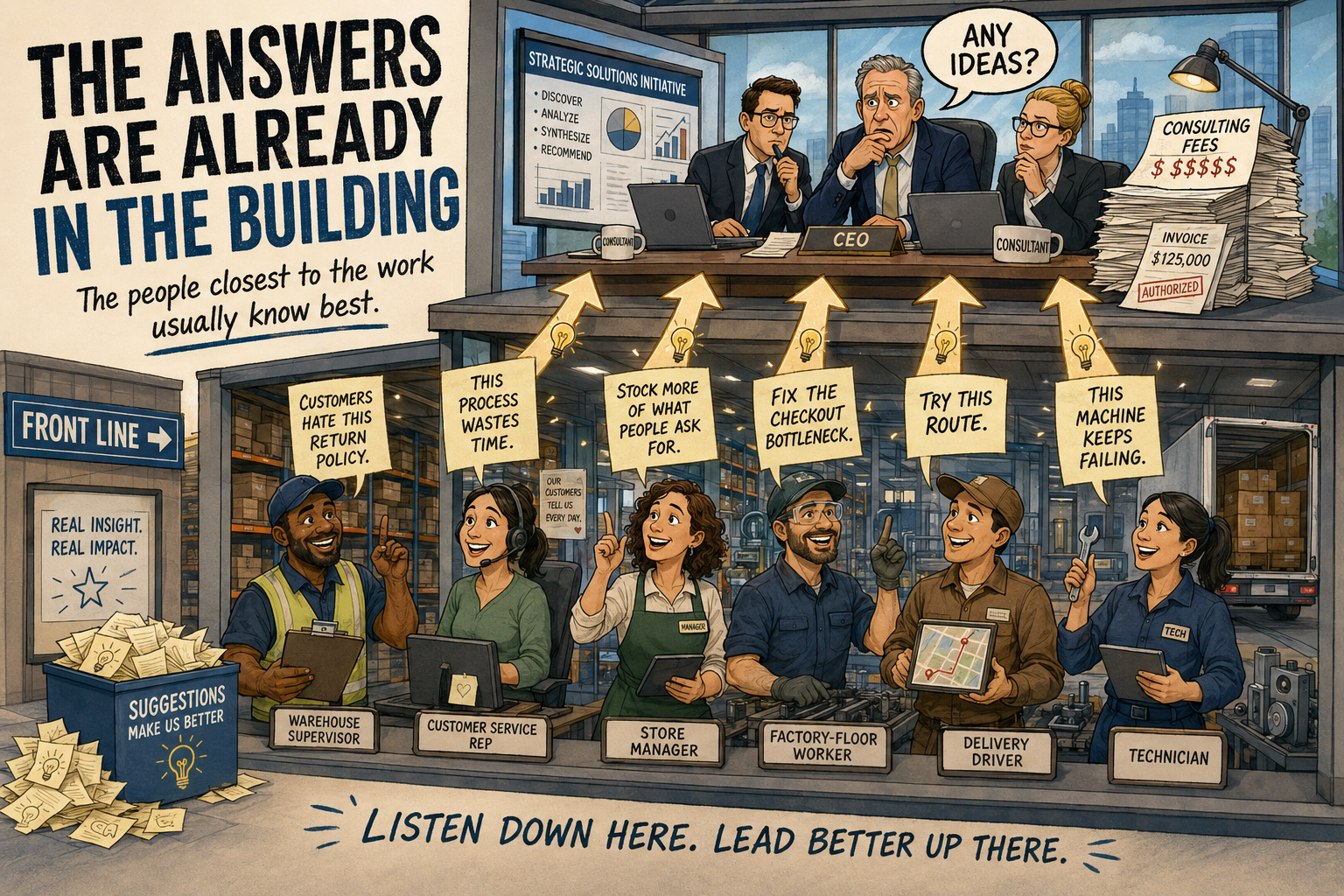
There's a consulting industry worth hundreds of billions of dollars built on a surprisingly simple arbitrage: companies pay outsiders enormous fees to tell them what their own employees already know.
It's one of the great ironies of organisational life. The person in the corner office, armed with an MBA, a strategic framework and a PowerPoint deck, spends months searching for answers that the warehouse supervisor, the customer service rep, or the factory floor worker could have provided in an afternoon - if only someone had thought to ask.
The People Closest To The Work Know Best
Joe Coulombe, who built Trader Joe's into one of the most successful retail concepts in history, put it simply: in any troubled company, the people at lower levels know what ought to be done. Lloyd Blankfein at Goldman Sachs noticed the same thing from the opposite end of the power structure - people knew the right answer, knew the system was broken, knew what needed fixing. They just hadn't been given permission to say so, let alone act on it. His solution was blunt: ask people what should be done, then tell them to do it.

Sam Walton was equally direct. The people on the front lines - the ones who actually talk to customers - are the ones who really know what's going on. The job of leadership, in his view, was to figure out ways to get them talking, and then actually listen. John H. Patterson at National Cash Register understood it in almost mathematical terms a century ago - why rely on one superintendent's brain scanning for problems when you could harness four thousand brains and eight thousand eyes, all simultaneously alert to mistakes and improvements?

IBM's Thomas Watson Jr ran a suggestion program that attracted more than 100,000 entries a year. Toyota built an entire production philosophy around the principle that only those at the front line can understand problems fast enough to react to them quickly. Henry Kravis at KKR tells anyone who will listen, from analysts to partners, to wake up each morning asking whether something could be done better. The source of the idea is irrelevant. What matters is that it surfaces.
Get Out of the Ivory Tower
The insight extends beyond internal operations to customers - and critically, to the customers who leave. Frederick Reichheld was unequivocal: there is simply no substitute for having senior executives learn directly from defectors why the company's value proposition is inadequate.

Terry Leahy, who built Tesco from Britain's third-largest grocer into one of the world's most successful retailers, made this viscerally real. He gave himself a challenge - one week every year working as a general assistant in a Tesco store. Checkouts, shelf-filling, back room, pricing, customer queries. Then he asked his three thousand top managers to do the same. Their combined firsthand experience, he noted, amounted to roughly sixty years on the shop floor in a single year. He learnt more in that one week than any other week that year - not from reports or dashboards, but from actually doing the work.
A consistent theme amongst many of the world’s most successful companies is getting management into the field. At Chick-fil-A, every headquarters employee works in a store at least one day each year. ServiceMaster introduced a ‘We Serve’ day, during which every leader participates directly in serving the customer - keeping management in touch with reality. The entire management of the Würth Group, right up to the group directors, is obliged to spend at least one whole day each quarter in the marketplace - in sales, visiting customers.
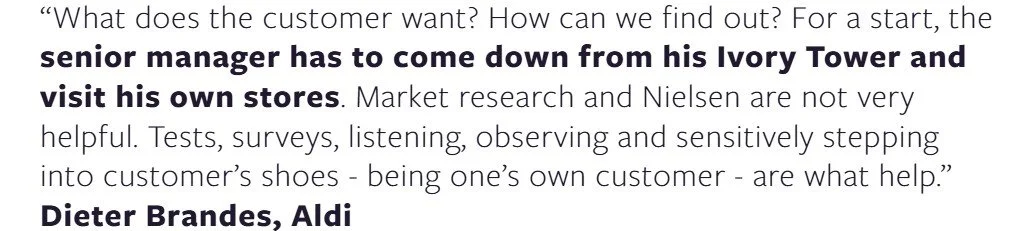
The best operators make field presence non-negotiable. Ed Stack built Dick's Sporting Goods into a dominant retailer by spending two days a week, three weeks a month, out in the field - walking stores, listening to managers, detecting shifts in customer demand long before anyone at a desk in Pittsburgh could. David O'Reilly at O'Reilly Auto Parts was blunt: you're either plugged in all the way or you're not.

There's no substitute for exposing yourself to your customers, your team members, and your vendors - and far too many executives simply don't do it. Brian Chesky at Airbnb spent six months living in his own company's rentals and found the core problem with his business hiding in plain sight - variability that no report had ever surfaced. Elon Musk slept on the factory floor during Tesla's most critical production crises, reasoning simply: if the team thinks their leader is off somewhere having a good time, it's demoralising. The more senior you are, the more visible your presence must be.

Two Harvard Business School professors who studied how CEOs actually spend their time found that on average, just 6% goes to frontline teams and 3% to customers. They spend 72% in meetings. The gap between those numbers is where organisational blindness is quietly manufactured.
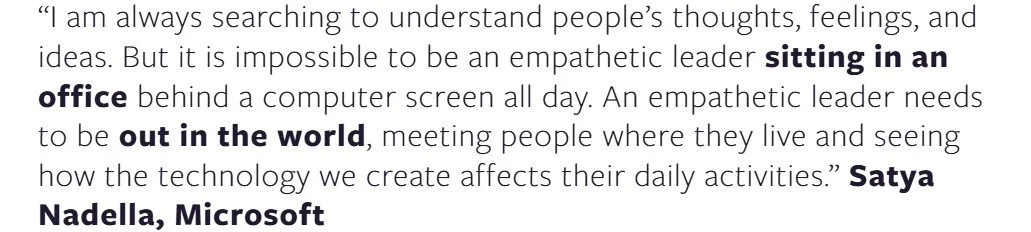
J.W. Marriott said it plainly: companies that get into trouble are ones where the CEO never budges from the executive suite and makes decisions without knowing what's really going on. You can't rely solely on reports or secondhand information. You have to get out there and find out for yourself.
The Paradox of Expertise
Here's the uncomfortable corollary. The more senior and experienced a leader becomes, the more likely they are to stop doing the thing that made them effective in the first place.
Expertise is great, but it has a bad side effect - it tends to create an inability to accept new ideas. William Taylor calls it the paradox of expertise: the more deeply immersed you are in a market or technology, the harder it becomes to open your mind to new models that might reshape it. The people with the most experience, knowledge and resources in a field are often the last to see and seize the opportunities for something dramatically new.

This is why fresh eyes matter. Henry Ford observed that some of his best results came from letting fools rush in where angels fear to tread. The person who doesn't know something is impossible has a structural advantage over the expert who knows exactly why it can't be done.

Chester Cadieux at QuikTrip spent at least two months every year in direct communication with any employee willing to participate - and made a point of reviewing even comments raised by a single person just once, because without fail, each year he learned something important from exactly that source.
Why Most Organisations Don't Actually Do This
So why don't more organisations embrace something so obviously valuable? A few reasons, none of them flattering.

The first is ego. Leaders are selected, promoted and compensated in ways that reinforce the belief that their value lies in having answers. Admitting the answers might exist two levels below them feels like an admission of redundancy.

The second is structure - most organisations are not designed to surface information upward. Suggestion boxes and town halls are often theatrical exercises that give the appearance of listening without the substance of it.

The third is pure inertia - things remain as they are not because anyone thinks they're optimal, but because changing them requires someone to actually decide to change them.

Bill Walsh at the San Francisco 49ers put it starkly: if you're uncomfortable walking around your team's workplace, awkward and out of place, you are a disconnected leader. His coaching staff ate lunch in the locker room with players at least once a week. Tuna sandwiches and Pepsi. Barriers came down. Information flowed.
The Simplest Competitive Advantage Available
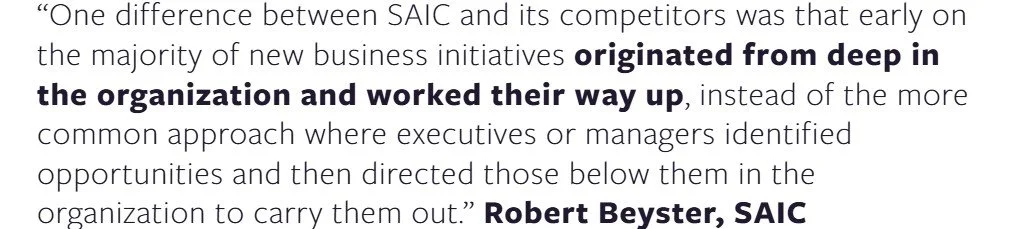
David Cote transformed Honeywell's sustainability performance not by importing expensive external expertise, but by asking the people already inside the building where energy was being wasted. Because employees developed the solutions themselves, they were personally invested in seeing them through. Joe Scarlett at Tractor Supply credits the overwhelming majority of the company's best product ideas to decades of continuous conversation with store managers and salespeople. Dick Wood at Wawa said it plainly: company intelligence is in the front line, not in the executive suite.
The answers to most of the problems an organisation faces are already inside it. They live in the person who processes the returns and knows exactly why customers send things back. In the technician who has quietly developed a workaround for the broken process that management doesn't know is broken. In the driver who has figured out a faster route that nobody ever thought to ask about.
As an investor, this is one of the most reliable signals available to you. Steve Mandel of Lone Pine Capital put it simply: you always learn more when you're outside the office than when you're in - body language, how offices are structured, little things that add up. Kelly Granat goes further: arrive early, sit in the lobby, watch who's coming in and whether they're happy to be there. Then go upstairs and notice whether the CEO talks over everyone in the room or creates space for others. All of it tells you something about how decisions are actually made.

We saw this firsthand at HEICO. Walking the floor, it was clear management's interactions with employees weren't a staged performance for visitors. They knew people by name, engaged in genuine dialogue, and asked thoughtful questions about projects and progress. It was a small detail, but a revealing one.
That culture - the one visible in the lobby at 8am, not the one described in the annual report - is ultimately what you're investing in. Companies where information flows freely from the bottom up, where leadership is genuinely curious, consistently present, and humble enough to listen, tend to improve continuously, adapt quickly, and compound reliably over time. Companies where the executive suite is insulated from operational reality tend to be slow, self-deceiving, and eventually blindsided.
The question was never whether the answers exist inside these businesses. The question - the one worth asking before you invest - is whether anyone in a position of authority cares enough to go looking for them.
Follow us on Twitter : @mastersinvest
* Visit the Blog Archive *
TERMS OF USE: DISCLAIMER