
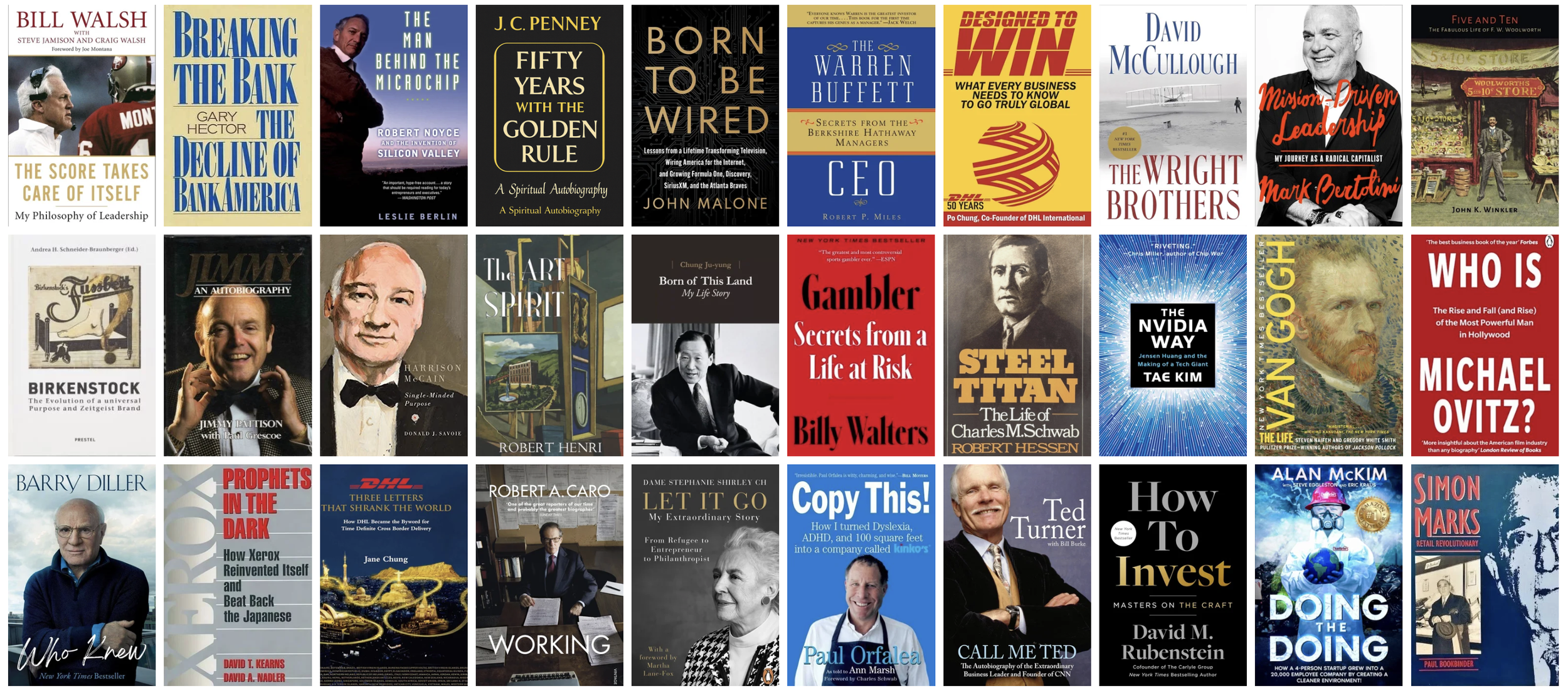
Reading 2025 - Top 30 [Top to bottom]
Each year I set out to read widely — across business, sport, art, psychology and history — knowing full well that it rarely follows a straight line. One book leads to another, then another rabbit hole opens. A footnote becomes a biography; a passing reference turns into a month-long detour. That wandering is the point. Pattern recognition is the by-product. Over time, ideas begin to rhyme — across centuries, disciplines and personalities — and judgment quietly improves.
This year’s reading spanned founders, operators and creators — from The Wright Brothers to Hugh De Pree’s Business as Unusual, from Bill Walsh’s The Score Takes Care of Itself to Van Gogh: The Life — united by an obsession with craft, culture and the compounding effect of small, daily improvements.
Culture Compounds
One of the clearest themes to emerge from this year’s reading was the power of culture. From ESPN to Herman Miller, the most enduring organisations share invisible foundations — trust, autonomy, ownership and purpose. The best leaders don’t impose control; they design systems where good judgment can spread. Hugh De Pree described it as “a community of accountable contributors.” When done properly, culture becomes an asset that quietly compounds year after year.
The Lessons of History
One of the recurring reminders was how little truly changes. History doesn’t repeat, but it certainly echoes.
The lessons in R.W. McNeel’s book written in 1927 — three years before Warren Buffett was born — mirror much of Buffett’s thinking decades later. The ‘Golden Rule,’ so central to J.C. Penney and the founder of Samsonite, reappears again and again in today’s most successful businesses.
The technological revolution that followed the invention of the microchip in the 1960s and 1970s offers a useful parallel for today’s explosion in artificial intelligence. Bob Noyce, co-inventor of the integrated circuit and co-founder of Intel, understood that the true impact of the microchip would unfold over decades, not quarters. Different eras, same principles.
The Long Game Wins
Another pattern that surfaced repeatedly was the primacy of the long game. The most durable advantages were built by resisting the quick fix and optimising for longevity. Alan Nesbitt of Capital Cities described “doing the right thing” as a roadmap — avoiding short-term solutions in favour of the long-term interests of the organisation and its stakeholders. Ralph Roberts made the same trade-off explicit at Comcast, accepting short-term sacrifice to protect long-term growth in earnings and value. François Michelin went further, arguing that the true capitalist must think like an ecologist — looking far into the future. John Malone captured the idea succinctly, noting that control allows leaders to ignore antsy Wall Street demands and make decisions that compound over decades rather than quarters.
The Unconventional Path
The unconventional path appeared everywhere. Picasso, Pissarro, Gauguin and Pollock were dismissed precisely because they saw differently. Their work looked wrong before it looked inevitable. The same pattern holds in business. Sony began as a small post-war Japanese start-up making rice cookers and tape recorders, ridiculed for betting on consumer electronics when Japan was known for cheap goods. McCain Foods started as a modest family potato operation in rural Canada, choosing frozen food and long-term partnerships over quick profits. Like DHL, ESPN, CNN and Hyundai, these were improbable ideas at inception.
Innovation almost always starts as heresy — a rejection of prevailing logic — before history quietly rewrites it as common sense.
Fanaticism as a Virtue
Across all these stories ran a streak of fanaticism — not excess for its own sake, but devotion. Jimmy Pattison wanted to work and hated holidays. Robert Caro spent years chasing facts with monastic discipline. Dame Stephanie Shirley worked twelve-hour, seven-day weeks. Chung Ju-yung measured life in effort, not years. Barry Diller believed that to stop evolving was to stop living.
Harrison McCain captured the idea with unusual clarity. He believed the first requirement for success was single-mindedness of purpose — the willingness to sacrifice, make difficult choices and persist long after others fall away. Those who endure, he argued, inevitably outperform those who do not. Billy Walters immersed himself for five decades in the craft of finding an edge. Alan McKim devoted four decades of sixty-hour weeks to building Clean Harbors. Ed Stack spent fifty years at Dick’s Sporting Goods, thirty-six as CEO, after starting in the store at thirteen. Properly directed, fanaticism isn’t imbalance — it’s commitment to excellence. It compounds.
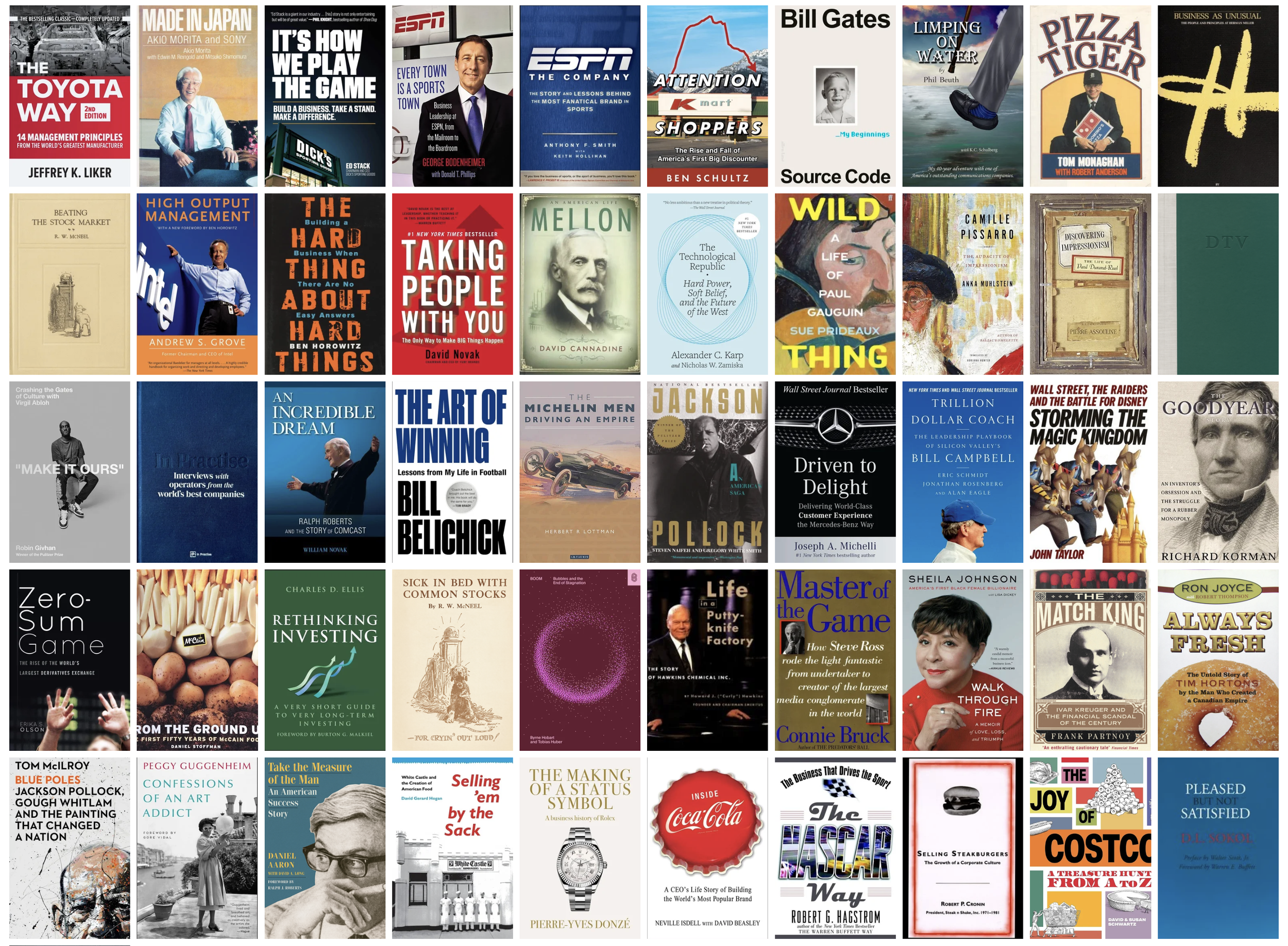
Reading 2025 - Books 30-80.
The Weight of Resilience
The deeper I read, the clearer it became that greatness is rarely born from comfort. Daniel Aaron arrived in the US as a thirteen-year-old refugee to escape the Nazis; his parents later took their own lives, and he went on to help build Comcast. Dame Stephanie Shirley was sent alone to England at age five to escape the Nazis and later built a pioneering technology company when women weren’t allowed in boardrooms.
Ted Turner lost his father to suicide at twenty-four and channelled that trauma into building CNN. Barry Diller later reflected that the dysfunction of his early life forged his own tools for success — an “alchemy,” as he described it, turning weaknesses into strengths. Sheila Johnson endured neglect and abuse before co-founding BET and creating opportunity for others. Resilience, it turns out, isn’t toughness; it’s the capacity to absorb adversity, adapt, and continue building despite it.
Business Pivots
Another recurring theme was the role of well-timed pivots in building durable businesses. John Malone shifted from regional signal retransmission to dense urban cable systems, materially improving network economics. Michael Ovitz redefined the Hollywood agent by moving from individual representation to packaging complete films for studios. Intel exited memory chips to focus on CPUs, while NVIDIA evolved from gaming graphics processors into a platform and chip supplier for AI. Birkenstock transitioned from a niche orthopaedic footwear brand into a global lifestyle and fashion business, and Herman Miller moved from designer furniture to integrated office furniture systems.
The Art Spirit
Design emerged as another quiet constant. Charles and Ray Eames refused to talk about “good design.” They asked simpler questions: does it solve a problem, is it serviceable, and will it still matter in ten years? That same mindset defines great investors and great businesses — durability over decoration, substance over style.
Robert Henri’s The Art Spirit may be the best business book never labelled as one. It’s about care, conviction and treating work as if it truly matters. From Rolex to DHL to Herman Miller, the most enduring enterprises see their craft not as a job, but as a calling.
In the End
By the end of the year, the message was unmistakable. Compounding isn’t just financial — it’s cultural, creative and moral. Whether in a studio, on a football field or inside a company, progress is a long obedience in the same direction.
Each book added another beam to the latticework of mental models beneath better judgment. Some books add knowledge. The best expand judgment.
Compounding works on ideas as much as capital — if you stay curious long enough to connect them. Here’s to another year of curiosity, discipline and quietly expanding the toolkit.
Thank you for taking the time to follow the blog posts this year.
Happy holidays, and best wishes for a fruitful New Year.
Follow us on Twitter : @mastersinvest
* Visit the Blog Archive *
TERMS OF USE: DISCLAIMER