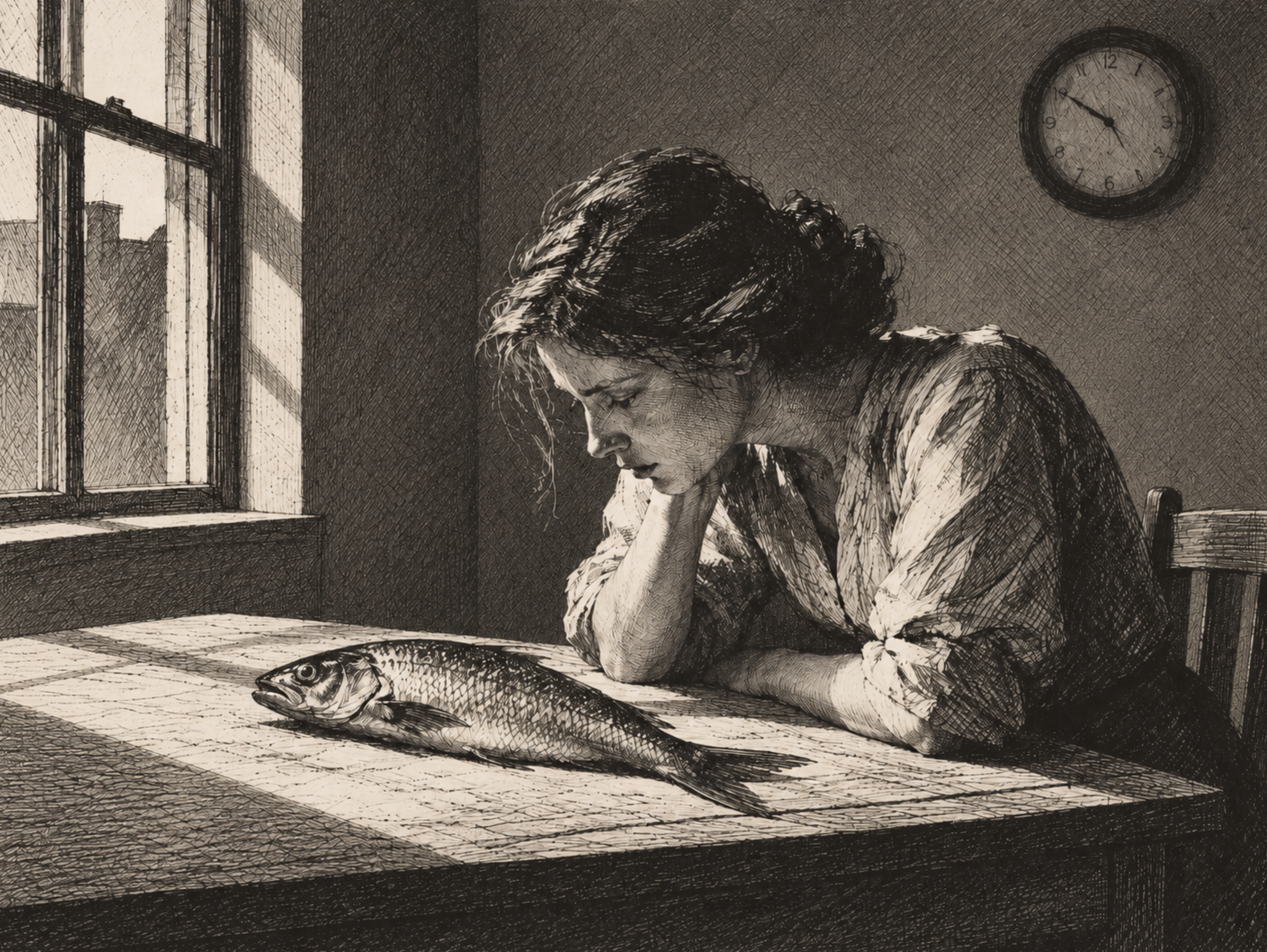
David McCullough was widely regarded as one of America's greatest biographers and historians. He won two Pulitzer Prizes and two National Book Awards, and was awarded the Presidential Medal of Freedom. Above the desk where he wrote those books hung a small card with four words on it: "Look at your fish."
When an interviewer asked about it, McCullough told a story he had told many times to his writing students. It concerns Louis Agassiz, the nineteenth-century Harvard naturalist, and the test he set every new student who came to study under him. It is a story about science, and McCullough used it as a story about writing. It is also one of the best lessons in investing I have come across, and it says nothing about markets at all.
The Ordeal with the Fish
Agassiz would take an odorous old fish from a jar, set it in a tin pan in front of the student and say three words: "Look at your fish." Then he would leave.
When he came back he would ask what the student had seen. "Not very much," was the usual reply. Agassiz would say it again, "Look at your fish," and leave again. This could go on for days. The student was encouraged to draw the fish but was allowed no tools for the examination. No magnifying glass. No scalpel. Just hands and eyes.
Samuel Scudder, who later became a famous entomologist and the leading expert on grasshoppers, left the best account of what he called the ordeal. After several days he still could not see whatever it was Agassiz wanted him to see. But he had noticed something about himself: "I see how little I saw before."
Then Scudder had a brainstorm. He arrived the next morning and announced it: "Paired organs, the same on both sides."
"Of course! Of course!" said Agassiz, very pleased.
So Scudder naturally asked what he should do next.
"Look at your fish."
"I See How Little I Saw Before"
The line in that story I return to most is not the breakthrough. It is the confession that came before it.
Most of us, handed a stock, an annual report or a business, look for as long as it takes to form an opinion, and then we stop looking. The opinion is mistaken for the seeing. Agassiz understood that the first look is mostly a look at our own assumptions. Only once those are exhausted, once boredom sets in and the student is forced to keep looking anyway, does the object itself begin to appear.
"I see how little I saw before" is where the real work starts. It is an admission of ignorance, and it is the precondition for everything that follows.
Marcel Proust put it memorably: "The real voyage of discovery consists, not in seeking new landscapes, but in having new eyes."
Insight Is Usually Already on the Table
McCullough's own reading of the story is the part every investor should pin above their desk: "Insight comes, more often than not, from looking at what's been on the table all along, in front of everybody, rather than from discovering something new."
This runs against much of how our industry works. Most investors look at the same things: the earnings announcement, the quarterly call, the broker reports. But in a market where public information is distributed instantly and universally, the fish is in front of everybody. The annual report is the same document for every reader. The difference is what each reader sees in it.
The great investment insights often look obvious in hindsight. A business that has promoted from within for decades. A founder who has never sold a share. A customer relationship structured so that both sides win. A culture whose stated values match its demonstrated ones. None of this is hidden. It sits in the history, the proxy statements, the founder's letters, the way the company talks about its people and treats its suppliers. It is simply not looked at for long enough, or by people who know what they are looking for.
The Business That Does Things Differently
John Kay once turned Tolstoy's famous opening to Anna Karenina on its head. In business, he argued, unhappy companies tend to resemble one another, while each successful company succeeds in its own way. "Business achievement depends on doing things that others cannot do." The challenge for an investor is to recognise those differences before their significance becomes obvious. Often, what makes an exceptional business exceptional looks, at first glance, like a disadvantage.
The clearest examples are businesses whose model is a deliberate departure from their industry's, where the difference was visible for decades to anyone who cared to look.
Aldi and Tesco. Walk into an Aldi and the difference is right in front of you: a fraction of the products a conventional supermarket carries, almost all of them private label, stock sold from the cartons it arrived in, a small team doing many jobs, smaller stores often in cheaper secondary locations rather than prime sites, and everyday low prices instead of a weekly cycle of specials. Tesco built the opposite: vast range, loyalty schemes, constant promotions, supplier income and relentless expansion. Since 2007, Aldi's UK market share has risen from 3 to 11 per cent; Tesco's has fallen from 31.6 to below 28.
HEICO and the OEMs. The aerospace original equipment manufacturers earn much of their return on spare parts, priced high because airlines have few alternatives, and those margins sat in plain view in their own accounts. HEICO built its business making FAA-approved replacement parts and selling them 30–50 per cent below the OEM price. It has been run on a decentralised model by the Mendelson family since 1990, with employees owning a substantial stake. Airlines save money, HEICO earns an excellent return, and the relationship is win-win rather than extractive. Since 1990, sales have compounded at about 16 per cent a year, from $26 million to $3.86 billion.
Costco and Sam's Club. Costco caps its markups well below what it could charge, pays its staff far above the retail average and earns most of its profit from membership fees. For years some analysts criticised it for being too generous to employees and customers at shareholders' expense. On a spreadsheet, its thin gross margin looked like a weakness. In reality it was the moat. Walmart's Sam's Club opened the same year with the same warehouse format, run on a lower-wage, higher-turnover model. By fiscal 2025, Costco's sales were $270 billion against Sam's $90 billion, and each US Costco warehouse sold roughly twice as much as a Sam's Club.
Nucor and US Steel. Under Ken Iverson, Nucor built mini-mills that melted scrap in electric arc furnaces, kept a tiny head office and only a handful of management layers, and paid workers bonuses tied to their mill's output. In downturns, management took pay cuts before workers lost jobs. US Steel ran integrated mills with layered management and adversarial labour relations. Nucor became the largest steel producer in America; US Steel was eventually sold to Nippon Steel.
Each pairing is the same fish viewed two ways. The conventional observer saw Aldi's narrow range, HEICO's discounts, Costco's thin margins and Nucor's unglamorous scrap and read them as limitations. The investor who kept looking saw the culture and business model, with the stated strategy matching demonstrated behaviour year after year. None of it required a proprietary data set. It required looking at the fish.
The Fish and the Price
There is a twist for investors that the naturalist never faced. Agassiz's student only had to see the fish. An investor has to see the fish and see what everyone else believes the fish to be.
Howard Marks: "What is the most reliable way to make money as an investor? Find situations where perception underestimates reality."
Seth Klarman explains why seeing alone is not enough: "In investing, other people's perception of reality influences price more than any underlying truth; your own assessment, even if correct, is valueless if it is already reflected in the market price."
François Rochon frames it as a matter of degree: "Opportunity arises when the gap between reality and perception becomes significant." A small gap is noise. A wide one is a fish nobody else has looked at properly.
No Tools — Just Hands and Eyes
Agassiz's most interesting rule was the ban on instruments. Tools carry other people's way of seeing. A magnifying glass decides for you where to look; a scalpel decides what is worth cutting into.
Agassiz took away the real scalpel. The investor's scalpel was always imaginary anyway. Álvaro Guzmán de Lázaro describes his firm's work this way: "We dissect reality with an imaginary scalpel to see if things are what they appear to be or not (i.e. what the market says they are!)." The instrument that matters is the one you carry in your head.
The investor's equivalents are everywhere: the stock screen, the consensus model, the sell-side note, the factor exposure report, the preset fields on the terminal. All useful. But each frames the fish before you have looked at it. A screen for low price-to-earnings ratios sees only what a price-to-earnings ratio captures. A model built from last year's numbers extrapolates last year. None of them will tell you that the founder still walks the factory floor, or that the company has never had to hire a chief executive from outside.
Robert Henri, the American painter and teacher whose The Art Spirit is among the finest books ever written on learning to see, distrusted any technique that came between the artist and the subject: "To my mind a fanciful, eccentric technique only hides the matter to be presented, and for that reason is not only out of place, but dangerous, wrong." The investing parallel is the beautifully constructed spreadsheet, discounted to four decimal places, that obscures rather than reveals the one or two things that actually matter about the business.
Note, too, that Agassiz encouraged his students to draw. Drawing forces seeing in a way that glancing never does: you cannot draw what you have not looked at. Betty Edwards built a whole method on this in Drawing on the Right Side of the Brain. She has students copy a picture turned upside down, which stops the mind from naming what it sees ("a nose", "a hand") and forces it to see the actual lines. John Singer Sargent used a similar trick, studying his portraits in progress upside down and through a mirror. Peter Kaufman calls this "getting outside the system," becoming unanchored from the familiar view so that its flaws become visible.
The investor can do the same. Write the thesis out in plain words, without a single valuation multiple. Describe the business as if to someone who has never heard of the ticker. Read the annual report back to front, notes first. Argue the bear case. Each is a way of turning the fish upside down.
Go and Look
For an investor, hands and eyes means going to the business itself. Phil Fisher called it scuttlebutt: talking to the people who see a company from every side, including customers, suppliers, competitors and current and former employees, and piecing together a picture no annual report contains. He found competitors among the most revealing sources of all. Few people understand a business's strengths and weaknesses better than those who have to compete against it.
This is not outsourced thinking. It is the opposite. The broker note is someone else's drawing of the fish. Walk the aisles of an Aldi and the business model is in front of you. Ask a supplier how a company pays its bills and you will learn more about its culture than any values statement will tell you. Ask a competitor whom they fear, and why. Ask a former employee why they left, and why so many of their colleagues stayed. At a trade fair, notice which competitor's stand is busiest, and ask the sales reps who they are losing business to. Arrive early for a meeting and watch people come through the door: do they look glad to be there? Notice how many people have been there ten or twenty years.
One of the most valuable conversations I have had as an investor came while we owned a truck and bus parts business. We spoke with an industry executive who had been backed by another industry player to build a competing business, with a budget running to many millions of dollars. He had done the work properly, including gathering detailed feedback from customers. His conclusion was that it could not be done. The time and cost of replicating the business were prohibitive, and even then success was unlikely, given the prices and service our company already provided. It was the clearest evidence of a moat we could have asked for, and we would never have reached it through our discussions with the company. Management were unlikely to know that a well-funded rival had studied them closely and walked away. No annual report records the competitor that never arrived.
As with Scudder's drawing, the discipline is in the noticing. The same questions asked of many sources begin to reveal a pattern.
We See What We Expect to See
The old line, "We do not see things as they are. We see things as we are," explains why the fish is so hard to see. We arrive with the answer already in mind, and what we look at mostly confirms it.
Charlie Munger, characteristically, reduced the cure to a single instruction: "Recognize reality even when you don't like it — especially when you don't like it."
The striking thing about markets is how violently perception moves while the fish lies still. Marks again: "In the real world, things generally fluctuate between 'pretty good' and 'not so hot.' But in the world of investing, perception often swings from 'flawless' to 'hopeless'."
The fish in the tin pan did not change between Monday and Thursday. Scudder did.
Don't Run with Crowds
Henri had a sharp line for those who let the group decide where to look: "Many things that come into the world are not looked into. The individual says 'My crowd doesn't run that way.' I say, don't run with crowds."
Crowds look at the same fish from the same angle, at the same moment, through the same instruments. That is precisely why the price reflects their view. Benjamin Graham's intelligent investor is "a realist who sells to optimists and buys from pessimists," which is only possible if the realist is not standing in either crowd.
John Huber puts his finger on why this matters so much: "My observation is that independent thought is extremely rare, which makes it very valuable… outsourced thinking appears to be pervasive." Most of the market is studying someone else's drawing of the fish.
Baillie Gifford makes the practical point: "If we are to see what others don't, and to spot potential, we must welcome different perspectives and steer clear of conventional inputs."
Living with the Fish
Agassiz's method took days. It was slow by design. Our industry, by contrast, rewards the appearance of activity: more meetings, more notes, more trades, more opinions delivered faster.
Henri: "No one can get anywhere without contemplation. Busy people who do not make contemplation part of their business do not do much for all their effort."
Scudder's breakthrough came after days, not minutes. The fish did not change. What changed was the length of the acquaintance. In investing the equivalent is measured in years, and the best investors treat that time not as waiting but as looking.
Nick Sleep saw the long holding period as a gift of exactly this kind: "There is a lot to be said for gentle contemplation. And of course, a long investment holding period allows one time between decisions to 'retreat and simmer' a little."
Li Lu makes the same point: "Most of the time, we grow with the company through thick-and-thin over many years, even decades. We gain unique insights this way, which in turn helps to improve our decision making over time."
That is Scudder's week, stretched across a decade. Day one is "not very much". Year three is paired organs.
Conviction Is a Relationship
Phil Fisher compared getting to know a management team to marriage: "You never really know the girl until you live with her. Until you've lived with a management, you don't really know them to that same degree."
Ian Cassel puts it in terms of trust: "It's impossible to have the same conviction at the beginning of a new investment that you had/have after 2-5-10 years in a successful investment. Conviction is like building trust in any relationship. It takes time. It can't be rushed. Every new investment is a new relationship."
Which is why many of the investors I most admire are in no hurry to start. Stephen Arnold allows "at least a year to feel like we know and understand a business well enough to even contemplate owning it." David Abrams keeps a running list of businesses and people, noting that research sometimes runs "more than a decade before we first look at something to buying it."
And Munib Islam describes where it leads when the seeing is right: "Some of our largest long-term winners are businesses where our conviction has increased over time. That conviction compounds alongside the business itself."
Our industry tends to treat a long holding as inactivity. In fact it is the longest look at the fish anyone in the market has had. Every annual report, every management meeting, every downturn lived through is another morning in front of the tin pan.
Educate Yourself
The most important thing Agassiz did was refuse to give Scudder the answer. He could have pointed to the paired organs on day one and saved everyone a week. But a fact handed over is not the same as a fact seen. Scudder never forgot what he found himself.
Henri said the same to his own students: "The best advice I have ever given to students who have studied under me has been just this: 'Educate yourself, do not let me educate you — use me, do not be used by me.'"
This is the paradox of learning from the masters, and it sits at the heart of why I write this site. Henri's advice was to go to kindred spirits, "others who have wanted to do that thing and study their ways and means, learn from their successes and failures and add your quota." Study Buffett, Marks, Klarman and the rest by all means. But no master, broker, newsletter or blog can see your fish for you. Their value is in teaching you how to look, not in telling you what is there.
The other teacher is your own past work. For investors, that is the investment journal: the theses written down at the time, before the outcome was known. Philip Tetlock's prescription: "Forecast, measure, revise; it is the surest path to seeing better."
The Master Is Never Finished
There is a final detail in the story that is easy to miss. When Scudder succeeded, Agassiz did not congratulate him and move on. He told him to keep looking. The reward for seeing something is more looking.
Henri: "It's a wrong idea that a master is a finished person. Masters are very faulty, they haven't learned everything and they know it. Finished persons are very common people who are closed up, quite satisfied that there is little or nothing more to learn."
The best investors I have met share this quality. They hold strong views and remain genuinely curious about where those views are wrong. Many of them are still working well past most people's retirement age, still looking, and still finding something new on the same old fish.
Make Me See
McCullough closed his answer by invoking what he called Dickens' great admonition to all writers: "Make me see." Seeing, he said, is as much the job of a historian as it is of a poet or a painter.
It is the investor's job too. The difference is that the investor must first make themselves see. The fish is on the table, in front of everybody. The annual report is public. The history is written. The culture is visible to anyone who visits, listens and pays attention.
What is scarce is not information. It is the patience to keep looking after you think you have seen it all, the humility to say "I see how little I saw before", and the discipline to begin again.
So pick up the next annual report, the next business, the position you have held for a decade and think you know completely.
Look at your fish.
* Visit the Blog Archive *
Learn more with us on Twitter: @mastersinvest
TERMS OF USE: DISCLAIMER