
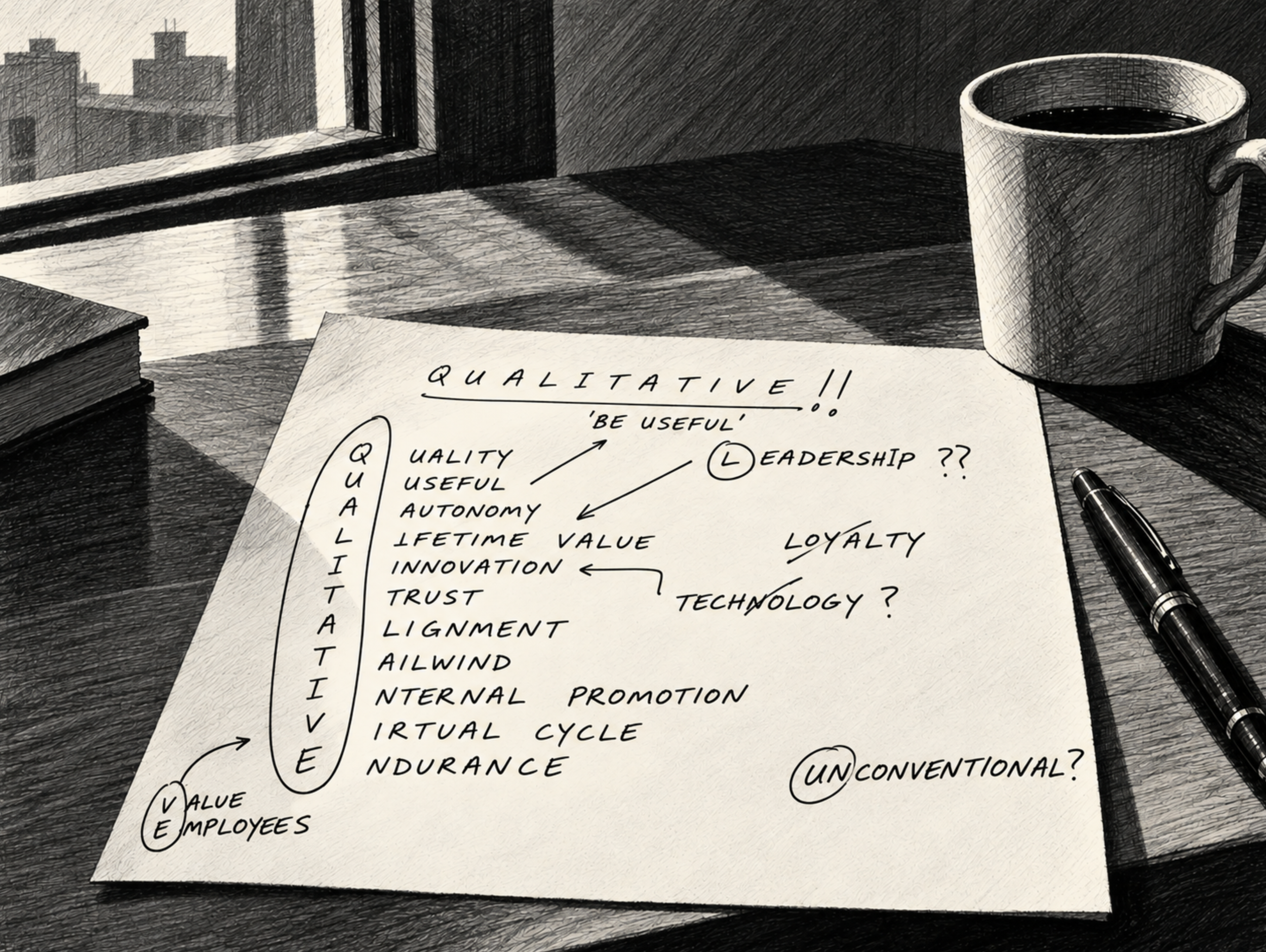
At university, I spent the week of study leave before exams cramming a semester into my head. To make it stick, I turned key concepts into odd words built from their first letters. In the first minutes of each exam, I’d scribble them onto the blank pages of the answer booklet before they vanished, then use them to rebuild everything I’d learned. It wasn’t sophisticated, but it worked, and the habit stuck. Years later, Robert Cialdini’s principles of influence, a guide to why people act the way they do, became CLASSROOM in my head. (Consistency, Liking, Authority, Social Proof, Scarcity and Reciprocation. The ‘Classroom’ represents Unity, the seventh principle Cialdini added later.)
Recently, I did it again, this time for the characteristics that set exceptional businesses apart. For as long as I’ve been investing, I’ve studied hundreds of businesses, from Costco, Cintas, Enterprise, Publix, Aldi, Patagonia, Simpson Manufacturing and National Cash Register to companies that faltered or failed altogether. The same traits kept appearing. Different industries, geographies, eras and personalities, yet strikingly similar philosophies. In the failures, those traits were often conspicuously missing. Few of them show up in a spreadsheet.
Financial statements tell us what has happened. They rarely reveal whether employees are proud of what they make, whether customers love the business, whether suppliers are treated as partners, or whether management will sacrifice this year's profits to protect its reputation a decade from now. Yet these are often the very things that determine the numbers of the future.
Two companies can report identical margins, one because of a beloved product and a loyal workforce, the other because it has squeezed suppliers and deferred essential spending. The numbers look the same; the businesses couldn't be more different.
As Buffett observed, “The really big money tends to be made by investors who are right on qualitative decisions.” Munger explained why: “You really have to understand the company and its competitive position, and the reasons why its competitive position is what it is, and that is often not disclosed by the math.” Pat Dorsey put it more bluntly: “Quantitative data is efficiently priced, qualitative insight is not.”
With a little creative licence, the traits I kept finding spelled a fitting word: QUALITATIVE.
Quality — an obsession with the product that is never compromised to hit a target.
Useful — creating real value that customers would genuinely miss.
Autonomy — pushing decisions to the people closest to the action.
Lifetime Customer Value — seeing customers as relationships, not transactions.
Innovation — continual reinvention, before it's forced.
Trust — earned with employees, customers and partners alike.
Alignment — win-win relationships with every stakeholder.
Tailwinds — competing in markets that can grow for decades.
Internal Promotion — growing leaders from within who already carry the culture.
Virtuous Circle — traits that reinforce one another.
Endurance — playing the long game.
Eleven letters. Eleven characteristics. A simple reminder of what often separates an ordinary business from an extraordinary compounding machine.
Quality
Quality is one of the most enduring sources of competitive advantage. Not high margins or returns on capital, though those often follow, but an obsession with the product itself, so embedded in the culture that standards are never compromised to save a few dollars or meet a quarterly target. Andrew Carnegie put it best: "The surest foundation of a manufacturing concern is quality. After that, and a long way after, comes cost."

The real test is what a business does when customers won't notice the difference. Steve Jobs described the craftsman who refuses to use cheap plywood on the back of a chest of drawers, even though nobody will see it. He will know it's there. Buffett regarded quality at See's Candies as "sacred," while Costco and Aldi prove that low prices and high quality aren't opposites: strip out unnecessary cost, never quality.

Cutting corners can flatter near-term earnings, but quietly erodes the trust that produces them. By the time the damage shows in the numbers, it's often too late. Businesses that hold the line earn what competitors struggle to copy: reputation, repeat business and pricing power. As Aldo Gucci observed, "Quality is remembered long after the low price is forgotten." The irony is that companies willing to put quality ahead of short-term profit often end up earning the greatest long-term profits.
Useful
One of the simplest questions to ask of any business is how useful it is. Does it save customers time, reduce their costs, remove headaches or help them succeed? Barclay Simpson, founder of Simpson Manufacturing, urged his people to ask, "How can you help make their jobs easier? How can you improve their lives?"

An equally revealing test is to imagine the business disappeared tomorrow. Would customers genuinely miss it? Would they struggle to replace it?
The best businesses don't merely satisfy customers; they create enormous value for them. Buffett described Nebraska Furniture Mart as "the ideal business – one built upon exceptional value to the customer that in turn translates into exceptional economics for its owners." Ron Blumkin put its purpose more simply: "We improve people's lifestyles." Frederick Reichheld observed that companies which leave plenty of surplus on the table for customers may sacrifice some current profit, but build trust and loyalty that insulates them from competitors.

Costco, Aldi and Amazon continually hand the gains from scale back to customers rather than capturing them all as margin. HEICO built its business making FAA-approved replacement aircraft parts at substantially lower prices than the original manufacturers, saving airlines hundreds of millions of dollars. The most enduring businesses focus less on extracting profit from each transaction and more on increasing the value they deliver.

Usefulness is also the most durable source of pricing power. When a business delivers far more value than it charges, it can raise prices and customers still come out ahead. The distinction matters. Pricing power earned through usefulness tends to endure; pricing power that simply extracts more from captive customers invites resentment, regulation and competition.
Autonomy
Autonomy is one of the most consistent themes I've found in exceptional businesses. At Berkshire Hathaway, Constellation Software, Fastenal, HEICO, Enterprise Rent-A-Car and IKEA, the philosophy is remarkably similar: push decisions down, give people responsibility and trust them to get on with the job. Those closest to the action usually know far more about customers and problems than anyone in head office.

As Captain David Marquet put it, "Don't move information to authority, move authority to the information." Genuine responsibility changes how people feel about their work. They begin to think and act like owners, with pride and initiative replacing compliance. Mark Leonard observed, "Autonomy and responsibility attract and motivate the best managers and employees."

Decentralisation allows large organisations to preserve the responsiveness of smaller ones. Constellation deliberately keeps its business units small, Fastenal's store managers operate like independent shopkeepers, and Ray Kroc wanted the man closest to McDonald's stores to decide without seeking directives from headquarters.

Buffett summed up Berkshire: "We centralize money and — everything else we decentralize, pretty much." Centralised control and layers of approval can slowly extinguish the very initiative that made a business successful.
Lifetime Customer Value
Great businesses understand the lifetime value of a customer. They see not a single transaction but a relationship that can last decades. As Enterprise Rent-A-Car founder Jack Taylor put it, "Repeat customers are the quickest way to build a solid business."

Fred Reichheld tells of a Domino's franchisee who calculated that a regular customer was worth more than $5,000 over ten years, and made sure every employee, from the phones to the delivery drivers, knew it. An unhappy customer was no longer a $20 pizza gone wrong, but thousands of dollars walking out the door.
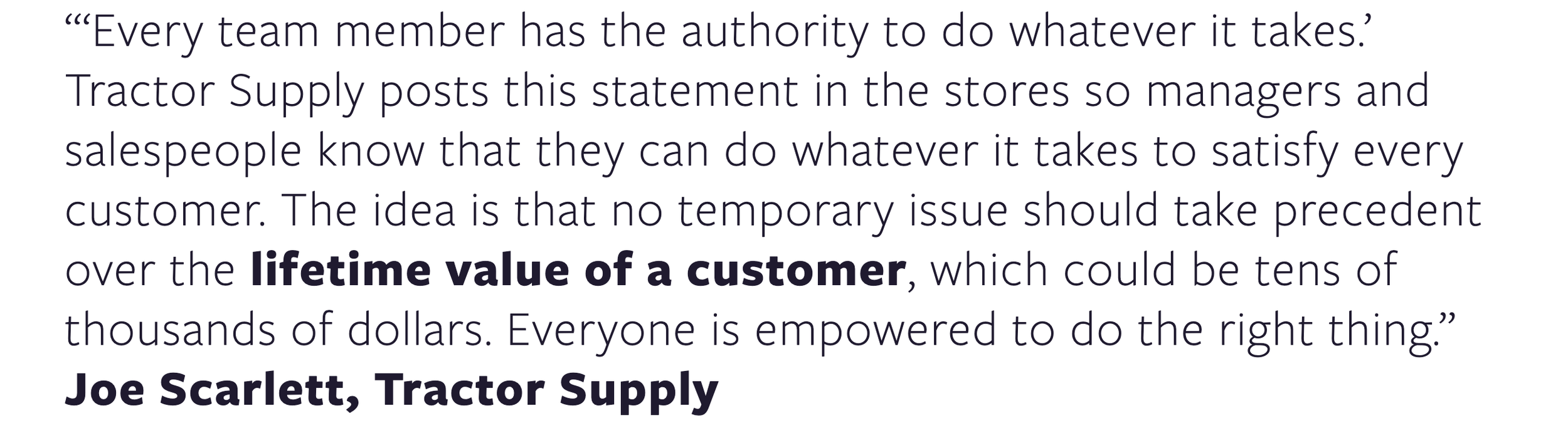
Loyalty is one of the most valuable, yet least visible, assets a business can own. Loyal customers return, recommend the business and rarely switch for a slightly lower price. Yvon Chouinard estimated a sale to a loyal Patagonia customer was worth six to eight times more to the bottom line than any other. Reichheld found, "In most of the industries we've studied, the companies with the highest customer retention rates also earn the best profits."
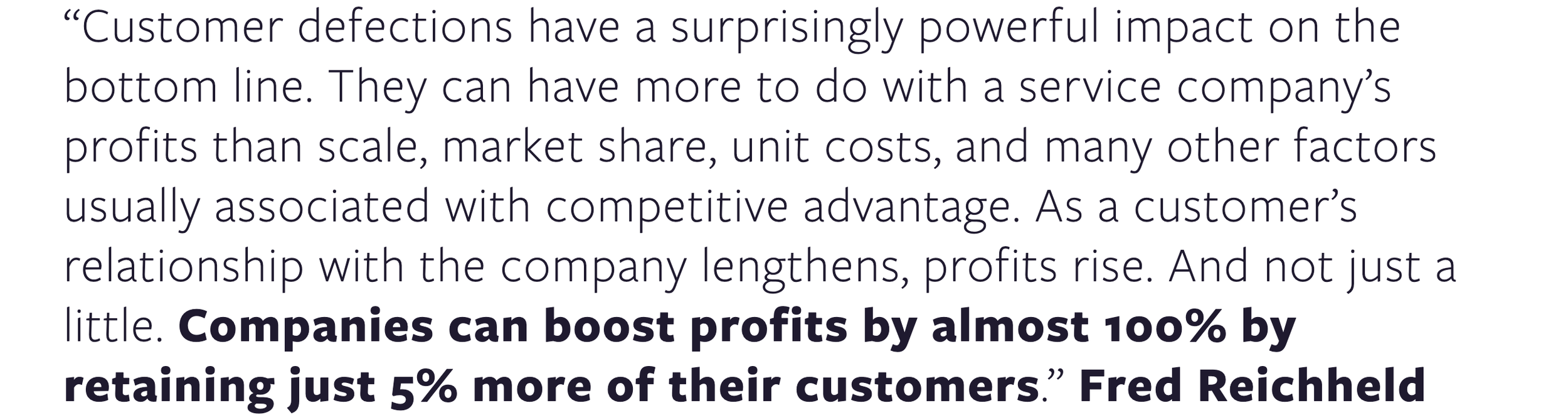
The question isn't how many customers a business attracts, but how many it keeps, and for how long. Terry Leahy, who made loyalty the centrepiece of Tesco's rise to Britain's largest retailer, judged every decision by a single question: "Will it make people more loyal to us or not?"
Innovation
Success is no guarantee of survival. Industries change, customers evolve and business models that once seemed unassailable become obsolete. The best businesses preserve their principles while continually adapting how they operate. At 3M, encouraging experimentation created businesses far removed from its original mining operations, and Amazon’s willingness to reinvest and enter new markets reflects a refusal to regard any business model as permanent.

The method is usually humble. Ideas come from anywhere: Sam Walton borrowed freely from competitors, and some of McDonald’s best-known products, including the Big Mac and the Egg McMuffin, came from franchisees rather than head office. New ideas are tested small, in a handful of stores or with a few customers, before they’re rolled out widely. And failure is tolerated, because a company that punishes every miss soon stops trying anything new. Fastenal moved beyond its branch model into onsite inventory management and vending, and Cintas expanded from uniform rental into additional services, using its relationships and distribution network to solve more customer problems.
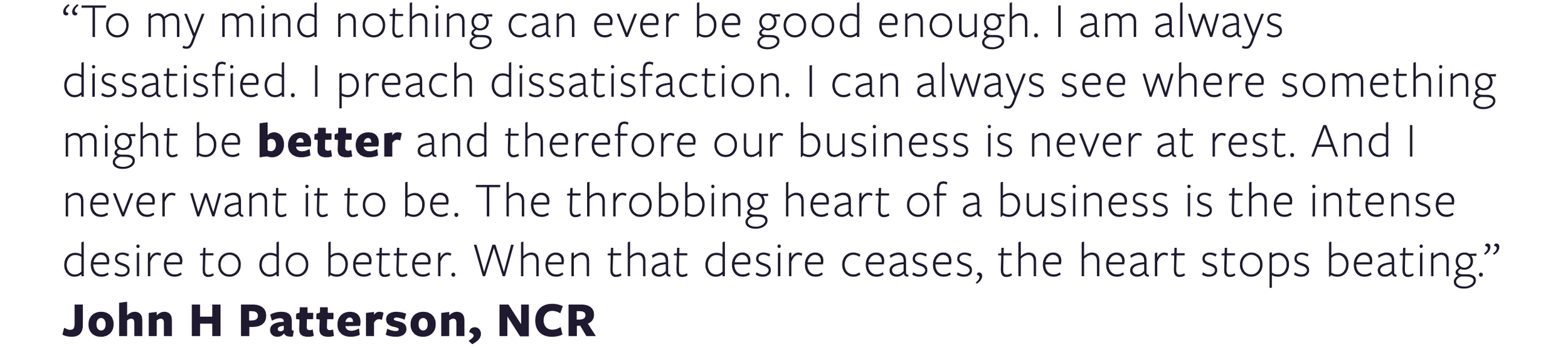
The danger is confusing consistency with rigidity. Principles may be timeless, but the practices that support them are not. Kodak helped pioneer digital photography yet failed to adapt its business model quickly enough, and Sears, which once transformed American retailing, eventually lost the ability to reinvent itself. Great companies know what should never change and what must continually evolve. They are willing to challenge their own success before somebody else does.
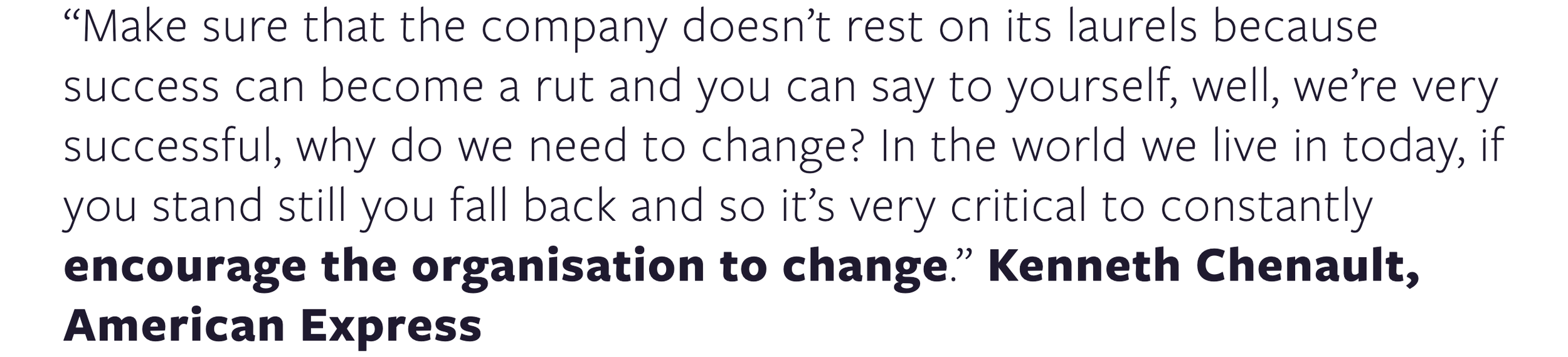
Trust
Trust is the invisible infrastructure of a great business. It reduces friction, eliminates unnecessary costs and allows people to act without endless supervision, contracts and approvals. At Berkshire Hathaway, Buffett gives managers extraordinary freedom because he trusts their judgement and character. At Nordstrom, the legendary employee handbook was distilled into a single instruction: use good judgement in all situations. The assumption was that capable, trusted people would usually do the right thing without being told.

Trust extends well beyond employees. Costco has built a reputation for treating customers fairly, while Enterprise understood that loyalty depended on delivering what had been promised, every time. At Cintas and Fastenal, long-standing customer relationships rest on reliability, responsiveness and consistently doing the right thing. A customer who trusts a company doesn't need to scrutinise every transaction, and a supplier who trusts its partner is more willing to invest in the relationship.

Trust takes years to build and moments to destroy. It accumulates through thousands of small decisions, particularly when doing the right thing is inconvenient or costly. Like a strong balance sheet, it provides resilience when conditions deteriorate. But unlike cash or inventory, it rarely appears in the accounts. Watch closely how management behaves when its interests conflict with those of customers, employees or suppliers. That's often when the true character of a business becomes visible.
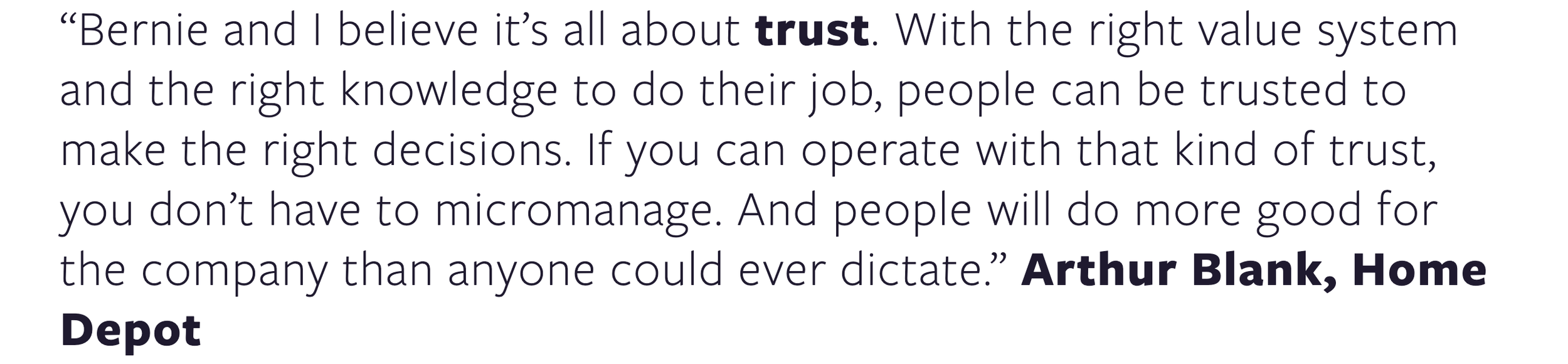
Alignment
The best businesses create win-win relationships with everyone they touch. Peter Kaufman argues for seeing through the eyes of six counterparties (customers, suppliers, employees, owners, regulators and communities) and structuring relationships so each benefits.

Yet he notes many businesses are proud of win-lose arrangements, boasting of how hard they squeeze suppliers. Stanley Marcus recalled that “equity” was his father’s favourite word at Neiman Marcus, practised with employees, customers and vendors alike. Munger, a long-time Costco director, put it simply: “Costco is into win-win. That’s what really works.”

Incentives are where alignment is tested. Munger famously observed, “Show me the incentive and I’ll show you the outcome,” and admitted that all his life he had underestimated their power. At Publix, Costco, Southwest Airlines, Fastenal and Enterprise Rent-A-Car, profit-sharing, equity ownership and performance pay have helped create cultures where employees act like owners. Herb Kelleher told of Southwest employees treating even the staplers as their own. As Jack Stack put it, “A company of owners will outperform a company of employees any day of the week.”

The temptation to maximise one party’s share of the pie is understandable. But squeezing a supplier today can mean losing a valuable partner tomorrow, and underpaying employees may lift this year’s margins while increasing turnover, eroding service and driving away customers. Poorly designed incentives do similar damage: pay salespeople purely on commission and they put transactions ahead of relationships, or reward executives for short-term earnings and they sacrifice investment and quality. Look beyond how much people are paid to what they’re paid for. The best businesses don’t merely divide the pie; they find ways to make it bigger.
Tailwinds
Warren Buffett once observed, "One of the lessons your management has learned — and, unfortunately, sometimes re-learned — is the importance of being in businesses where tailwinds prevail rather than headwinds." Peter Keefe noted, "Every mega compounder we've owned had a long secular tailwind behind it," and Dan Davidowitz found his biggest winners had decades-long market opportunities ahead of them. Even the best managers struggle against a shrinking market.

The automobile, suburbs and interstate highways created enormous opportunities for McDonald's. Tailwinds can come from regulation too: Barclay Simpson rode post-war construction and stricter building codes to make Simpson Strong-Tie the industry standard, and Alan McKim of Clean Harbors recalled tougher environmental rules in the late 1980s creating "a gold rush of sorts."
Others come from where people move. Florida's population grew from 1.9 million to 9 million between 1940 and 1979 as Publix expanded across the state, A.P. Giannini built Bank of America as California grew more than sevenfold in the first half of the century, and Discount Tire rode the shift to the Sunbelt, where new residents had no loyalty to established retailers. In South Korea, Hyundai's Chung Ju-yung observed, "Since Hyundai's founding, the company and the country grew in tandem."

A tailwind gives a successful business room to keep growing and reinvesting profits without having to take share from competitors. It is no guarantee of success, but without one, even the most capable management team may spend its energy fighting for scraps in a shrinking pie. Great management matters, but choosing the right industry makes its job considerably easier.
Internal Promotion
The pattern is hard to miss. Danaher, Macquarie Bank, O’Reilly, ABC Supply, Publix, Wegmans, Texas Roadhouse, USAA and Würth all grow their own leaders. More than 95 percent of Fastenal’s branch general managers were promoted from within, and in its first 34 years Les Schwab never hired a manager from outside: every one started out changing tyres. Jim Collins found that ten of eleven good-to-great CEOs came from inside the company. Mark Leonard explained Constellation’s preference simply: “Mutual trust and loyalty take years to build, and conversely, newly hired smart and/or manipulative mercenaries can take years to identify and root out.”

When Monty Moran became co-CEO of Chipotle, the data settled the question for him. Managers who had come up from crew positions ran much better restaurants and were four times less likely to quit than those hired from outside. Within two years, he lifted internal promotion from about 30 percent to 100 percent. The benefits compound. Ambitious people join because they can see a path upward. Existing staff stay motivated, managers know every job beneath them, and they hire more carefully because they’re choosing a future general manager rather than filling a role. The reverse is just as powerful. As Mary Kay Ash warned, when a company too often looks outside, people conclude that no matter how well they perform, an outsider will get the job they want.

For investors, the habit is a useful signal. Culture is carried by people, and an outsider at the top often brings a different one. A steady stream of external executives, especially in the CEO’s chair, deserves a closer look. There are exceptions. Phil Fisher accepted that rapid growth or specialist skills sometimes justify outside hires, but he was clear on the rule: “In general, however, the company with real investment merit is the company that usually promotes from within.”
Virtuous Circle
Perhaps the most important insight is that these characteristics rarely operate in isolation. Like strands in a rope, each is modest on its own; woven together, they become remarkably strong. At Costco, well-paid, fairly treated employees stay longer. Experienced staff deliver better service and run more efficient operations, which support lower prices. Lower prices attract more customers and greater volumes, improving buying power and operating leverage. Those gains are passed back to members, strengthening loyalty and driving the cycle again.

Jack Taylor built a similar system at Enterprise. Give managers responsibility and incentives, focus relentlessly on customer satisfaction, and satisfied customers return and recommend the business. Growth creates opportunities for employees to advance, and their commitment sustains the service that keeps customers loyal. Amazon's flywheel works the same way: better customer experiences attract more traffic, more traffic attracts sellers and selection, and greater scale lowers costs and prices, attracting still more customers.
This is why great businesses are so difficult to compete against. Their advantage isn't a single product, patent or strategy that can be copied, but a system of mutually reinforcing behaviours built over decades. A rival may match Costco's prices, Fastenal's service model or Enterprise's satisfaction measures. Replicating the culture, incentives, relationships and economics that make the whole system work is considerably harder.

The reverse is equally powerful. Cut employee benefits and service may deteriorate. Squeeze suppliers and quality can suffer. Sacrifice product standards and customers lose trust. A small decision to improve margins can set off consequences that weaken the entire business. Pull one strand loose and the whole rope begins to fray. Good businesses build virtuous circles. Poorly managed ones create vicious ones.
Endurance
The final characteristic is a willingness to play the long game. Great businesses make decisions with years and decades in mind, not the next quarter. They invest through downturns, preserve relationships when doing so is costly and resist the temptation to maximise short-term profits at the expense of future opportunities.

At Berkshire Hathaway, Buffett has long emphasised financial strength and allowing exceptional managers to build businesses over decades. At Costco, Jim Sinegal resisted pressure to maximise margins and focused instead on delivering value to members. George Jenkins built Publix around employee ownership and customer service designed to endure beyond any single generation of management.

Privately owned businesses such as Enterprise and In-N-Out Burger have used patient ownership to favour customer experience, employee development and measured growth over short-term targets. At IKEA, Ingvar Kamprad's emphasis on thrift, affordability and independence established a culture intended to outlast its founder.

Long-term thinking is easy to profess and much harder to practise. It may mean turning away a profitable customer, declining an acquisition, forgoing a price increase or investing in something whose payoff won't arrive for years. Those choices may make this year's earnings look worse while leaving the business considerably stronger. The real question is whether management is prepared to make them.
Add an Extra L, If You Like
There's one notable omission from the list. I spent some time wondering whether leadership deserved its own letter. QUALLITATIVE doesn't spell anything, but I'd forgive anyone who wrote it that way.

In the end, I left it out because it's already everywhere. Look closely and much of the list describes great leadership in practice. Great leaders create alignment and earn trust. They push decisions down and give people autonomy. They keep the business focused on the customer, and resist the pull of the next quarter for the sake of the next decade.

It's no coincidence that so many of the businesses I've studied were shaped by founders, or by leaders who think like them: fanatical about the details, with meaningful skin in the game, and casting a long shadow over the culture they built. Tone is set at the top. Employees watch whether a leader's behaviour matches their words, and integrity, or its absence, cascades through every layer of an organisation. Leadership isn't a separate box to tick; it's the thread running through all eleven. When these characteristics are present, it's usually because someone at the top put them there, and has protected them ever since.
Bringing It Together
What strikes me after studying so many businesses is how often the same ideas reappear. The industries change, the products differ and the founders come from different generations and countries. Yet the philosophies barely change. Look after customers. Treat employees well. Share the rewards. Push decisions down. Never compromise quality. Keep innovating. Think long term. Over decades, small differences in behaviour can produce enormous differences in outcomes.
The financial statements are the result. The culture, relationships and decisions behind them are often the cause.
At university, those strange acronyms helped me remember the answers. Decades later, QUALITATIVE serves a slightly different purpose.
It helps me remember the questions worth asking.
* Visit the Blog Archive *
Learn more with us on Twitter: @mastersinvest
TERMS OF USE: DISCLAIMER