
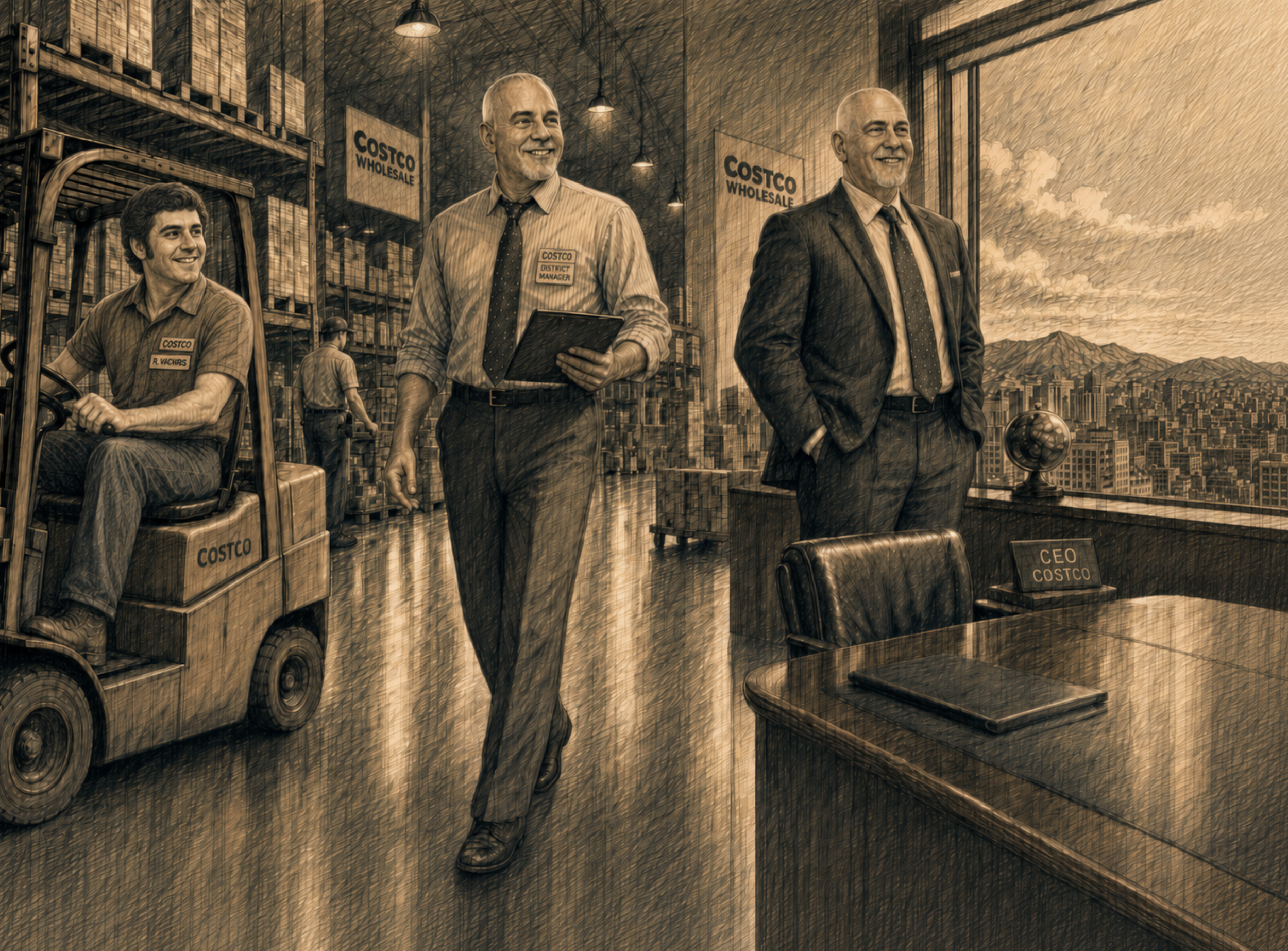
Ron Vachris started at Costco forty years ago as a forklift driver. He unloaded pallets, worked the floor, learned the business one job at a time — merchandising, operations, real estate — for four decades, before eventually becoming the company's CEO. There was no shortcut through the middle. He walked the whole path.
It's tempting to read that as a nice story about one particular warehouse, one particular career. It isn't. Pull on that thread and you find the same walk — floor to office to boardroom — repeating itself in company after company, industry after industry, country after country, decade after decade. Not as an inspirational exception. As a well-worn path that the world's best-run businesses seem to build on purpose.
Not One Factory. A Pattern.
Collect enough examples and a remarkable pattern emerges. The companies are different, the industries unrelated, the decades far apart—but the same leadership path keeps appearing. It shows up in American retail (Costco, Publix, Wegmans), in industrial manufacturing (Illinois Tool Works, Sherwin-Williams, Simpson Manufacturing, US Steel under Elbert Gary), in logistics spanning three continents (FedEx and UPS in the US, DHL International out of Hong Kong, Mainfreight out of New Zealand), in Scandinavian and German manufacturing (IKEA, Hästens, and Würth), in Australian finance (Macquarie Bank), and in businesses a century apart in age — from Henry Ford's early auto plants and Endicott Johnson's shoe factories in the 1910s, to modern compounders like Constellation Software, Danaher, and O’Reilly Automotive today.
USAA, Lincoln Electric, Kiewit, Fastenal, Enterprise Rent-A-Car, Discount Tire, Les Schwab, Bloomberg, Wawa, QuikTrip, Mars, Patagonia, Tractor Supply, Old Dominion, Marriott, Four Seasons, Stew Leonard's, Procter & Gamble, Panda Express, In-N-Out, ALDI, Texas Roadhouse, Svenska Handelsbanken, A.J. Gallagher, Greggs, ABC Supply, Toyota, Jack Henry & Associates — and, as I found sitting down with its leadership recently, Cintas.
Even Berkshire Hathaway fits the pattern. Robert Miles, in The Warren Buffett CEOs, found that all but one of Berkshire's subsidiary CEOs had been promoted from inside the business.
That's not a random assortment of "nice culture" companies loosely sharing a value statement. It's a genuine cross-section of some of the best long-term compounders in business history, and the thing they keep independently arriving at is this: the walk from the floor to the top isn't incidental to how they got great. It may be the mechanism itself.
Why it Works
1. It preserves what actually makes the company good.
Phil Fisher made this case as far back as 1958, in Common Stocks and Uncommon Profits, writing that "the company with real investment merit is the company that usually promotes from within." He returned to the idea nearly two decades later in Conservative Investors Sleep Well (1975): companies of the highest investment order develop policies and ways of doing things peculiar to their own needs, and if those ways are truly worthwhile, it is "always difficult and frequently impossible" to retrain someone long accustomed to doing things differently. The higher up the newcomer sits, he noted, the more costly that indoctrination becomes — which is why, in his observation, "a surprising number of executives brought in close to the top tend to disappear after a few years." He went further: bringing in outsiders near the top is frequently a "damning sign" that something is already broken, no matter how clean the recent earnings look.
Jim Collins found the same pattern empirically in Built to Last and Good to Great: across seventeen hundred combined years of company history in his visionary companies, he found only a handful of instances of hiring a CEO from outside. Comparison companies went external roughly six times more often — and underperformed accordingly.
2. It's the ultimate incentive system.
Nearly every operator quoted here says some version of the same thing: people stay, work harder, and take more ownership when they can see a real path to who they could become. It's one thing to be told the company values you. It's another to watch the person running the warehouse today, knowing they once pushed the same cart you're pushing now — that's proof, not a promise. Chester Cadieux of QuikTrip framed it sharply — you can train competence, but you can't train commitment, which is exactly why promotion from within matters more than raw skill.
Discount Tire is now one of America's largest independent tire retailers, with well over a thousand stores, and it built that scale on a single unbroken rule: nobody, at any level, gets the keys to a store without starting out busting tires. Founder Bruce Halle held himself to the same standard. "If I were to bring someone in at a high level without having worked in the stores," he said, "I may as well get in my car, drive around to the stores, and slap every one of the guys in the face."
Les Schwab Tire ran the same experiment for thirty-four straight years and never once broke the rule: not a single manager or assistant manager was hired from outside. Every one of its 250-plus managers earned the job the same way — starting at the bottom, changing tires.
Fastenal put it plainly in a 2022 company statement: "More than 95 percent of our current branch General Managers have been promoted from within, and that trend continues all the way to the top. In fact, nearly all of our senior leaders worked their way up from entry-level positions." Founder Robert Kierlin has said it's the thing he's proudest of building at the company — the opportunity it gives ordinary people to excel, most of them starting with little expertise in the product line before working their way up.
3. It compounds knowledge and culture
Every new outside hire at a senior level is, in effect, a double write-off — years of institutional knowledge walking out the door, replaced by someone who has to relearn not just the business but the culture, often imperfectly. O'Reilly Automotive is perhaps the starkest example of this (more on that below). Jim Sinegal made the same point about Costco: every warehouse manager running the company's stores had spent ten, twelve, fifteen years inside the business before getting there. The pattern held all the way to the top — Craig Jelinek started as a Costco warehouse manager in 1984 and rose through operations for two decades before becoming CEO, and his successor, Ron Vachris, began as a forklift driver forty years before taking the job, working through nearly every operating role in between. It's the same logic as compounding capital, just applied to people instead of dollars.
Patagonia founder Yvon Chouinard captured the logic in a single sentence: "As much as possible we hire from within, to keep the company culture strong." The point isn't simply to retain talented employees; it's to preserve the habits, judgement and standards that have compounded inside the business for decades.
4. It develops better operators.
Danaher's internal data (via an HBR case study) found roughly three of every four senior promotions were filled internally, with about a fifth of senior managers promoted every year — a deliberate, almost mechanical pipeline rather than a policy applied occasionally. Vicki Tenhaken's research into "Century Club" companies — firms that have survived over a hundred years — found the same thing: leadership development from within wasn't incidental to their longevity, it was one of the core mechanisms behind it.
Henry Ford described his own leadership team in the same spirit, and it reads almost like a roll call from the factory floor: the head of the whole operation started as a machinist, the man running the giant River Rouge plant began as a patternmaker, another senior department head started as a sweeper. "There is not a single man anywhere in the factory who did not simply come in off the street," Ford said. National Cash Register's early history offers the cautionary flip side — founder John Patterson tried repeatedly to hire star talent from outside, and by the company's own account, every one of those hires failed. The people who actually built the business were the ones who came up through the ranks.
Tom Peters found essentially the same pattern decades later studying America's top-performing companies for In Search of Excellence: "value-infused top-performing companies are led by those who grew up with the core of the business — electrical engineering at HP or Maytag, mechanical engineering at Fluor or Bechtel. The star performers are seldom led by accountants or lawyers."
George F. Johnson, of Endicott Johnson, framed the logic almost as a matter of dignity: "Why should I hire a manager of a plant who is a stranger to the workers — a man who comes from outside to take a job at the top and talk down to them from a height?" It's worth noting what that philosophy actually built: under Johnson, Endicott-Johnson grew into the largest shoe manufacturer in the world during the 1910s and into the early twentieth century, run top to bottom by people who'd worked the bench and the vats themselves.
Po Chung, who built DHL International, made essentially the same point with a sharper edge — the operational staff were always hired from within, he said, because "have you ever heard of an army anywhere on the planet that hired a general from another country?" David Ogilvy went further still, framing outside hiring almost as a failure of leadership: "We detest having to go outside to fill important jobs, and I look forward to the day when that will never be necessary."
5. It puts leaders in the shoes they used to fill.
A manager who has never done the job is guessing at what it feels like. A manager who has done the job knows. Lynsi Snyder at In-N-Out makes this the center of the company's operating philosophy: "every operations leader has done the exact jobs as the associates they're leading. They understand each one of those tasks, hands on, all the way up the line. They earned their way into their roles." It changes what gets asked of frontline employees, what gets forgiven, and what gets fixed — because the person making those calls has personally stood where the complaint is coming from.
6. It treats building people as the job itself.
Everything above describes what promotion from within produces — the incentive, the compounding knowledge, the empathy. But talk to the leaders who actually run these companies, and a different explanation surfaces: they don't describe developing people as a means to an end. They describe it as the actual job.
Les Schwab put this in capital letters in his own writing, as if the emphasis mattered. Asked what his company should do to keep succeeding, "the answer is, as it has always been … BUILD PEOPLE." Andy Taylor at Enterprise Rent-A-Car drew the distinction against competitors explicitly: "their business is cars and ours is people. They focus on building their fleet of cars; we focus on building our employees' careers." Howard Stoeckel said something similar about Wawa — the products and service matter, but "even more, it's about building people with the ability and drive to make their dreams come true."
Lynsi Snyder frames it as a genuinely long-run bet at In-N-Out: "We want to build success into every person who works for our company … We want them to learn how to make good or even extraordinary decisions right from the start, then stay with our company for the long-term."
The Cintas Case in Miniature
I got to see a live version of this recently, sitting down with Cintas CEO Todd Schneider and COO Jim Rozarkis. Cintas turned a uniform-and-workplace-supply business into a roughly 750-bagger, and it's tempting to hunt for some hidden breakthrough behind a number like that. There isn't one.
Both Schneider and Rozarkis started at the bottom of the business and worked their way through every layer of it. It shows. When I asked what new hires notice first, the answer was blunt: "You people are crazy." Cintas is intensely competitive, and everything gets measured, which shakes plenty of people out early. That's why it recruits straight out of college and builds leaders internally—shaping them before anywhere else gets the chance. The people who thrive in that environment tend to stay, rise through the ranks, and eventually lead the company.
O'Reilly: The Case for the Whole Thesis
If any company treats promotion from within as the entire explanation for its success rather than one factor among several, it's O'Reilly Automotive. CEO Brad Beckham doesn't hedge on this: "At the heart of our culture is promote from within." He didn't go to college. He grew up in the company's stores, ran districts and regions, and now runs the whole thing — and he's explicit that this wasn't an unusual path at O'Reilly, it was the standard one. "I immediately knew that I had a career path with our 'promote from within' philosophy," he's said of his own early days there.
The scale of it is what makes O'Reilly's case so striking. Beckham points to Doug Bragg, the company's EVP of stores and professional sales, who's on his thirty-first year at O'Reilly — starting out loading trucks in a distribution center before working through stores, districts, and regions. Beckham's three regional SVPs of store operations average, by his count, roughly twenty-two years each, either at O'Reilly directly or at a company O'Reilly acquired. He connects that tenure directly to how well the company understands its own customers: "that's incredibly important to us when it comes to really understanding what our installers, what our professional shops are going through every day." And it isn't just the top of the org chart: O'Reilly runs thirteen divisions across the US, and every single divisional vice president ran an O'Reilly store first, then a district, then a region, before taking responsibility for groups of five hundred to seven hundred stores.
The company's own filings back up the anecdotes. As of December 31, 2025, O'Reilly's 264 senior managers averaged 20 years of service, its 377 corporate managers averaged 13 years, and its 649 district managers averaged 14 years — a leadership bench built almost entirely through internal tenure rather than external hiring. It's a case that goes further than most of the companies here: O'Reilly doesn't present promotion from within as one input into its culture. It presents it as the culture, full stop.
A Few More Scenes From the Shop Floor
The pattern shows up in some genuinely vivid places if you go looking. At Wegmans, half of all store managers started working for the company as teenagers — meaning a meaningful share of the leadership team spent their formative working years, not just their careers, inside the same stores they now run. Barclay Simpson at Simpson Manufacturing put the whole philosophy in a single line that's hard to forget: "when people join our company, they don't come for a bus stop; this is a career."
And that brings the story back to where it started. Endicott Johnson's own company history, describing the same walk from the floor to the boardroom that built the world's largest shoe manufacturer, likened the effect to an old line about Napoleon's soldiers — each one supposedly marching with a field marshal's baton tucked in his knapsack. The point was never that every soldier would use it. It was that every soldier knew there was a real pathway to the top, and that knowledge alone was enough to change his effort, his discipline, his sense of what he was fighting for.
When Going Outside Makes Sense
This isn't a blanket rule, and the best practitioners are explicit about the exceptions. Phil Fisher himself noted that a company growing very fast, or one that needs a genuinely rare specialized skill — a particular legal specialty, a scientific discipline far outside the core business — may have no choice but to hire outside, and that doing so occasionally can even inject useful fresh thinking. Isadore Sharp at Four Seasons put it simply: promotion comes from within, "except when we need talent we don't yet have."
The companies on this list mostly reserve external hiring for specialist roles — legal, some technical functions, occasionally finance — while treating the operating core, and especially the CEO seat, as something earned from the inside. Macquarie Bank hasn't hired a CEO from outside its own ranks in over fifty years. O'Reilly hasn't hired outside the company for field leadership in decades. It's policy, defended deliberately, year after year — not an accident of history.
The Investor's Takeaway
None of this shows up cleanly in a discounted cash flow model. But it shows up everywhere else: in employee tenure numbers, in the near-total absence of the “new CEO reset” that so often destroys value, in the depth of a leadership bench that can survive a downturn without a costly external search, and in a workforce that believes — correctly — that the person running the warehouse today could be running the division in fifteen years.
It’s a quiet variable. It’s also, across a remarkable number of the best long-term compounders, a remarkably consistent one. The path from the forklift to the boardroom does more than reward loyalty. In many of the world's best businesses, it's how knowledge, trust and culture compound — and how the company ensures that the person making decisions at the top still remembers what the work felt like at the bottom.
The best companies do not merely build products, stores or factories. They build people capable of carrying the business forward.
* Visit the Blog Archive *
Learn more with us on Twitter: @mastersinvest
TERMS OF USE: DISCLAIMER