Lollapalooza Time

lollapalooz.JPG

We’re all looking for great businesses to invest in. Those companies that seem to defy the natural order; that succeed in industries or sectors where others quite simply, don’t. They each have a difference, an advantage over their competitors which is quite often something so simple that it leaves others wondering why they hadn’t thought of it themselves.

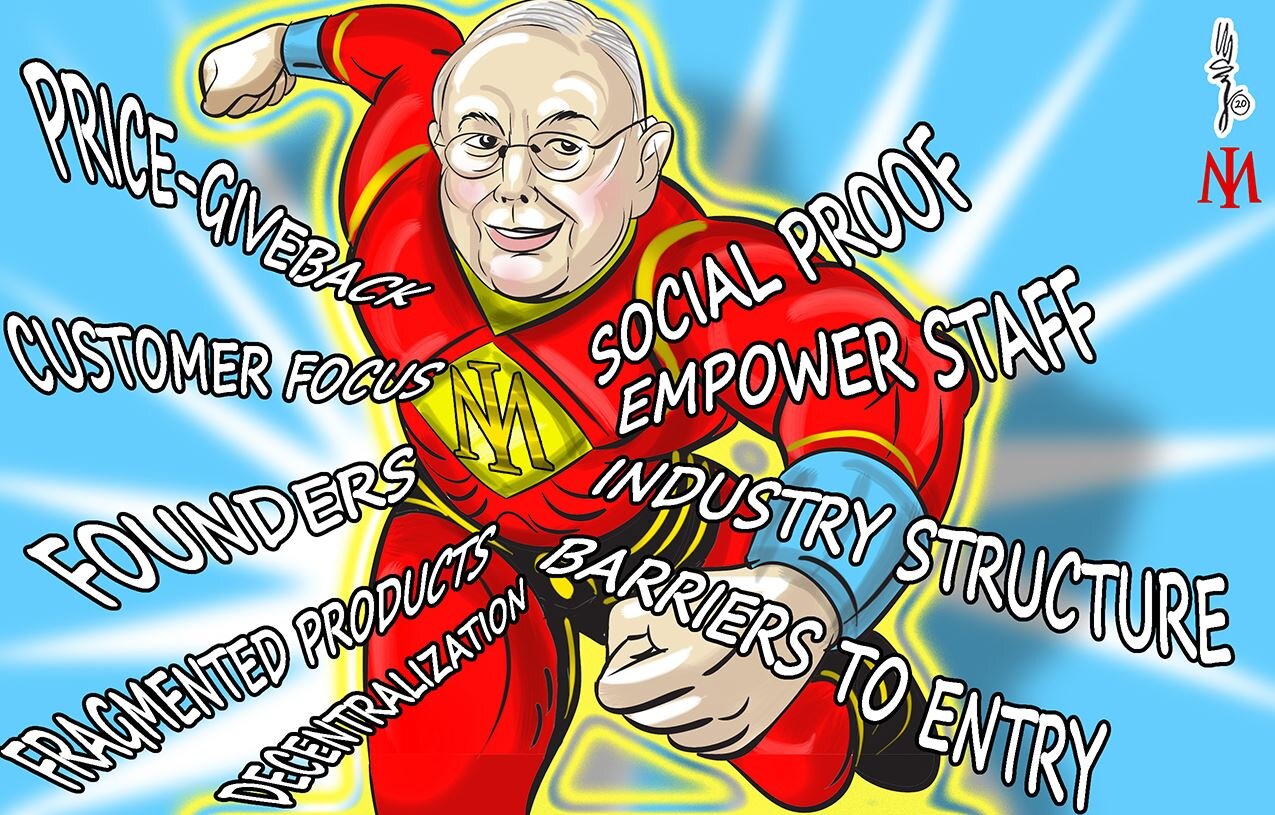
It doesn’t sound like rocket science, and often it’s not; it could be a combination of lots of little things producing results that defy the incremental benefits. Often the results are non-linear; one plus one equals more than two. It’s something Charlie Munger refers to as Lollapalooza effects.

Really big effects, lollapalooza effects, will often come only from large combinations of factors. Charlie Munger

A few years ago I met with the CFO of a highly successful national furniture chain. This family business had achieved financial metrics that defied its industry; returns on equity consistently above 50%, gross margins above 60% and payback on new stores of under six months. Quizzing the CFO I asked, “Should the economy turn down, you could always cut margins a little?” To which he replied, “No, you don’t understand how the business works.” Expanding a little further, “The CEO starts with the 60%+ margins and works backwards. That’s the goal. A two hundred dollar chair is a two hundred dollar chair. Price it at two-hundred and fifty dollars and you won’t sell any. The CEO does the buying (how many other furniture store CEO’s do?) The CEO works with the suppliers to deliver that chair at a price that allows a 60%+ margin. It might mean removing the number of buttons, changing the fabric or redesigning the chair a little to get that outcome. It’s not about dropping price.” Wow, I thought to myself, that’s the silver bullet. That’s what makes this business so successful. A few months later I had the opportunity to ask the CEO directly, “What’s the key to success? Is it in the sourcing of product?,” I asked. Expecting confirmation of the silver bullet I’d uncovered, he replied, “yes that’s one thing, but really it’s the fact we do lots of little things a little better.”

This combination of factors often creates an impenetrable barrier for competitors. Polen Capital’s Jeff Mueller touched on this in a recent Columbia Business School podcast:

“There’s this song by Blink 182 called ‘All the Small Things’. For some reason when I think about competitive advantages it pops into my head. The best compounders I’ve studied and the best ones we’ve invested in don’t just have one competitive advantage where you point to it and say ‘yep, that’s it’. They usually have built this mosaic pulling from almost all the competitive advantages; they have networks, and a great culture, and a safe or aspirational brand and also economies of scale. When you get a lot of these working in the same direction it makes the companies almost impossible to really compete with out in the market place.” Jeff Mueller

Such firms are often more predictable businesses than firms which rely on a single competitive advantage (e.g. a patent).

"There is no a priori reason why a comparative advantage should be one big thing, any more than many smaller things. Indeed an interlocking, self-reinforcing network of small actions may be more successful than one big thing… Firms that have a process to do many things a little better than their rivals may be less risky than firms that do one thing right [e.g. develop/own a patent] because their future success is more predictable. They are simply harder to beat. And if they’re harder to beat then they may be very valuable businesses indeed." Nick Sleep
Screen Shot 2020-05-18 at 6.03.01 pm.jpeg

In the book, ‘In Search of Excellence - Lessons from America’s Best Run Companies’, McKinsey alumni Thomas Peters & Robert Waterman identified a number of ‘strikingly similar themes’ that characterised the excellent companies they’d researched. It was a combination of these that accounted for the outperformance:

“The most important notion, as we’ve said time and again, is that there aren’t any one or two things that make it all work. [It can be] a dozen factors. And it’s all of them functioning in concert.”

Despite almost four decades passing since the book’s publication, the themes are as relevant today as they were then. Little wonder the book has been accredited by Warren Buffett as, “A landmark book, without question the most important and useful book on what makes organisations effective, ever written.”

I was reminded of this concept recently when reading a Forbes article about an aircraft parts manufacturer called Heico. The title certainly grabbed my attention, ‘The 47,500% Return: Meet The Billionaire Family Behind The Hottest Stock Of The Past 30 Years”. I couldn’t help but notice many of the factors that had surfaced in Thomas Peters and Robert Waterman’s research.

I’ve extracted a selection of the more interesting comments from the Heico article complemented by a few other sources, and where relevant, provided extracts from ‘In Search of Excellence' [ISOE].

Family Business:

HEICO: “I mean, it’s hard to envision family businesses that have been this successful for this long.”

ISOE: “Many of the best companies really do view themselves as an extended family.”

Culture:

HEICO: “Our culture is what ultimately drives the bottom line.”

ISOE: “The excellent companies are marked by very strong cultures.”

ISOE: “Without exception, the dominance and coherence of culture proved to be an essential quality of the excellent companies.”

Focus on the Customer:

HEICO: “We believe that the customer is the most important person in our overall organization. So we are here to serve the customer. And we pride ourselves on making good profits but not gouging the customer in terms of pricing.”

HEICO: “Our customers are our highest priority. After all, without customers, we have no business.”

ISOE: “Whether bending tin, frying hamburgers, or providing rooms for rent, virtually all of the excellent companies had, it seemed, defined themselves as de facto services businesses. Customers reign supreme.”

Close to The Customer:

HEICO: “Typically, our new products are designed in response to direct customer specifications or requests, not as general concepts offered for sale which we hope will later be purchased. This allows us to have a laser-sharp focus on our exact customer requirements.”

HEICO: “Our approach has been, and will continue to be, to learn from our customers what they need, not to develop products and then try to convince our customers to buy the products.”

ISOE - “The excellent companies are better listeners. They get a benefit from market closeness. Most of the real innovation comes from the market. The best companies are pushed around by their customers and they love it.”

ISOE: “The excellent companies pay close attention to what customers want. From listening. From inviting the customer into the company. The customer is truly in a partnership with the effective companies and vice versa. Successful firms understand user needs better. Successful innovations have fewer problems.”

Cheap Prices:

HEICO: “They have done so by acquiring 78 companies over the years and by pricing their parts cheaply.”

Diversified Products / Customers:

HEICO: “Heico produced nearly 100,000 parts, sold to nearly every major airline in the world, as well as defence customers like the U.S. government.”

Wrong Incentives:

HEICO: “The board [of the original Heico company] owned nothing—owned no shares,” recalls Larry. “They weren’t motivated.”

Barriers To Entry:

HEICO: “They found [the after-parts market] to be particularly alluring. Everything needed Federal Aviation Administration approval, which ensured that not every Tom, Dick and Larry could easily enter the industry.”

But Not Too Many Barriers:

HEICO: “Replacement parts weren’t generally patent-protected, so all the Mendelsons had to do was reverse engineer them, then prove to the FAA that they were up to snuff.”

ISOE: “The so-called high tech companies are not, first and foremost, the leaders in technology. They are in high tech businesses, but their main attribute is reliable, high value-added products and services for their customers.”

Win-Win:

HEICO: “Among our greatest strengths over the past five decades is our emphasis on building relationships — relationships with team members, customers, suppliers, shareholders and other stakeholders.

ISOE: “We have a host of big American companies that are doing it right from the standpoint of all their constituents - customers, employees, shareholders, and the public at large. They’ve been doing it right for years.”

Product Quality Critical:

HEICO: “We do a full metallurgical inspection on every single lot of parts we produce. That includes material hardness, grain size, grain-flow structure, coatings. . . . The reason we do it is because we can’t afford to have a failure.”

ISOE: “Raychem sells complicated ‘smart’ electrical connectors… They sell their connectors on the basis of high economic value of the product to the customer… The connectors are a microscopic fraction of the value of the eventual product - for example, large aircraft; therefore , the customer can, in fact, afford to pay a bundle.”

ISOE: “Quality Obsession. Many of our excellent companies are obsessed by service. At least as many act the same way over quality and reliability.”

Social Proof:

HEICO: “Lufthansa’s investment in Heico—a tacit stamp of approval.”

Investment in Price-Giveback / ‘Jam Tomorrow’:

HEICO: “As their business gained altitude, Larry insisted they live by a blunt rule: “We don’t try to screw the customer.Heico keeps its prices locked between a third to a half off what an original manufacturer would charge. Heico’s net margin hovers around 15%. It could be more than that if the Mendelsons pushed harder (and some defence products are more profitable). “They’ve historically been reluctant to print a margin over 20%,” says Hebert, the Canaccord Genuity analyst. “They never want to be perceived as gouging or excessively profiting from their airlines.”

HEICO: “Heico’s low-cost, high reliability solutions save each of our airline partners an average of $25m annually.”

Acquire Cost Conscious Founder Businesses:

HEICO: “The Mendelsons are shrewd buyers themselves, having in 2019 completed seven more acquisitions. They shop for owners or top executives who resemble them. “The companies we buy are very entrepreneurial—entrepreneurs that started years ago, started businesses in their garages,” says Larry. “They started with nothing,” which, he says, means “they watch every nickel.”

ISOE: “A few companies have thrived on growth via acquisition, but via a ‘small is beautiful’ strategy. They don’t believe, apparently, in the oft-cited wisdom that ‘A $500 million acquisition is no tougher to assimilate than a $50 million one, so make one deal instead of ten.”

Proper Incentives / Alignment:

HEICO: “The Mendelsons don’t usually buy an entire firm. More often than not, they leave a fifth of it in the hands of the owners or the chief executives running the place to keep them incentivized.”

Incumbents Won’t Compete:

HEICO: “The Mendelsons have been able to earn a foothold in an industry dominated by the so-called original equipment manufacturers, the GEs and Boeings of the world, who are the first to develop the parts and keep prices high on any replacements to help recoup the original R&D costs.”

Innovate:

HEICO: “One of our key tenets is that we must constantly develop, produce and sell new products to add to our existing product lines. Simply put, we are not interested in having our existing businesses remain static.”

ISOE: “There are some associated rules. For example, each division [at 3M] has an ironclad requirement that at least 25 percent of sales must be derived from products that did not exist five years ago.”

Stick to the Knitting:

HEICO: “It wasn’t long before they were casting about for similar opportunities in the after-parts market, which they found to be particularly alluring.”

ISOE: “Our principal finding is clear and simple. Organisations that do branch out (whether by acquisition or internal diversification) but stick very close to their knitting outperform the others.”

ISOE: “Acquisitions followed a simple rule. They have been small businesses that could be readily assimilated without changing the character of the acquiring organization. And small enough so that if there is a failure, the company can divest or write it off without substantial financial damage.”
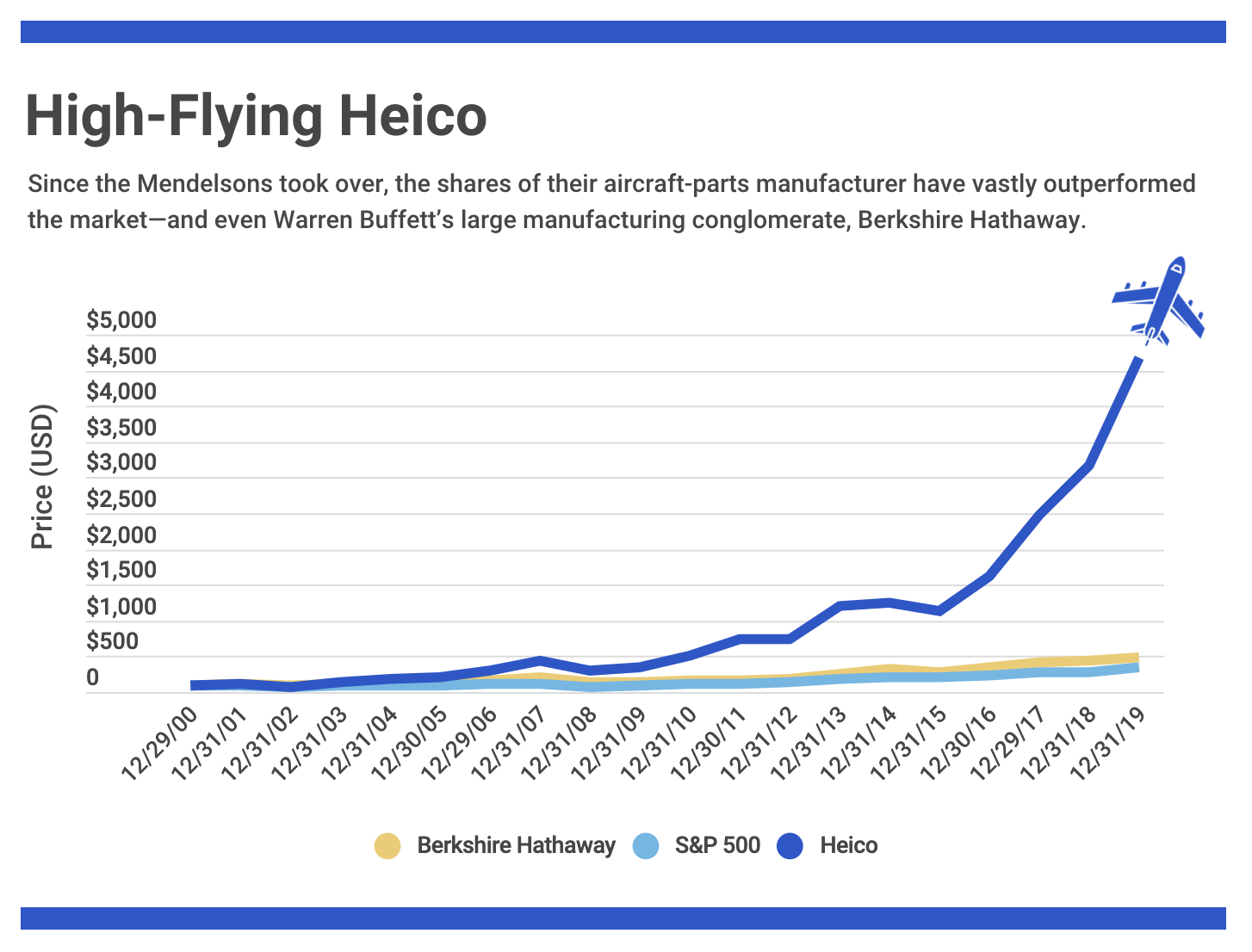
Source: Forbes

Source: Forbes

Decentralise / Autonomy

HEICO: “As long as you do what you say you’re going to do, they”—the Mendelsons—“leave you alone,” Barnes says. “And they ask, ‘Do you need anything?’” 

HEICO: “We understand that entrepreneurs have unique skills and that they focus on their businesses in critical ways; we generally go to great lengths to avoid losing that. This entails greater autonomy for the businesses than many large companies are willing to give, and an aversion to consolidating acquired companies, but we are committed to this model.”

ISOE: “If the manager of a business can control all aspects of his business it will run a lot better. We believe a lot of the efficiencies you are supposed to get from economies of scale are not real at all. They are elusive.”

ISOE: Regardless of industry or apparent scale needs, virtually all of the companies we talked to placed high value on pushing authority far down the line, and on preserving and maximising practical autonomy for large numbers of people.”

Value Employees

HEICO: “We feel very good about the way that we are taking care of our team members. Some organisations say their people are employees; we prefer to say team members.”

ISOE: “Most impressive of all the language characteristics in the excellent companies are the phrases that upgrade the status of the individual employee. Again, we know it sounds corny, but words like Associate (Wal-mart), Crew Member (McDonald’s) and Cast Member (Disney) describe the very special importance of individuals in the excellent companies.”

ISOE: “Treating people - not money, machines, or minds - as the natural resource may be the key to it all.”

Encourage Ownership:

HEICO: “The Mendelsons have long encouraged their employees to take advantage of a lucrative retirement plan. They match up to 5% of what workers sock away in their 401(k)s—not in cash but in Heico stock. So, put in $5,000, get $5,000 worth of Heico shares, which, of course, have done nothing in the past 29 years but wildly appreciate. In other words, the stock has turned a lot of ordinary Heiconians, especially early staffers, into millionaires. No, that’s incorrect, Larry says. “Multimillionaires.”

HEICO: “The people who work in the company: the machine operators, the secretary, shipping clerks, floor sweepers, cleaning people - anybody associated with HEICO who is on the payroll, is eligible for that 5% match.”

Head Office:

HEICO: “Our corporate head office consists of only six people.”

ISOE: “Top level staffs are lean; it is not uncommon to find corporate staff of fewer than 100 people running multi-billion dollar enterprises.”

Long-Term:

HEICO: “When we came to this company 33 years ago, we decided we wanted to build something for the long term, and it wasn't going to be built for years or a single decade, it was going to be built for multiple decades. And frankly, every single thing that we've done and every decision that we take has been designed to drive sustained long-term growth of the business as opposed to any short-term focus. So when we've got to make decisions on everything from inventory, capital expenditures, people, customer relationships, everything is focused on cash generation as a result of also maintaining low debt, and being able to create a culture which drives long-term performance.”

HEICO: “The thing that's interesting is, I think that these margins are a result of frankly what we did a decade and two decades ago. They're not as a result of what we've done in the last year or two. When you treat your customers right, you treat your people right, you get into a virtuous cycle and I think that's very much where we are. And I think, we're reaping the benefits of the long-term culture that we put into place over 20 years ago, 30 years ago and that's what's driving these numbers.”

Summary

There’s a plethora of useful mental models in the above:

Industry Structure [Incumbents don’t discount so they can recoup previous R&D expense] / Small Cost of Product vs Total Cost / Fragmented Customers / Fragmented Products / Mission Critical - Quality Products / Barrier to Entry [ie FAA Approval] / Reputational Advantage / Pricing Power / Investment-in-Price-Giveback / Decentralisation - Autonomy / Innovation / Close To The Customer / Encourage Ownership / Sensible - Smaller Acquisitions / Aligned Management / Minimal Headquarters - Valued Staff

These attributes together create a formidable ‘Barrier to Entry’ for Heico.

Perhaps, unsurprisingly, you’ll notice that many of the same attributes above are also evident in the great companies covered in these pages before. The majority of these are qualitative in nature - you won’t find them in a spreadsheet.

“Economists talk about ‘barriers to entry,’ what it takes to compete in an industry. As is so often the case, the rational model leads us to get ‘hard’ and ‘soft’ mixed up on this one, too. We usually think of principal barriers to entry as concrete and metal - the investment cost of building the bellwether plant capacity addition. We have come to think, on the basis of the excellent companies data however, that that’s usually dead wrong. The real barrier to entry are the 75-year investment in getting hundreds of thousands to live service, quality, and customer problem solving at IBM, or the 150-year investment in quality at P&G. These are the truly insuperable ‘barriers to entry', based on people capital tied up in ironclad traditions of service, reliability, and quality.” ISOE

While we haven’t covered all the useful mental models from ‘In Search of Excellence’ we’ve ticked off a lot of them. By studying the characteristics that have made businesses excellent, we can then search these out in other potential investments. When a multitude of factors create an impenetrable barrier, a Lollapalooza effect could be in the making - but don’t just look for that single silver bullet; it might just be made up by a lot of little things.


Sources: Forbes - ‘The 47,500% Return: Meet The Billionaire Family Behind The Hottest Stock Of The Past 30 Years’. Abram Brown. January 2020.

In Search of Excellence - Lessons from America’s Best-Run Companies’. Harper & Row Publishers. 1983

Follow us on Twitter: @mastersinvest

TERMS OF USE: DISCLAIMER
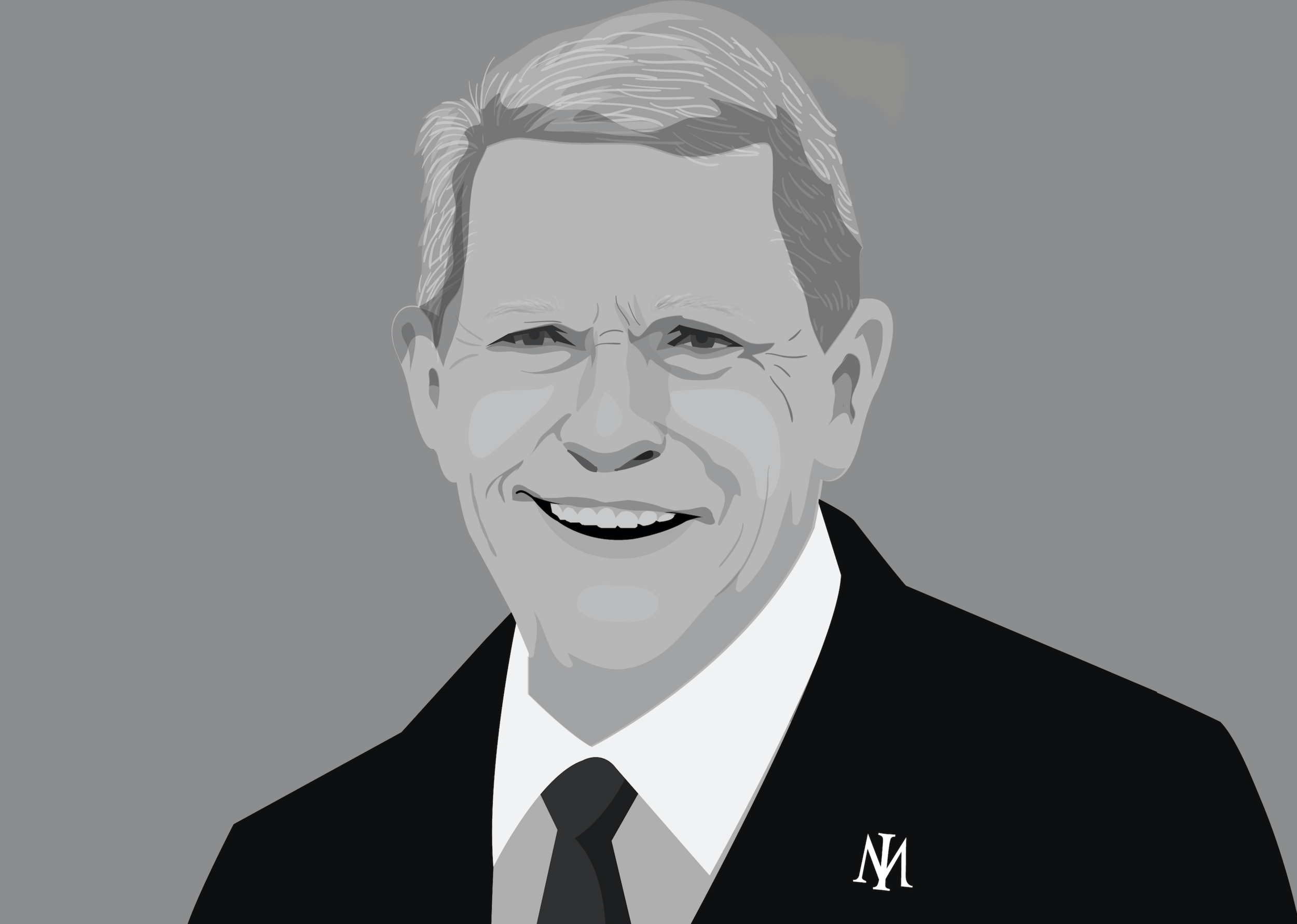
Railroader - Learning from Hunter Harrison

“It may not be ‘cool’ or sophisticated to operate in a low capability field, but ‘contrast’ is optimised by being a super performer, in the weakest of fields.” Peter D Kaufman

The second law of thermodynamics holds: ‘The greatest thermodynamic efficiency is achieved by working with the hottest possible source and the coldest possible sink’. In Munger like fashion, Peter D Kaufman, Chairman and CEO of Glenair, adopted this as a useful mental model in business: ‘we should strive in our performance to be the ‘hottest possible source’, in combination with the ‘coldest possible sinkof competitive field, niche or system.’ A telling example is the Railroad industry; an industry that hadn’t adapted for a generation and then combined with a ‘super performer’ named Hunter Harrison.

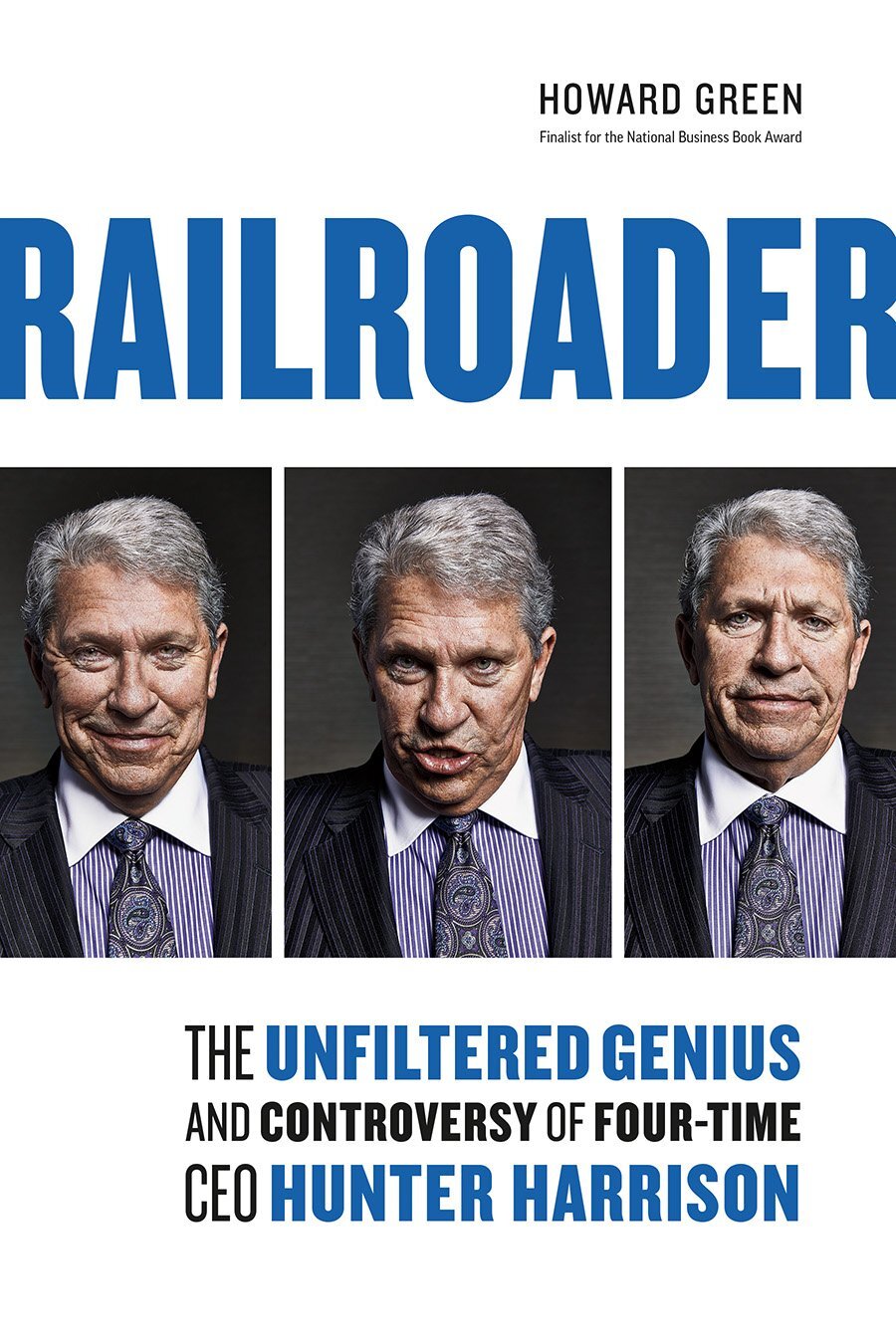
The late Hunter Harrison was a tour de force, a railroading genius who worked his way up from the rail yards at eighteen to run four publicly traded railroads, at the same time delivering billions in value to their shareholders. Harrison’s story is told by Howard Green in the recent book ‘Railroader - The Unfiltered Genius and Controversy of Four-Time CEO Hunter Harrison’. Warren Buffett, a railroad owner himself, noted ‘It’s an interesting read.’

Harrison’s story highlights the potential for a brilliant operator to significantly improve the operating performance of a lazy capital-intensive asset. Having developed a more efficient operating philosophy, ‘Precision Scheduled Railroading’, Harrison achieved operating margins and profitability which were the envy of competitors.

In contrast to the win-win philosophy evident in many of the recent businesses we’ve studied, at times Harrison’s approach drew criticism from employees and customers. This is an important differential, as his success suggests different cultures may be appropriate for different business models. WCM Investment Management’s Paul Black, suggested something similar, in that it’s important to ensure a business’ culture aligns with the company’s competitive advantage.

"Sam Walton really embraced the notion that you have to bring people along, you have to get people excited, you have to make people happy. You have to pay people well and tie them into the bottom line. He built this culture where people just loved coming to work and they had a lot of fun doing it. As a result they took on these old stale bureaucratic centralised organisations. That works for a retailer. But do you really need happy employees to run a railroad? Probably not. You want people that are highly accountable, that probably think in certain way, more linear, because it's all about delivering an on-time product in an efficient, cost effective manner. There is a high cost of failure. Different stresses. Very difficult corporate culture is needed for that than for a retailer. We found there are different cultures you find for different businesses that are effective." Paul Black

The book is an enjoyable read. In particular, the story of how Bill Ackman’s Pershing Square, having recognised Harrison’s innate abilities, made billions buying a stake in Canadian Pacific and recruiting Harrison to run the business.

I’ve included some of my favourite quotes below:

Super Performer

“For decades, Hunter Harrison, an American from working class Memphis, would repeatedly show people how to do it better than anyone else.”

“While Harrison, the unrivaled operator, did not envision a global computing Goliath, in certain respects, he was the Steve Jobs of railroading: uncompromising, unrelenting, fierce, antagonistic, confrontational, and a winner.'"

Shareholder Value

“Railroading wasn’t about being a train aficionado. It was only a route to shareholder value creation. That was everything.”

Stakeholders

“You don’t turn around capital-intensive businesses with legacy costs and thousands of employees, making them the most efficient major railroads in North America, without leaving some ‘blood on the tracks'.’”

“‘My mandate in these jobs has never been to be Mr. Popularity’. Indeed, Shareholders of four railroads hired Mr. Un-Popularity to turn around their flagging fortunes. The willingness to not be loved was the price he paid to get things done.”

Capital Intensity, Sweating Assets & Lots of Little Things

“So much of what Harrison taught came down to assets. Few things bothered him more than under-utilised ones. If an asset isn’t used, he wrote, ‘It’s a liability’ because of the costs associated with owning it. ‘Railroads only make money when cars are moving. Track is a railroad’s most expensive physical asset. Track has a 40 year life. So why would we lay down tracks to have cars sit idle?’”

fp0805_cp_ackman.png

Railroads, he wrote ‘were awash in long-lived assets’ - track, locomotives, and cars. He went deeper. What if dwell times in yards were cut to eight or twelves hours instead of twenty-four? What if customers unloaded faster so their cars were there for half the time? What if average velocity went from twenty-five to thirty miles an hour? ‘Now we’re getting more cycles from the same equipment.’ As he would say, a thousand little things equal a lot of money.’

Data

“It was during his time at Burlington National that Harrison became intrigued by computers.. Harrison was acutely aware of the value of data.”

“The birth of MCSM (Major Corridor Service Measurement), a system that tracked traffic patterns from origins to destinations. From that day on, there became pressure to measure like that. The team would define an acceptable amount of time for a boxcar to get from origin to destination and then monitor it to see if it made it in the set time. If it didn’t, the system showed them where a car lost time and why. [Harrison] was the only one who actually understood what the data meant. He could look at the data and know exactly what that meant from an operating perspective.”

“Soon [Harrison] was scrutinising the return on assets, capital spending, depreciation, cash flow, and revenue. He also wanted all the regions of the railroad to be cognisant of these numbers.'“

Hunter Harrison would drool over such data like a kid over a comic book. More precision was being built into the railroad’s schedule, a step toward heaven for the obsessed, continuous learner and improver. Every possible scenario had to be accounted for so it could be in the algorithm and the algorithm could figure out what was supposed to happen.”

“Previously, CN quoted delivery times in days - plus or minus a day or two for flex. Edmonton to Chicago was seven to nine days. Sometimes is was five or six, other times ten or eleven. That drove Harrison nuts. He wanted to quote in hours not days. If a train was scheduled to leave at 8am, whether there were sixty or one hundred cars. If you measured in hours, everything got more precise. Taking it even further, if you measured car inspections in seconds, they got faster too.”

Trouble was often avoided by a deep understanding of railroading - and a deep understanding also meant measurement, something Harrison was big on.’

Competitive Advantage / Precision Scheduled Railroading

“As Harrison said, his basic view didn’t change during the decades he ran railroads - service customers, control costs, utilise assets, don’t get anybody hurt, and recognise and develop people.”

“Leadership skills and boxcar moving skills would one day coalesce into Precision Scheduled Railroading, the operating philosophy that would become his calling card worldwide.”

“Freight trains ran on volume. Customarily, when the car was full, it would depart. Neither the railroad nor the customer knew when that would be. He said, we’re going to flip this very basic premise and run on schedule. By doing so, the railroad would utilise its assets at maximum efficiency and get rid of ones it didn’t need, saving huge amounts of money.”

What produced results [at Illinois Central] was the approach he would preach for the next two and a half decades - what train velocity does for efficiency, what longer trains mean for efficiency, and on and on. He saw better processes for everything, base hit after base hit.”

“Everywhere I’ve been, we’ve gained market share and been able to increase price. And I think that’s the important thing, and that’s driven on the product you have.”

“Harrison predicted CSX could take about 10 to 15 percent of Norfolk Southern’s business. He said CSX would get its cost lower than NS’s and then price more aggressively.’

Common Sense

“While much of what Harrison did was based on an intellectual approach that had developed over years of observation, thought, and the honing of processes, much of it was also common sense.”

Operating Ratios

“Harrison’s operating ratios were not, however, aberrations. Illinois Central was usually ten points better on Operating Ratio than the next best - and twelve or thirteen points better than the average. For Harrison, a lot of it came back to his time as a train master.”

“By most performance metrics, the CP turnaround had been off the charts. At the end of 2016, the operating ratio was 58.6 percent, the best on record at the railroad - and down from more than 80 in 2012.”

Source: Fortune Magazine

Source: Fortune Magazine

Customers

“[Harrison came] to the conclusion that if you said yes to everything the customer wanted, you wouldn’t make any money. That approach would help him make enormous profits in later years, but it would also eventually result in criticism that would later hound him.”

Culture

I’ve never seen a guy grab hold of a company,’ Gray said [CN Board Member], ‘and change the culture and the results in such a short period of time.’ Was it all warm and fuzzy? Gray asked rhetorically. ‘Not on your life.’”

“[At Hunter Camps for senior executives,] Harrison wanted the campers to internalise his key principles - provide service, control costs, utilise assets properly, concentrate on people, and not get anybody hurt. He didn’t necessarily want the smartest people in the world, he wanted the hardest working people in the world.”

“[He wanted attendees at Hunter Camps] to be passionate, arguing that people - employees - were dying to do something that mattered, to be inspired. ‘Just care’, he pleaded. He told the room he viewed Hunter Camps as the most important thing he could do at the railroad - changing the culture.”

Among the factors highest on Harrison’s list was culture. CSX, he said, was the sum of putting together more previous railroads than any of the other Class 1’s. ‘We don’t have a culture.’, he said. ‘We have about nineteen.’ As a result, he said staff ‘don’t know where they belong.’ To enact cultural change, Hunter Camps would be revived.’

Industry Structure & Change

“Harrison was a ‘change agent,’ and the status quo, while comfortable for most people, was uncomfortable with him. Railroads, Gray [CN Board Member] said, were ‘slow to adapt’. The industry had not evolved for a generation. Given that the sector was ripe to be whipped into shape, he said it was inevitable that someone like Hunter Harrison would come along eventually. ‘I’d never seen anybody who was more appropriate for the time and the changes required than Hunter.”

“Harrison quoted the former chief of staff of the US Army, General Eric Shinseki: “If you don’t like change, you are going to like irrelevance even less.” He pointed no further than the cassette tape and the compact disc. As for those who say businesses just mature and get commoditised, Harrison wrote in one of his manuals, “this is simply the excuse of losers… Time after time, people and organisations entered stable, mature markets and turned them on their ears. Haagen-Daazs did it with ice-cream, Starbucks did it with coffee, and Canadian National keeps doing it again and again with railroads.’

Competitors

A1Uc3c3jlKL.jpg

When asked, however if competitors would up their game and perhaps try to copy what he was doing, he said they could buy the books he’d written at CN. “[They’re each] on eBay for a thousand dollars,” he cracked, adding that he hoped they would try to emulate his operating methods, because he viewed his competitors as partners, since railroads depend on each other’s lines to get their cars where they need to go.”

Boards

Harrison had little patience for boards. Put simply, they were a pain, a waste of time and money.”

“Did a board add shareholder value? In the final analysis, Harrison would say no, at least at a railroad.”

Head Office

“[Upon joining CP] Harrison also didn’t like head office, which he called the ‘glass house’ in downtown Calgary. It would not be long for this world… It was also the opposite of what he thought a revamped railroad needed - in-your face contact with rail cars. Harrison would soon announce that he was relocating head office to a rail yard. CP’s headquarters would be where the action was - next to the tracks.”

Mergers

“Hunter Harrison once said, ‘They ain’t buildin’ any more railroads.’ Critical infrastructure was constructed decades, if not more than a century ago, as cities built up around rail lines. The only way for existing railroads to get bigger and more efficient was to swallow others.”

Failure

“‘Success is a lousy teacher,’ Harrison wrote. ‘It seduces smart people into thinking they can’t lose.’ He preferred types like those who came up with the household lubricant WD-40, named numerically because the inventor failed 39 times before coming up with the magic formula.”

Team

“Harrison invoked ‘the team’ and studied great sport coaches of the modern era. While many CEO’s love reading biographies of political leaders, Harrison’s shelves were full of books about winning coaches. While he drew lessons from all of them, he favoured the no-nonsense, tough-guy styles of the past - Vince Lombardi of the Green Bay Packers and Bear Bryant of the University of Alabama. Both were feared and respected.”

“‘Great teams don’t allow people who don’t want to really play to stay,’ he wrote in his first manual.”

“Soon, non-operating people like computer programmers would be trained as conductors. Managers would learn how to drive trains. This would not only give the company flexibility, but office workers would learn what it was like on the front lines of actually operating a railroad. ‘Nothing was sacred’ was the message.”

Reward Employees

More than half of the employee base at CN had joined the stock purchase plan, and the improvement in the operating ratio and the stock price benefitted many.”

Walk The Floors - Tone At The Top

Harrison travelled constantly, so employees everywhere saw him in action.”

“Like at CN, nose-to-nose encounters with the new chief had a way of resonating throughout the organisation.”

Consultants, Monthly Budgets & Rule Books

“Rule number one: no consultants without Harrison’s approval - and he added they wouldn’t get his approval.”

“Then came the assault on the monthly ‘outlook.’ He growled that compiling it was simply busy work, again adding no value, The team drew up the budget for the year in the fall. Unless something changed drastically, he didn’t want high-priced employees fooling with spreadsheet updates. ‘Shit, we ain’t nuthin’ but statisticians .. I want to move boxcars’ and serve customers, he added. ‘I want to know who in the shit you do this for?’ Again, silence.”

“Thumbing through the CSX employee rulebook, which resembled a phonebook from a mid-sized city, he shook his head .. He argued that voluminous rulebooks gave people a false sense of security. He planned to eliminate it and have a new one written that would fit in a pocket and not tell people ‘how to walk'.’”

Summary

Hunter Harrison was a maverick in an industry largely unchanged for decades. His intimate understanding, like a sixth sense, allowed him to extract costs and increase efficiencies across the companies he ran. Assets had to keep moving, otherwise they were a liability. Inverting the incumbent operating system, harnessing technology and data, and optimising hundreds of small processes created a superior operating system that maximised profitability.

While some customers may not have welcomed some of the changes Harrison implemented, they benefitted from a faster and more reliable freight service. At times, despite employees and management considering his approach ‘too tough’, Harrison deemed it essential to achieve the cultural changes so required for a successful turnaround.

Ultimately, shareholders were rewarded. Harrison’s record of improvement was so astonishing, a few investors sought him out to run other underperforming railroads.

“Canadian Pacific is shipping 20% more freight than it did before we started, or than it has ever shipped in the past. And it’s shipping that freight 40% faster than ever, with record on-time performance, 40% fewer locomotives, 35% fewer people, and 14% improved fuel efficiency—all while maintaining an industry-leading safety record. In sum, CP is doing much, much better and more safely—and with far less. For our investors, these changes have resulted in an explosion of cash flows. When we made our investment five years ago, the company was worth only $8 billion, reflecting the poor performance of the railroad. Today, with the improvements cemented, it’s worth $30 billion. Bottom line, there are large amounts of latent value in public companies waiting to be unlocked. All it takes is some fresh eyes and hard work.” Paul Hilal, Pershing Square, 2016.

It’s little wonder Buffett has kept a close eye on Hunter Harrison’s railroad success.

“All of those companies [run by Hunter Harrison] dramatically improved their profit margins, and they had varying degrees of difficulty with customer service in the implementing of it. We are not above copying anything that is successful. And I think that there’s been a good deal that’s been learned by watching these four railroads, and if we think we can serve our customers well and get more efficient in the process, we will adopt whatever we observe.. there’s been growing evidence that we can learn something from what they do.” Warren Buffett 2019

Cold sink’ industry investments coupled with ‘super-performers’ can be a recipe for billions.


Further Reading:
Pershing Square Presentation on Canadian Pacific
’Value Creation by Active Investors (and Its Potential for Addressing Social Problems)’ - Columbia Business School, 2015

Reference:
‘Railroader - The Unfiltered Genius & Controversy Of Four-Time CEO Hunter Harrison.’ Howard Green, 2018. Page Two Books


Follow us on Twitter: @mastersinvest

TERMS OF USE: DISCLAIMER
Learning from Charles Schwab

Many of the great Investors have left their mark on our investment world. Some have been innovators, others have been pioneers and all have been performers. And unsurprisingly, all have posted consistently outstanding results because of it. Each in their own way has crafted individual legacies which can teach us new ways of thinking when we trade. When it comes to the business of trading one man stands out from the crowd and has significantly changed the way Americans buy and sell investments.

And that one man is Charles Schwab.

In doing so, he built a Fortune 500 company whose value compounded at an average rate of 19% a year since IPO in 1987; twice the growth rate of the S&P500. Central to his belief; the customer was at the heart of everything Schwab did. He entered a race that for fear of revenue loss, the large incumbent brokers didn’t want to be involved with, a lucrative niche providing customers with cut-price stock transactions which he exploited and expanded with new technologies.

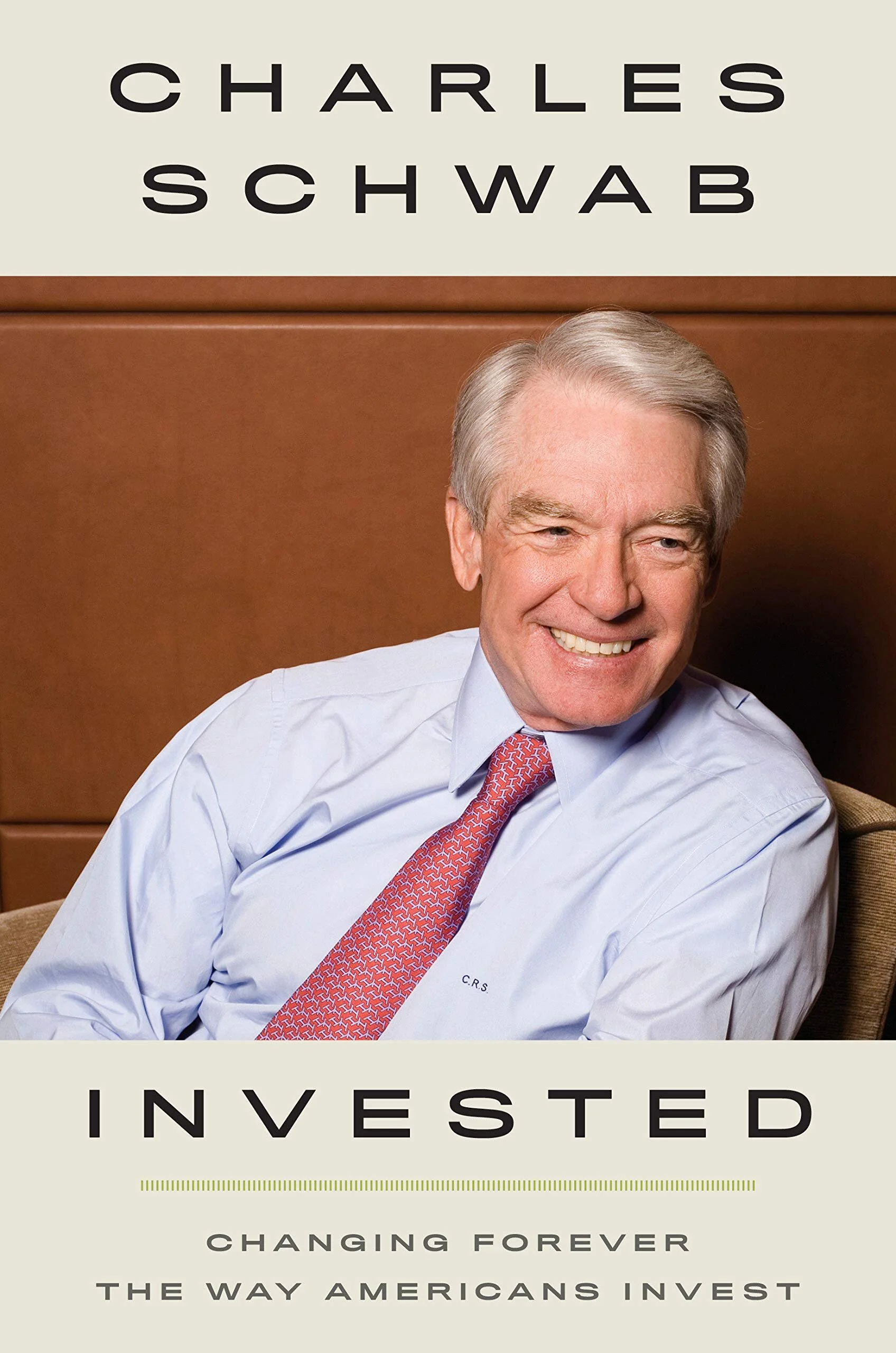
Charles Schwab tells his story in a recent book, ‘Invested - Changing Forever The Way Americans Invest’. On the dust jacket, Warren Buffett notes, ‘I’ve admired Chuck Schwab for a long time. When you read this book, you’ll understand why.’

In many ways Charles Schwab epitomises the ‘Scale-Economics Shared’ model employed by many of the great enduring companies. In a recent investor letter, IP Capital Partners noted, ‘Throughout its history, Schwab has continually cut the cost of investing through its platform and kept its competitors under constant pressure.’ Lower prices = more customers & increased revenue. Lower costs = increased profits. Return profit to customers via even lower prices. Repeat.

“Never underestimate the power of a low-cost structure: if you can make a profit by offering consumers good value; it’s a great business plan.” Francois Rochon

Charles Schwab vs S&P500 - 1987-2020 [Source: Bloomberg]

Charles Schwab vs S&P500 - 1987-2020 [Source: Bloomberg]

As a veteran of markets for over forty years, Charles’ reflections on the 1987 crash and the Global Financial Crisis are timely reminders of the need to remove emotion and maintain an investment plan in times of panic. I’ve collected some of my favourite quotes from the book below, but don’t be surprised to see many of the common themes we’ve seen with the other great businesses we’ve studied.

Competitive Niche

“Everybody said to me, ‘Wait until Merrill Lynch decides to go into your business. You are going to be crushed.’ I was worried, but Merrill was an entrenched member of the Wall Street establishment. It was still beholden to its many commissioned brokers, and its highly profitable investment banking and research business. It couldn’t just chuck all that out the window.”

“I thought if I could strip away all the fluff surrounding the purchase and sale of stocks - the tainted research, the bogus analysis, the flimsy recommendations, all the ways that Wall Street had historically justified high commission - and sell just the plain-vanilla service of executing trades, I could slash overhead, focus on efficiency, cut prices dramatically - by as much as 75% - and still make a profit.”

How would my firm differ from the kind of firms that had ruled Wall Street for so many years? For one thing, I meant to serve an entirely new client base, composed of what we now call independent investors.”

We were the common enemy of every big firm that had ever prospered under the old, protected system (regulated commissions).”

“If you take brokers out of the equation - as I was proposing to do - how then do you sell stocks? Well, you don’t sell. You market. My big aha! was when I realised I didn’t have to sell at all. All I had to do was market the discount brokerage service and then provide the best possible customer service.”

Recognising a business opportunity is only one part of succeeding as an entrepreneur. The key is acting on your business insight and following through.”

Our business was based on finding ways to break compromises. That was the magic behind lower trading costs, 24-hour phone service, local branches, no-fee IRAs, and internet trading.”

A business like ours comes down to two things; a big idea that makes a difference in people’s lives, and people who believe in it and will see it through to fruition day after day, despite what may get in the way. You have to get both right.”

Leverage Change

81wqjBLqenL-1.jpg

“I was starting Schwab hoping to take advantage of the significant changes that would come from the deregulation of the brokerage industry.”

Low Costs

Our whole business plan revolved around keeping costs low. No lavish expense accounts, no fancy digs, no high salaries or fat commissions for our brokers.”

“I wanted to cut out all the frivolous costs so that I could make the price to the investor substantially lower than had ever been seen before - as much as 75% lower than traditional firms were charging. It would be a fact that practically jumped off the page at independent investors when we began advertising.”

Technology

We paid a price early on by automating well ahead of our competitors, but the leverage we gained for later growth was enormous.”

“People often ask why Schwab got into technology so early and in such a big way to make it a defining part of who we are and how we operate to this day. In some ways, necessity is the mother of invention. We had to get more efficient or we were dead in the water. When I first started Schwab and slashed commissions by 75%, I had just a vague idea that I could make it work. I knew it would take volume.”

“I’m no technology expert, but I have always been willing to invest in technology, and not just because it lowers our costs and gives us a competitive advantage. The way I see it, every time we make another advance, we strip away one more layer of intermediation between the masses and the markets. That’s always good.”

With each new technological advance, we provided a level of service a cut above other discounters; and we brought our clients one step closer to my ideal of direct, unmediated participation in the market.”

We were trying as many things as we could to get ahead in technology. Not all of them were working but we kept pushing forward - knowing the future was coming at us fast, and the future was all about technology.”

Culture

“[We had] an entrepreneurial culture that was big on creativity and imagination and not so big on structures, details, and planning.”

Path to Freedom

“Today, I remain more convinced than ever that investing is the individual’s path to financial freedom.”

Be An Optimist

I’m an optimist. And investing has always seemed to me to be the ultimate act of optimism. You’ve got to have confidence that the money you invest today is going to grow; otherwise, you might as well stuff it under the mattress. You have to believe tomorrow will be better than today.”

“I believed it then, I believed it when I started Schwab against so many odds, and I still believe it today. To be a successful investor, you have to be optimistic.”

Approach to Money

“Trying to build a life in the wake of the Depression had an enormous impact on my parents’ attitude toward money, saving, and risk that lasted their entire lives… So much of a person’s attitudes and habits towards money get formed when they are young. We see it with clients at Schwab every day.”

A person’s approach to money, his or her saving and spending habits, and comfort or discomfort with risk are all deeply ingrained, and more emotional than rational.”

Reciprocation

“I’m sure one of the reasons for my success over the years has been that people generally like me - and the secret to that is just human nature: I pay attention to them. I listen to their stories and take a genuine interest. And it’s made for a richer life. People are endlessly fascinating and their stories are motivating.”

Screen Shot 2020-04-09 at 7.08.55 pm.png

Reading

I read a lot of biographies of people who had accomplished great things, people such as John D Rockefeller, J.P. Morgan, Charles M Schwab, the steel magnate (no relation), and many others. I saw the importance of determination, or passion and fighting hard for what you believed in, and the importance of optimism and believing good things are possible. All the people I read about had a maniacal focus on growth.”

Public Speaking

“To this day I encourage young executives to get training in public speaking. No matter how good they are, mastering those moments in front of an audience is crucial to leading others, and it rarely comes naturally.”

The Stock Market & Investing

With the stock market, there are no guarantees. You can guarantee service, costs, quality, and certainly integrity. But you can’t guarantee performance; Risk is just part of the deal.”

I don’t think human nature deals very well with the patience and strong stomach investing requires. We’re wired for fight or flight.”

I have now seen nine crashes in my life, and it still troubles me that investors react this way [sit on the sidelines], because it always ends the same. The market roars back and leaves too many investors sitting on the sidelines missing out. Sometimes I wish I could just tie them to their chairs to help them ride out the temporary storm. To this day our advice is the same: ‘Panic is not a strategy, stick with your investment plan, and don’t let emotions get the better of you.’ Heeding that advice when you’re in full panic mode is just not easy. People aren’t wired to be good investors.”

The most natural instinct is to run for the door. To sell. Sell everything,’ I said [in 2008 when reaching out to clients]. ‘You’ve got to fight that emotion because you want to be able to hang on for the recovery. Which has happened every time we have had an experience like this in my career .. and that goes back now some 40 years … nine different cracks in the market like this. Smart investing is about taking it year by year. It is a little bit of a nightmare, but we handle those by living through them and looking forward to better days.’ Did I get the timing right with my advice? Not exactly. You never do. And that’s exactly the point… Timing the market is impossible. As the saying goes, it’s not timing the market that counts, but time in the market.”

Successful investing is not easy, that’s the bottom line. It involves so much of your emotions, your sense of self-worth, your ego.”

The Unexpected

“To be fair, every worst-case scenario at the time [prior to 1987 crash] assumed a sudden market decline of 5%, not 25%. What happened on Black Monday was a previously unimaginable event, which, after the fact, becomes a calculable risk against which responsible parties take steps to protect themselves in the future. It’s those extreme moments when things come out of a dark closet and into the light so that you see them… [One account] exposed a hole in our defences. Today, we take those measures to new heights, running crisis scenarios that are far out of the realm of any prior experience, trying to make the unknown, if not knowable, at least manageable.”

Decisions & Process

You control your decisions and you control how well you execute them; you don’t control the environment.”

Don’t panic and overreact to the economic environment or the stock price; stay focused on what works.”

Mistakes

“I’ve always felt that when you make mistakes, if you stand up and admit them, people will give you the benefit of the doubt. Acknowledge and own up to problems and people will trust you. That will be helpful the next time. If you blame somebody else or try to sugarcoat the problem, you may get away with it once.”

Encourage Ownership

“Experiencing how powerful and motivating that sense of ownership is, I’ve always encouraged and helped my employees over the years to be owners in our company as well.”

Reward Staff

I paid people what I thought they were worth, regardless of seniority, and I used perks and bonuses to reward my stars.”

Employees are your most important resource. Helping them take care of their health is simply good for business.”

People

Business is all about people and you need to find those who share your vision and values, who will bring their own passion and strengths to the task. And you need that at every level of the organisation, from the mailroom up to the boardroom.”

An entrepreneur who is afraid to hire people who can do something better than he can is doomed.”

Growth

I always wanted our company to be a growth company.”

In my experience earnings follow growth, and stock prices follow earnings. My philosophy is that with growth, everyone wins: clients get better service; investors get a better return; employees get jobs and rising pay; the community gets support; and, of course, the government gets taxes.”

“I believe it is incumbent on every leader of a company that the number one thing on their mind is growth. You don’t prosper without it.”

“We are growth junkies - people who thrive on change and adaptability and the next new thing.”

It’s an irony: growth is a sign of success and shows you’re on to something that people want, but with a young company like ours the growth outpaces your sources of capital. You’re reinvesting every penny of profit you can, and it’s not enough.”

Source: Schwab.com

Source: Schwab.com

Risk

Gamblers like taking risks, not entrepreneurs. Entrepreneurs start with a vision and accept, reluctantly, that no vision was ever realised without risking something important. But a true entrepreneur seeks to control his risks as much as possible.”

Taking and managing risk is a critical part of any successful endeavour. In business particularly, you have to have an appetite for it or you stagnate and don’t do things that delight the customers and keep them coming back.”

My role was to embrace risk when I saw an opportunity for a huge reward. I’ve always tried to encourage my operating people to make big leaps that could have a significant impact on the company’s bottom line.”

You’re never gambling the whole house, you take calculated risks. You’ve thought things through, and experience and maturity and intuition and the tests you go through give you incrementally better odds each time.”

Innovate & Accept Mistakes

“You have to be willing to embrace client-focused innovation, even when it competes with your own existing business. Sometimes the most important competitor you confront is yourself. That’s how you stay a step ahead of everyone else. You can’t think just because you’re big, just because you’re successful, that you can’t disrupt yourself. You can - and in fact in today’s world, you have to.”

We tried a lot of things that didn’t work. For a while it was one failure after another. But that never worried me. Innovators should expect failure, it’s part of the process. As head of the organisation, it was my job to encourage experimentation, not punish it.”

We had a history - a culture of innovation - that helped prepare us for the internet.”

You try a lot of things as an entrepreneur. You learn as you go. And sometimes you wind up with something that works that wasn’t planned.”

The work, the innovation, is never done. There’s always another new idea, another convention to challenge, a million ways to make investing better. We just need to do it.”

Help the Customer

“Our clients have always been the heart of our business.

"I always believed that profits were something that come naturally at the end of the line, if you got the first part right - finding new ways to help the customer succeed."

“We had a lot to learn on the way to becoming a company that could be proud of its customer service, which was the goal, and it took us a long time to get there.”

All I ever set out to do was build a firm that serves the customer the way I’d want to be served myself.”

“We have never been the cheapest discount broker, but we have always tried to offer our customers the most value.

Every client interaction changes our company’s future - either to the positive or negative.”

“It was really one thing that bought us success: a zealous team of people on a mission that I fondly refer to as ‘Chuck’s secret sauce', all of them in lockstep pursuing a simple innovation, total empathy for our clients: make it better, easier, more successful for the investor. I call it the mother lode of our innovations, more important than any single technology or new product. It was building a company from a basic belief; view your decisions through your clients’ eyes.”

Nuisance Fees

“[In 2004] we were struggling to grow, and Schwab has always been a growth company. Now we were doing things to solve our problems that created difficulties for our clients. Our prices weren’t competitive, and we’d let some nuisance fees creep in. Walt Bettinger, who was then leading the branch network, called them gotcha fees, which we tried to avoid. We’d gotten harder to work with. We made our struggles into our clients’ problem, and that couldn’t stand.”

Walk The Floors

I had never paid much attention to what my competitors were doing. I did not waste time thinking about how to exploit their weaknesses. Instead, I was always keyed into my own clients. To me the trick was coming up with products and services that satisfied investor needs before anyone else did. Get out ahead and others would be playing catch up. .. The only way that works is if you have first hand knowledge. I got mine spending a lot of time in the branches - talking to customers, watching what they were doing, trying to understand what they were thinking.”

Cost Cutting

You can’t cut a company to greatness.”

Branch Offices

It turns out there is something about having a nearby presence that helps persuade people to do business with you.”

The branch offices turned out to be spectacular growth engines.. We opened somewhere and, boom, our business exploded by a factor of 15. Here, I saw, was the key to growth on a grand scale - the kind of growth I had been seeking ever since I founded Schwab.”

It took roughly four years on average for a branch to become profitable. Opening branches is expensive, it eats into profits. But not forever - that’s the key.”

Debt

“We face enough risk and uncertainty every day in our business, not just normal operating risk, like any other company, but also stock market risk. To compound that double uncertainty with a mountain of debt strikes me as unwise. Plus I spent too many years as a young man having to scratch and claw for money. If that means we keep more cash around than some analysts think is appropriate for maximising shareholder value, so be it.”

“[We’ve] always been conservative with the balance sheet.”

Wall Street

When it comes to telling tales aimed at garnering sales - as I know from hard experience - brokers are the best. I suffered my share of bubbles as a young investor.”

“Our employees weren’t compensated in a way that encouraged them to persuade clients to do more trading.”

Advertising - Social Proof

The biggest obstacle we had to overcome was a perceived lack of credibility. Most of our customers knew us only as a telephone number… One way we fought that perception was the same way McDonald’s did - by counting our customers and bragging constantly about our growing numbers; ‘16,000 investors can’t be wrong,’ we said in one of our early newspaper ads.”

“Nothing compares to the word of mouth that results from good PR. It was true then, and is truer today, with the explosion of social media.”

“[Our agency] floated the idea of using my picture as the centrepiece for all our print advertising .. We had to find a way to personalise our clients relationship with the firm, or we were just a phone number and a mailing address.”

Acquisitions

A lesson about acquisitions: understand the culture you’re buying, really figure that one out. Is it compatible with yours? Or do you have an opportunity to transform their culture so it aligns with yours?”

“You get so confident about things, willing to do anything to acquire companies, but you still have to do your analysis to see, ‘Does it really fit?’ In my experience, the biggest potential problem, is always culture.”

Summary

Schwab’s initial competitive advantage exploited the changes in regulated commissions at a time the incumbent brokers refused to compete for fear of lost revenue. Like Amazon’s AWS in cloud computing and Starbucks’ Coffee Shops, this provided a long runway for growth before like-minded competition entered.

A culture of continuous innovation coupled with an unrelenting focus on satisfying customer needs fed Schwab’s unbridled demand for growth. The willingness to adopt a longer term view allowed the business to sacrifice near term profits as technology spend ramped to further automate and scale. This provided the opportunity to cut prices and grow volume, dissuading others from entering the market while widening the company’s competitive advantage. Investors, whether employee owners, shareholders, or customers of the Charles Schwab company have been amply rewarded.

Finally, Charles Schwab is an optimist. After more than forty years witnessing investor behaviour and umpteen markets dislocations, he vehemently maintains optimism is the right mindset for an investor. Self awareness is another key component. For as Chuck says, in good times or bad:

Sometimes the most important competitor you confront is yourself.


Further Reading:
Ip Capital Parters Letter [No Association]

Reference:

‘Charles Schwab - Invested. Changing Forever The Way Americans Invest’, 2019. Penguin Random House.


Follow us on Twitter: @mastersinvest

TERMS OF USE: DISCLAIMER


Sit On Your Ass

SOYA.JPG

Outperforming the market is hard. Over the last five years, it was easy. Easy if you owned just one stock. The world’s largest. You just had to buy Apple. And NOT sell it.

John Huber of Saber Capital touched on this in his annual letter:

“Over the past 5 years, with exceptions that you could probably count on two hands, Apple has outperformed the entire hedge fund industry, every one of the 10,000+ mutual funds, the passive funds at Vanguard and Blackrock, the most prestigious private equity funds, and the vast majority of venture capital funds in Silicon Valley. We’re talking about many trillions of dollars in all kinds of investment vehicles with all kinds of fees, managed by extremely smart people with unlimited research budgets and super smart employees, who all work extremely hard, and are all highly incentivized to produce great results. And Apple beat nearly every last one of them.”

When it comes to investing mistakes, most people think in terms of what’s been bought, not sold. Yet, selling a stock can be the biggest mistake there is.

“Of our most costly mistakes over the years, almost all have been sell decisions.” Chris Cerrone

“By far, the biggest mistakes I’ve made is selling stock early. As an example, we made a big investment in Tencent in 2003 and having sold that position early cost the fund twenty billion dollars.” Philippe Laffont

"The biggest mistake an investor can make is to sell a stock that goes on to rise ten-fold. It's not from owning something into bankruptcy. But that's what everyone thinks, at least judging by the questions we get from clients." Nick Sleep

"Over time, any honest investor and especially any honest value investor will tell you that their biggest mistakes were what they sold, not what they bought." Chris Davis

"The biggest mistake you can make is not failing to sell something you should have sold, it's selling something that you should have held on to.” Tom Slater

“If I’ve made one mistake in the course of managing investments it was selling really good companies too soon. Because generally, if you’ve made good investments, they will last for a long time.” Lou Simpson

“As the old saying goes: ‘it’s never wrong to take a profit’. But it is often not just wrong but the worst mistake that can be made.” James Anderson

“Selling early is the high blood pressure of the investment business. It’s a silent killer. And you know, people will always talk about the business they bought that went to zero, or the one that went down 50% or 75%. Yes, that’s bad. You want to avoid that but the business that you sold too early, that went on the compound tenfold, or 20-fold after that in my career, has been a real killer.” Peter Keefe

“Investor should be especially careful with their winners – selling too early is the most overlooked detractor from long-term outperformance.” Shad Rowe

Some of the best track records in investing have come from those investors who’ve identified great companies and ridden them. Whether it’s Li Lu, Terry Smith, Nick Train, Nick Sleep, Chuck Akre, Francois Rochon, Shad Rowe, Dan Davidowitz, Ted Weschler or Warren Buffett, they’ve chosen a different path to most investors. They view companies through a different lens and have delivered market crushing returns as a result.

Charlie Munger dubbed this approach, Sit On Your Ass’ investing.

A few years ago I penned a piece titled, ‘When to Sell a Great Company?’ The conclusion was, almost never. I enjoyed a recent post by Chris Cerrone of Akre Capital titled ‘The Art of [Not] Selling, aka ‘Sit on Your Ass’ investing. The article inspired me to finish a post which had been sitting dormant in my ‘drafts’ for the last year. I’ve woven elements of Chris’ article with investing insights from some of the eminent investors mentioned above.

While ‘Sitting On Your Ass’ sounds simple. In practice, it’s not. Ahead are some tips to help you remain seated when everyone else has decided to get out.

Let’s start with some of the attractions of ‘Sit on Your Ass’ Investing:

Availability

As much as I enjoy reading about Jim Simons, Ray Dalio, George Soros, Paul Singer, Stanley Druckenmiller and Howard Marks, their investment style is near impossible for Joe Average to replicate. That’s unless you’ve got a team of code cracking PhD’s, employ a hundred uncorrelated multi-asset strategies, have an intuitive leveraged global macro trading capability, a structurally hedged activist style or deep expertise in distressed assets.

The beauty of ‘Sit on Your Ass’ investing is that it’s available to everyone.

Lower Transaction Costs / Taxes

A benefit of not trading is avoiding short term capital gains tax, meaning less dollar leakage and a larger asset base to compound. Lower turnover also means less frictional costs like commissions and market impact.

Sit on your ass investing. You’re paying less to brokers, you’re listening to less nonsense, and if it works, the tax system gives you an extra one, two, or three percentage points per annum.” Charlie Munger

“One of the key roles I’ve played at Peninsula on your behalf over the past 12 years is resisting the temptation to sell - doing nothing can run counter to a serious work ethic, but in the world of investing it can be a very effective strategy in that it: i) minimises transaction costs, ii) minimises taxes, and iii) respects the fact that as a practical manner, market timing is a fool’s errand.” Ted Weschler

“When you sell a stock you’ve got to be right twice. You gotta pay taxes and replace the investment. On a growth stock you just have to right once.” Shad Rowe

“Strong companies also offer us the chance at long-term compound growth in capital appreciation without incurring taxes, which essentially serves as an interest-free and recourse-free leverage from government taxing authorities.” Li Lu

Fewer Decisions / Less Re-Investment Risk

A strategy of buying stocks cheaply to sell higher requires a constant supply of new ideas. Not only do you have to get the buy decisions right, but the sells too, and in perpetuity. ‘Sitting on Your Ass’ requires fewer decisions and allows more time to get acquainted with the companies you own.

“What we really like is buying good-sized to very large first-class businesses with first-class management and just sitting there. You don’t have go from flower to flower. You can just sit there and watch them produce more and more every year.” Charlie Munger

“If our firms can successfully grow, and we can resist the temptation to fiddle, then we can meaningfully reduce the reinvestment risk embedded in lots of share buying and selling.” Nick Sleep

Harness Compounding

The human brain is wired to think linearly not exponentially. Chris Cerrone reminds us that a penny doubled everyday for a month turns into $10,737,418.24! Of course, there’s no better investor to demonstrate the extraordinary power of compounding than Warren Buffett, who’s life has been the ‘product of compound interest’. The following table pretty much says it all.

The Power of Compounding - Warren Buffett vs The Market [Source: Visual Capitalist]

The Power of Compounding - Warren Buffett vs The Market [Source: Visual Capitalist]

“A great company keeps working when you’re not. A great company will eventually earn more and more and more while you’re just sitting and doing nothing. And a mediocre company won’t do that. So you’re harnessing a long range force that will help you. It’s very important.” Charlie Munger

Sit on Your Ass’ investing leverages the growth in a business’ intrinsic value. Terry Smith, a dyed-in-the-wool ‘Sit on Your Ass’ investor, touched on this in his recent letter.

“Equities are the only asset in which a portion of your return is automatically reinvested for you. This retention of earnings which are reinvested in the business can be a powerful mechanism for compounding gains.”

Rare Quality Businesses

A multitude of factors impact stock prices in the short term; quarterly earnings, investor sentiment, macro developments, valuation re-ratings, analyst recommendations, etc. As the holding period lengthens, business performance exerts a greater influence on stock prices.

The best businesses for long term investment therefore are those with both ‘enduring’ high returns on capital and attractive reinvestment opportunities.

‘Enduring’ high returns require sustainable competitive advantages to protect the business from the vagaries of capitalism. These businesses are often referred to as ‘Compounding Machines’.

“We endeavour to look past the non-essential details. We want to identify the essence of each business’s competitive advantage.” Chris Cerrone

These businesses are few and far between. As such, businesses worthy of ‘Sit on Your Ass’ investors tend to represent sizable positions in their portfolios.

“Companies with truly unusual prospects for appreciation are quite hard to find for there are not too many of them.” Phil Fisher

“There's only a tiny number of exceptional companies.” Reece Duca

“Truly strong companies with sustainable competitive moats are rare.” Li Lu

Long Runway

Growth is an essential element. Businesses that don’t grow are unlikely to be profitable long term investments.

“The real money is going to be made by being in growing businesses, and that’s where the focus should be.” Warren Buffett

“The runway ahead for our businesses may be very long indeed.” Nick Sleep

"In our office we often say, ‘How wide and how long is the runway’?" Chuck Akre

Macro Concerns

Macro issues often spook investors out of positions; trade wars, Fed policy, GDP growth, politics and geopolitical tensions are but a few. These short-lived facts and data points rarely have a bearing on a business’ long term value.

Businesses stress tested by previous economic cycles, with solid balance sheets, good management and sustainable competitive advantages survive.

“We try hard to tune out concerns about politics and the economy. We read the newspapers, and we work just down the road from Washington D.C. However, it has been our experience that we are at our worst as investors when we allow concerns about these issues, including elections, trade wars, and Fed policy, to influence our investment decisions.” Chris Cerrone

“Charlie and I spend essentially no time really thinking about macro factors.” Warren Buffett

Adopting the mindset of a business owner as opposed to a stock trader can help. Would a business owner sell their private company based on a tweet by Trump, a lower GDP print or a strategist forecast?

“Our business owner mentality.. allows us to virtually ignore the constant babble of short term macro noise." Allan Mecham

notforsdale.JPG

Destination Analysis

The myopic market focus on the short term provides opportunity for mis-priced opportunities in the long term. Wall Street analysts publish valuations and price targets with scant regard to where a business might be in five or ten years. Armed with a deep understanding of a business’ DNA, an investor can overlook short term operating results and reflect on how a business might be positioned five or ten years hence.

“We always focus on what the business will look like in the very long term.” Zhang Lei

“We patiently build up core expertise that allows us to evaluate the long term prospect of the businesses we are interested in.” Li Lu

“We’re trying to figure out what this businesses is going to look like five years from now and ten years from now, not what’s going to happen in the next quarter or the next year.” Dan Davidowitz

Focusing on the destination can also help an investor stick with a position, even after periods of significant outperformance. Nick Sleep articulated this point with regard to Amazon in his 2007 letter:

‘To those who argue Amazon is large already we ask two questions: What do you think e-commerce will be as a proportion of US retailing in ten years, and what do you think it was last year?

After doubling in the share price and the weighty resultant position in the Partnership it would be easy to claim victory, high five, and sell our shares in Amazon. However, the high weighting makes sense given our understanding of the destination of the business and the probability of reaching that destination. We have argued that the biggest error an investor can make is the sale of a Wal-Mart or a Microsoft in the early stages of a company’s growth. Mathematically this error is far greater than the equivalent sum invested in a firm that goes bankrupt. The industry tends to gloss over this fact, perhaps because opportunity costs go unrecorded in performance records. We wonder, would selling Amazon today be the equivalent mistake of selling Wal-Mart in 1980?

Valuation

“To the surprise of many, neither valuation nor price targets play a role in our sell decisions.” Chris Cerrone

“Another question we often get from investors concerning valuation: Do you assign price targets for your companies? The answer is no. Price targets strike us as too precise and, as importantly, potentially limiting to total return if one feels compelled to sell once the stock reaches the price target.” Dan Davidowitz

The opportunity to buy the shares of a great company at a fair price is rare. So, selling a great company because it surpasses an arbitrary price target after six, 12, or 18 months seems on its face to be counterproductive and tax-inefficient.” Shad Rowe

A high multiple doesn’t imply a stock is a poor investment. The power of compounding can render an ‘optically expensive stock’ cheap very quickly.

Valuations are inherently imprecise. Most analysts’ DCF models assume a company’s growth and returns mean revert in time. Businesses with enduring competitive advantages that can resist this reversion are likely to be worth significantly more than typical finance models suggest.

In addition, great management teams have a tendency to enhance value through time.

“The very best businesses tend to exceed expectations. What may seem like a high price today may be proven to be perfectly reasonable in hindsight.” Chris Cerrone

“I have noticed that the truly great companies and great managers generally get better over time.” Shad Rowe

This suggests valuation should carry less weight in the investment decision.

“We really have a great reluctance to sell businesses where we like both the business and the people. So I don’t think I’d count on seeing many sales. But if you ever attend a meeting here, and there are 60 or 70 times earnings, keep an eye on me.” Warren Buffett, 1996

Selling great companies with large growth potential, even at seemingly rich valuations, is usually a mistake.” Allan Mecham

Position Sizes / Volatility

Not selling a stock that delivers exceptional returns can result in a quality problem; the stock becomes a large part of the portfolio. Ted Weschler’s position in W.R Grace & Co. was almost 50% of his fund before he closed Peninsular to join Berkshire Hathaway in 2011. When Nick Sleep closed Nomad Partners in 2014, Amazon had grown to represent more than thirty percent of assets. Chuck Akre’s position in Speedway had grown to c50% of his portfolio in 1993 despite trimming a third of the position over the previous two years. And when Li Lu delivered a 200%+ fund return in 2009 as BYD skyrocketed 400%, BYD constituted over 50% of his partnership.

When positions get large, future fund returns become increasingly influenced by such positions. Li Lu’s 2009 annual letter noted, “the extreme appreciation [of BYD] has made the stock constitute a very large portion of our portfolio. This will lead to more volatility going forward.

A large position can also constrain decision making if it leads to commitment bias. Li Lu’s fund struggled in 2010 and 2011 as the BYD share price declined nearly 80% from its 2009 high. By the end of 2012, the position size still represented one third of the fund. By 2014, the position size had been substantially reduced [to c10%] as a result of new investments by limited partners and other portfolio gains. With the benefit of hindsight, Mr Lu questioned his decision regarding the proper sizing of BYD after the market gains became so large. In the end he felt commitment bias [via a prominent association with the company and loyalty to its top leadership] had constrained his decision making.

Aligned Investors

Investor alignment is paramount in light of the potential for outsized positions and volatile returns.

Educating investors and preparing them for an absence of portfolio activity is a sensible strategy.

One common psychological trap that agents may fall into is that clients expect action, or to be more accurate, fund managers expect their clients to expect action! The investor Seth Klarman was once challenged on whether Buffett’s track record was statistically significant as he traded so little? To which Klarman answered that each day Buffett chose not to do anything was a decision too.” Nick Sleep

"If we were private business owners/investors, long spans of inactivity would raise no eyebrows. No reasonable person would expect a farmer to sell his farm in order to buy a different farm every decade, let alone every year or several times a year. As public -market investors, however, this ‘sitting on our hands’ behaviour is unusual." Clifford Sosin

“‘He really doesn’t Do anything. All he does is buy and hold. What I need are people who make money’ is a comment I occasionally hear from arithmetically challenged investors. I plead guilty. What we attempt to do is simple – identify great companies that fit within compelling long-term themes . . . companies that do something better, faster and cheaper FOR instead of TO their customers, with balance sheets big enough to go after huge opportunities. We attempt to buy shares at reasonable prices, and then hold on (hopefully forever).” Shad Rowe

Patience

Pascal observed, 'The hardest thing for a man to do is sit quietly in a room'. Charlie Munger and Warren Buffett have insurance and operating businesses to occupy them. Over the years I’ve noticed some investors, Warren Buffett included, have played around the edges in different investments while leaving their ‘quality’ companies well alone - a strategy worthy of consideration should it override a temptation to sell.

“It’s waiting that helps you as an investor, and a lot of people just can’t stand to wait.” Charlie Munger

“Investing is a mind game. If you are in a rut as a concentrated investor, increase your chances of winning and add a couple positions. It also lets you breathe and your positions breathe a bit.” Ian Cassell

Pot Holes

Expect pot holes. Business performance, like stock returns, aren’t linear. Businesses have hiccups. Ensure they are temporary not structural.

I don’t expect the best companies to show their excellence every quarter.” Li Lu

"Businesses do not meet expectations quarter after quarter and year after year. It just isn’t in the nature of running businesses." Warren Buffett

“It’s in the nature of things that the market is not going to do exactly what you want, when you want it.” Charlie Munger

Many of the great ‘Sit on Your Ass’ investors, Terry Smith, Li Lu, Warren Buffett, Francois Rochon, and Nick Sleep included, look to their companies operating results to judge progress, not stock prices.

“I introduced the concept of viewing our entire portfolio as a single ‘HCI Holding Company” based on the weighted average of our shares in each individual portfolio company. This is a very useful way to understand our activities since we view ourselves primarily as owners of businesses and hold our positions for a very long time with very low turnover.” Li Lu

When To Sell

Mr Cerrone sets out three criteria where Akre Capital may sell a stock; slowing growth, loss of competitive advantage or adverse new management. You’ll note they are all related to the operating characteristics of the business, not the soap opera of the market place or macro considerations.

“We sell really when we think we're re-evaluating the economic characteristics of the business. We probably had one view of the long-term competitive advantage of the company at the time we've bought it, and we may have modified that.” Warren Buffett

“When we become concerned about the strength of a company’s franchise, its competitive advantage, or its balance sheet we will sell immediately.” Dan Davidowitz

The major risk when adopting a ‘Sit on Your Ass’ investment approach is mis-analysis of the business. It’s all about the business and its future.

“What costs us money is when we mis-assess the fundamental economic characteristics of the business.” Warren Buffett

“In our opinion, the biggest risk in investing is the risk of mis-analysis.” Nick Train

Summary

If you’ve been a reader of my posts over the last few years, you will have no doubt noticed the commonality of the world’s best investors and their collective thinking regarding what constitutes a great business. And I have written about this for a reason. ALL of the best investors spend their time finding those outstanding businesses, so that when the urge to sell certain stocks overcomes the collective market and people are running for the hills, these Masters can sit comfortably in the knowledge that the deep understanding of those businesses that they own allows them a certain level of reassurance, and they can choose not to sell, or to Sit On Their Ass.

Selling, as explained above, costs more in the long run and requires an adeptness that most of us lack. When the world’s best state that their biggest mistakes were in selling, not buying, you have to take notice. Outperforming the market is almost impossible for the average investor, yet these Masters do it … ‘Sitting On Their Ass.’

Sources:
The Art of (Not) Selling- by Chris Cerrone. Akre Capital Management. 2019.
When to Sell a Great Company’ by Investment Masters Class. 2017.
Quality Companies, Compounders and Value Traps’ by Investment Masters Class. 2016.
Hold Discipline,’ Lawrence Burns, Baillie Gifford, 2021.


Follow us on Twitter: 
@mastersinvest

TERMS OF USE: DISCLAIMER


Onward - Starbucks’ Howard Schultz

When Howard Schultz opened his first coffee store in Seattle, he strove to replicate the experience of the coffee houses he’d visited in Italy; a place where people would come to meet, in a place that encompassed a welcoming and engaging atmosphere. Starbucks wasn’t to be just about selling a good cup of coffee, in fact it was to be an experience, and it was all about people.

From the beginning, Starbucks took extra care of their staff, which elicited the power of reciprocation and fostered a bond between Starbucks’ employees and their customers. A friendly culture developed which drove repeat business and provided a competitive advantage. A focus on customer experience ensured the stores offered a unique and inviting social gathering place for the communities they served, and a long runway for store roll-outs propelled the company’s earnings and share price.

While Starbucks’ beginning was all about people, over time, unfortunately, it became all about the numbers. Numbers, numbers, numbers. A history of double digit earnings growth allowed the company to neglect it's cost base, all while setting the bar higher for even more growth. And naturally, management and Wall Street obliged.

As a result, a major impetus was placed on growth metrics like new store openings and comp sales. New product offerings unrelated to coffee and inferior store locations drove short term growth all while hurting the brand and the business.

And unfortunately, this is more common an occurrence than you might think.

For more than 25 years, Jim Collins has studied what makes great companies tick. In a recent Farnam Street podcast, he articulated that ‘over-reaching’ and ‘the undisciplined pursuit of more’ was responsible for the downfall of many great companies.

“Almost none of the companies we studied that were great companies that fell, fell because of complacency. They fell because of overreaching, the undisciplined pursuit of more. They became too aggressive, too much growth, firing un-calibrated cannonballs, expanding into areas of which they have no business operating. There’s a certain animus that happens, if we’ve been really successful. Now we just need to have more, and we need to be bigger.” Jim Collins

Once the Financial Crisis hit, Starbucks’ once unstoppable growth reversed. Declining consumer spending laid bare the misjudgments, cost blow-outs and inefficiencies of the business. Starbucks was broken.

It was then that Starbucks’ founder, Howard Schultz, returned to the role of ceo to rectify the company’s woes. While there was no silver bullet, there were many things the company needed to do to return to its core. The retail industry has witnessed very few successful turnarounds, but Starbucks is one. And the book, ‘Onward’, by Mr. Schultz, tells that story.

It’s a tale about how a business came to lose its way, about hubris and the dangers successful businesses face. It’s also a guide for getting back to your core, staying true to your values and innovating for the future. The book distills the essence of Starbucks success through its unique competitive advantages.

I’ve collected some of my favourite extracts below. Once again, you’ll notice many common threads with the other great businesses we’ve covered.

Remove Hierarchy

“Since Starbuck’s earliest days, we have lower-cased all job titles.”

Win-Win

“As a business leader, my quest has never been just about winning or making money; it has also been about building a great, enduring company, which has always meant trying to strike a balance between profit and social conscience.”

No business can do well for its shareholders without first doing well by all the people its business touches. For us, that means doing our best to treat everyone with respect and dignity, from coffee farmers and baristas to customers and neighbours.”

Value Employees

“We were the first US company to offer both comprehensive healthcare coverage as well as equity in the form of stock options to part-time workers, and we were routinely heralded as a great place to work.”

Even as we lost money in the early years, Starbucks established two partner benefits that, at the time, were unique: full health-care benefits and equity in the form of stock options for every employee. This was an anomaly.”

Acting with this level of benevolence helped us build trust with our people and, as a result, long-term value for our shareholders.”

“Owning a piece of the company gave so many of our partners a tremendous sense of pride, demonstrating that we respected our people enough to share our success.”

Work should be personal. For all of us. Not just for the artist and the entrepreneur. Work should have meaning for the accountant, the construction worker, the technologist, the manager and the clerk.”

“Perhaps the most important step in improving the faltering US business was to re-engage our partners, especially those on the front lines: our baristas and store managers. They are the true ambassadors of our brand, the real merchants of romance and theatre, and as such the primary catalysts for delighting customers.”

Our turnover rates in stores were too high, and a new generation of baristas had not been effectively trained or inspired by Starbucks’ mission.”

Our compensation and benefits plans, while generous compared to almost any other retailer, no longer rang revolutionary.”

“Many baristas pen personal notes - ‘Christina rocks!’ - on cups of morning coffee. Our partners’ attitude and actions have such great potential to make our customers feel something. Delighted maybe. Or tickled. Special. Grateful. Connected. Yet the only reason our partners can make our customers feel good is because of how our partners feel about the company. Proud. Inspired. Appreciated. Cared for. Respected. Connected.”

“Franchising would have given us a war chest of cash and significantly increased our return on capital. But if Starbucks ceded ownership of stores to hundreds of individuals, it would be harder for us to maintain the fundamental trust our store partners had in the company, which, in turn, fueled the trust and connection they established with customers. Franchising worked well for other organisations, but would, I believe, create a very different organisation by diluting our unique culture.”

People will always be our most important asset and Starbucks’ competitive advantage.”

Value Customers

“One of the most important pieces of advice I’d heard upon my return came from a dear Seattle friend and one of the country’s best retail executives, Jim Sinegal, the co founder and CEO of Costco Wholesale Corporation. ‘Protect and preserve your core customers’ he told our marketing team when I invited him to speak to us. ‘The cost of losing your core customers and trying to get them back during a down economy will be much greater than the cost of investing in them and trying to keep them.’”

Owner Mentality

“Part of the problem was that we did not have the proper incentives or the right in-store technology to help store managers operate like owners, taking more control of their stores’ destiny.”

“Knowledge can breed passion. Our company had to do a much better job sharing our coffee knowledge and communicating our mission. Pride in purpose would help give our partners a sense of ownership.”

“Starbucks’ best store managers are coaches, bosses, marketers, entrepreneurs, accountants, community ambassadors, and merchants all at once. The best managers take their jobs personally, treating the store as if it is their very own.”

Misguided Focus on Growth

By 2007 Starbucks had begun to fail itself. Obsessed with growth, we took our eye off operations and became distracted from the core of our business. The damage was slow and quiet, incremental, like a single loose thread that unravels a sweater inch by inch.”

We continued to set high bars for ourselves that Wall Street held us to, and every quarter, our people felt more intense pressure to maintain annual revenue and profit increases of at least 20 percent. It was an ambitious, some said unattainable goal that I was admittedly complicit in actively promoting.”

“We had trapped ourselves in a vicious cycle, one that celebrated the velocity of sales instead of what we were selling. We were opening as many as six stores each day, and every quarter our people were under intense pressure from Wall Street - and from within the company - to exceed past performance by showing increased comparative store sales, or comps.”

“We were so intent on building more stores fast to meet each quarter’s projected sales growth that, too often, we picked bad locations or didn’t adequately train newly hired baristas.”

“I liked to say that a partner’s job at Starbucks was to ‘deliver on the unexpected’ for customers. Now, many partners energies seemed to be focused on trying to deliver the expected, mostly for Wall Street.”

“[We needed to] refocus the company on customers instead of breakneck growth.”

"As I saw it, Starbucks had three primary constituencies: partners, customers, and shareholders, in that order, which is not to say that investors are third in order of importance. But to achieve long-term value for shareholders, a company must, in my view, first create value for its employees as well as its customers. Unfortunately, Wall Street does not always see it the same way and too often treats long-term investments as short-term dilution, bringing down the company’s value. Adopting this mentality was, in large part, how Starbucks had become complicit with the Street… We chased the pace of growth by building stores as fast as we could rather than investing in sustainable growth opportunities. The top line grew fast, but in a way that, for a variety of reasons was impossible to sustain.”

“Starbucks had been acting out of fear, mainly a fear of failure. So much of what the company had done was defensive, done to protect itself. Our primary goal had been to avoid missing our earnings projections rather to actively engage our customers.”

“Starbucks, I said, would no longer report its same store sales. Our comps would no longer be made public.”

“There was an even more important reason that I chose to eliminate comps from our quarterly reporting. They were a dangerous enemy in the battle to transform the company. We’d had almost 200 straight months of positive comps, unheard of momentum in retail. And as we grew faster and faster clip during 2006 and 2007 maintaining that positive comp growth history drove poor business decisions that veered us away from our core.”

The fruits of this ‘comp effect’ could be seen in seemingly small details. Once, I walked into a store and was appalled by a proliferation of stuffed animals for sale. ‘What is this?’ I asked the store manager in frustration, pointing to a pile of wide-eyed cuddly toys that had absolutely nothing to do with coffee. The manager didn’t blink. ‘They’re great for incremental sales and have a big gross margin.’ This was the type of mentality that had become pervasive. And dangerous.'"

“Eliminating comps from the radar was my attempt to send a message to Starbucks partners; We will transform the company internally by being true to our coffee core and by doing what will be best for customers, not what will boost comps.”

Starbucks Vs S&P500 (normalised) 2000-2020 [source:Bloomberg]

Starbucks Vs S&P500 (normalised) 2000-2020 [source:Bloomberg]

“It is difficult to overstate the seductive power that comps had come to have over the organisation, quite literally becoming the reason to exist and overshadowing everything else.”

“We [had] predicated future success on how many stores we opened during a quarter instead of taking the time to determine whether each of those stores would, in fact, be profitable. We thought in terms of millions of customers and thousands of stores instead of one customer, one partner, and one cup of coffee at a time.”

We had to replace our comps-at-any-cost mind-set with a customer-centric one.”

“From where I sat as ceo, the pieces of our rapid decline were coming together in my mind. Growth had become a carcinogen. When it became our primary operating principle it diverted attention from revenue and cost-saving opportunities, and we did not effectively manage expenses such as rising construction costs and additional monies spent on new equipment, such as warming ovens. Then as customers cut their spending, we faced a lethal combination - rising costs and sinking sales - which meant that Starbucks’ economic model was no longer viable.”

Success is not sustainable if it’s defined by how big you become. Large numbers that once captivated me - 40,000 stores! - are not what matter. The only number that matters is ‘one’. One cup. One customer. One partner. One experience at a time. We had to get back to what mattered most.”

“As Starbucks now knew all too well, growth for growth’s sake is a losing proposition.”

Growth, we now know all too well, is not a strategy. It is a tactic. And when undisciplined growth became a strategy for Starbucks, we lost our way.”

Losing Focus

“We also extended our brand beyond our coffee core and into areas like entertainment. Where once we sold a couple of CD’s - artful compilations we played in stores - soon we were displaying kiosks packed with the music of an array of musicians… The business deals looked great on our profit and loss statements. It would be a while before I recognised that Starbucks’ amplified foray into entertainment, while it had its upside, was another sign of hubris born of a sense of invincibility.”

“We were venturing into unrelated businesses like entertainment. And we were pushing products that deviated too far from the core coffee experience.”

Maintain Smallness

“It was all too easy to assume that an almost $10 billion company could not operate with the perspective of a single merchant fighting for its survival. But wasn’t every Starbucks store a single merchant? Yes, was my position, and I was adamant that we should think of ourselves as such.”

Simple Model

“Starbucks’ ability to build and operate profitable stores had succeeded for years because we had adhered to a simple yet ambitious economic model; a sales-to-investment ratio of two to one. During a Starbucks store’s first year in business, it needed to bring in $2 for every $1 invested to build it. If the company spent $400,000 to lease and design a store, for example, we expected and always got at least $800,000 in revenue in the first 12 months of operation. Historically, the average store in the US had bought in about $1m annually. These so-called unit, or store, economics were widely known to be best in class because few, if any, retailers could achieve what Starbucks had accomplished year after year. But in 2008, Starbucks was, for the first time in history, missing that ratio at hundreds of stores... Many of our under performing stores had been opened in the last two years, revealing a lack of discipline in real estate decisions that was, in my opinion, an example of the hubris that had taken hold.”

Love

“There is a word that comes to mind when I think about our company and our people. That word is ‘love.’”

Mistakes

Celebrate, learn from, and do not hide from mistakes.”

“We have made many mistakes over the years, and we will continue to make them.”

Product

We are in the people business and always have been.”

“People come to Starbucks for coffee and human connection.”

“Starbucks coffee is exceptional, yes, but emotional connection is our true value proposition. This is a subtle concept, often too subtle for many business-people to replicate or cynics to appreciate. Where is emotion’s return on investment? they want to know. To me, the answer has always been clear. When partners like Sandie feel proud of our company - because of their trust in the company, because of our values, because of how they are treated, because of how they treat others, because of our ethical practices - they willingly elevate the experience for each other and customers, one cup at a time. I could not believe any more passionately than I already do in the power of emotional connection in the Starbucks Experience. It is the ethos of our culture. Our most original and irreplaceable asset.”

“The Starbucks Experience - personal connection - is an affordable necessity. We are all hungry for community.”

CVLMt_yXIAEPrnD.jpg

“I always say that Starbuck is at its best when we are creating relationships and personal connections. It’s the essence of our brand, but not simple to achieve. Many layers go into eliciting such an emotional response.”

“I strongly believe that if we protect, preserve, and enhance the experience to the point where we really demonstrate that the relationship we have with our customers is not based on a transaction, that we’re not in the fast-food business, and then let the coffee speak for itself, we’re going to win.”

“We would reignite the emotional attachment with customers. Unlike other retailers that sold coffee, the equity of Starbuck’s brand was steeped in the unique experience customers have from the moment they walk into a store.”

Every little act matters: A store manager’s job is not to oversee millions of customers transactions a week, but one transaction millions of times a week.”

“Our intent to create a unique community inside the company as well as in our stores has, I think, separated us from most other retailers.”

Values

In business, as in life, people have to stay true to their guiding principles. To their cores. Whatever they may be. Pursuing short-term rewards is always short-sighted.”

Source: Starbucks.com

Source: Starbucks.com

Tone from the Top

How leaders embody the values they espouse sets a tone, an expectation, that guides their employees’ behaviour.”

Innovation

Innovation is in our DNA.”

Going against conventional wisdom is the foundation of innovation, the basis for Starbucks’ own existence.”

“The best innovations sense and fulfil a need before others realise the need even exists, creating a new mind-set.”

“I remember investors whom I had approached to fund Il Giornale bluntly saying they thought I was selling a crazy idea. That I was out of my mind. Insane! ‘Why on earth do you think this is going to work? Americans are never going to spend a dollar and a half on coffee.”

“Any market [eg instant coffee] that had not seen innovation for decades was ripe for renewal.”

Innovation, as I had often said, is not only about rethinking products, but also rethinking the nature of relationships. When it came to our customers, connecting them in a store and online did not have to be mutually exclusive.”

Every company must push for self-renewal and reinvention, constantly challenging the status quo.

Culture

“The very foundation of Starbucks, our true competitive advantage, is our culture and guiding principles.”

“Creating an engaging, respectful, trusting workplace culture is not the result of any one thing. It’s a combination of intent, process, and heart, a trio that must constantly be fine-tuned.”

Every small gesture mattered, and so much of what Starbucks achieved was because of partners and the culture they fostered.

Starbucks is not a coffee company that serves people. It is a people company that serves coffee, and human behaviour is much more challenging to change than any muffin recipe or marketing strategy. Many of the decisions I was making confounded others because they did not grasp the intangible value of preserving the company’s culture.”

Brand

A well-built brand is the culmination of intangibles that do not directly flow to the revenue or profitability of the company, but contribute to its texture. Forsaking them can take a subtle, collective toll.”

Every brand has inherent nuances that, if compromised, will eat away at its equity regardless of short-term returns.”

“Each store’s ambiance is the manifestation of a larger purpose, and at Starbucks each shop’s multidimensional sensory experience has always defined our brand. Our stores and partners are at their best when they collaborate to provide an oasis, an uplifting feeling of comfort, connection, as well as a deep respect for the coffee and communities we serve. Starbucks Coffee Company’s challenge has always been to authentically replicate this experience hundreds upon thousands of times.”

Marketing

“Unlike other brands, Starbucks was not built through marketing and traditional advertising. We succeeded by creating an experience that comes to life, in large part, because of how we treat our people, how we treat our farmers, our customers, and how we give back to communities.”

“I have never embraced traditional advertising for Starbucks. Unlike most consumer brands that are built with hundreds of millions of dollars spent on marketing, our success had been won with millions of daily interactions. Starbucks is the quintessential experiential brand - what happens between our customers and partners inside our stores - and that has defined us for three decades.”

Reinvigorating the Brand

“The only filter to our thinking should be: Will it make our people proud? Will this make the customer experience better? And will this enhance Starbucks in the minds and hearts of our customers?

No Silver Bullet

“Yes, opportunities to transform Starbucks for profitable, sustainable growth existed everywhere, but no single move, no product, no promotion, and no individual would save the company. Our success would only be won by many. Transforming Starbucks was a complex puzzle we were trying to piece together, where everything we did contributed to the whole. We just had to focus on the right, relevant things for our partners, our customers, for our shareholders, and for our brand.”

Hubris

“Perhaps because we viewed the company as too good to fail, we did not work or operate the business as wisely as we should have. Rarely did we make the effort or take the time to step back and question whether we made the most of our resources.”

Visit Stores

I prefer to visit stores in person rather than read spreadsheets.”

“I also visited our stores and our roasting plants, and almost daily I made a point of walking the floors of our home office, up and down the stairs multiple times, saying hello to people working at their desks, often stopping to chat.”

Seek Feedback

“Our open forums are brief and unscripted, and anyone can ask any question with no fear of retribution.

Change

“I had written hundreds of memos during my 26 years at the company, and all had shared a common thread. They were about self-examination in the pursuit of excellence, and a willingness not to embrace the status quo. This is a cornerstone of my leadership philosophy.”

Difficult Choices

“I wasn’t returning to the chief executive post intent on being liked. In fact, I anticipated that many of my decisions would be unpopular with various constituents.”

Know the Customer

“Starbucks was building a rich database that we could use to better understand our customers behaviour and reward them accordingly. The card program was a truly, sustainable, competitive advantage for us in the marketplace.”

Humility

“There is never a finish line.”

Competitive Advantage

“There are companies that operate huge global networks of retail stores, like us. Others distribute their products on grocery shelves all over the world, like us. And a few do an extraordinary job of building emotional connections with their customers, as we have learned to do. But only Starbucks does all three at scale, and we increasingly see a future where each complements the other, forming a virtuous cycle that allows us to go to market and grow the company in a unique way.”

Source: ‘Onward’ by Howard Schultz

Source: ‘Onward’ by Howard Schultz

Costs

“The work to keep costs in check will never end, and the challenge ahead is to sustain what we have achieved and strive for more while continuing to wisely invest in our people, in growth, and in innovation.”

Summary

A decade of solid growth and share price performance set the stage for Starbucks’ undoing. Past success meant Wall Street demanded more growth, more stores and more comp sales. Starbucks’ management obsessed over meeting the market’s demands and in the process neglected the deep reality of the business.

Jim Collins opined on Wall Street’s obsession with growth in his book, ‘How The Mighty Fall’:

“Public corporations face incessant pressure from the capital markets to grow as fast as possible. But even so, we’ve found in all our research that those who resisted the pressures to succumb to unsustainable short-term growth delivered better long term results by Wall Street’s own definition of success, namely cumulative returns to investors.”

Howard Schultz’s return as ceo refocused the company on the central engine of its success: customer relationships and innovation. Both qualitative factors. To Wall Street’s dismay, he stopped reporting comp sales. He set about re-engaging and re-invigorating the partner/customer relationships. Often such relationships are the key to a company’s success. Nick Sleep of Nomad Partners expressed this concept in his investor letters:

As time goes by, the performance that you receive, as Partners in Nomad, is the capitalisation of the success of the firms in which we invested. To be precise, the wealth you receive as partners came from the relationship our companies’ employees (using the company as a conduit) have with their customers. It is this relationship that is the source of aggregate wealth created in capitalism.’

Sleep recognised human attributes often are what lead to success, attributes which have ‘hardly changed in a millennia’.

When we study truly great businesses we find that very often it has been simple human attributes that have led to their success.

It’s the reason Sleep focused on the bond between businesses and their customers.

There are so many distractions… It is all too easy to make things more complicated than they need to be or, to invert, it is not easy to maintain discipline. One trick we use when sieving the data that passes over our desks is to ask the question: does any of this make a meaningful difference to the relationship our businesses have with their customers? This bond (or not?) between customers and companies is one of the most important factors in determining long term business success. Recognising this can be very helpful to the long-term investor.

It will be this bond that determines the fate of Starbucks.


Further Reading
Learning from Howard Schultz’ - Investment Masters Class. 2017
Onward - How Starbucks Fought for Its Life without Losing Its Soul’. Howard Schultz. 2011. Rodale.


Follow us on Twitter: 
@mastersinvest

TERMS OF USE: DISCLAIMER

Ethical Capitalist - Julian Richer

Retailing is hard. Staying on top of the industry for decades is even harder. Particularly when the products you sell are technology based and always changing. Which begs the question, how did a small UK retailer selling Hi-Fi components come to hold the World Record for sales per square foot of any retailer in the world for over twenty five years?

The answer to that question is anything but conventional. Most things about Richer Sounds, the business that holds the record, are unconventional too. In 1978, a nineteen year old hi-fi enthusiast named Julian Richer, opened his first shop on London Bridge Walk. Today that business, Richer Sounds, comprises a successful chain of 52 retail hi-fi stores.

I came across Richer Sounds in a recent article in the Economist titled ‘From Rags to Richer - A Business Success Story Built on Treating People Well.’ Treating people well is a touchstone of Mr Richer’s philosophy. So much so, in May 2019, Mr. Richer handed control of the business over to an Employee Owned Trust, which resulted in Richer Sounds now being controlled and majority owned by the employees.

Mr Richer is an atypical entrepreneur who shared his business philosophy in a book titled ‘The Ethical Capitalist’.

Mr Richer’s approach to business was largely influenced by another book, ‘In Search of Excellence - Lessons from America’s Best Run Companies’ published in 1982 by two McKinsey alumni. The book has been accredited by Warren Buffett as “A landmark book, without question the most important and useful book on what makes organisations effective ever written.” [n.b. an excellent book, which will feature in an upcoming post].

“What really transformed my thinking was reading Tom Peters’ and Robert Waterman’s classic business text ‘In Search of Excellence’, which I first encountered over thirty years ago. The authors identified various factors that they believed made companies successful. Key among them were how they treated their employees and customers. I began to apply ‘In Search of Excellence’ ideas to my own business and found they really produced results.” Julian Richer

Not surprisingly, many of the unconventional attributes of Julian Richer’s business unify many of the other great businesses we have previously covered.

I’ve included some of my favourite extracts from Mr Richer’s book below.

Ethical Capitalism

“My own experiences in the business world suggest that an ethical approach, far from being a potential barrier to profits, is actually the secret to success.”

Good companies survive. Unethical companies go to the wall.”

Ethical capitalism is about doing our best to ensure that everybody we work with, from staff to customers to the wider community, feels their lives, and their happiness, are improved by what we offer - both materially and emotionally.”

What do I mean by ethical? I mean treating staff, customers and suppliers honestly, open and respectfully. I mean taking responsibility for our actions, owning up when things go wrong and setting out to put them right. Seeing ourselves as an integral part of society and paying our dues - and taxes - accordingly. By following this approach I believe we can create a virtuous circle for ourselves: not only can we sleep better at night, but a fair and honest approach to customers and staff leads to a huge competitive advantage that in turn reinforces the need to be fair and honest.”

“The ethical approach must be built into the way the business operates every day.

Ethically run businesses are better businesses - there are huge competitive advantages to be gained from creating an honest and open culture, from paying a fair wage to ensuring customers are well treated, and so on.”

“The ruthless pursuit of shareholder value, however, is not actually a company’s legal obligation. What’s more, it is downright dangerous. If managers believe that their duty is only to their shareholders - and not at all to society more generally - they will be prepared to make socially harmful decisions in pursuit of immediate gain.”

Conscienceless capitalism doesn’t work even for shareholders.”

Source: Richer Sounds [https://www.richersounds.com/information/the_richer_way]

Short Termism

“If you’re directing all your attention to the bottom line for the next quarter, you’re not going to make decisions that serve the long-term interest of your company. Sadly, ‘short-termism’ is now built into the mindset of managers.”

Culture

Organisations that create cultures based on fairness, honesty and respect reap the rewards. They acquire motivated, hard-working staff who are there for the long haul. It’s no coincidence that many of the world’s most successful companies are those that are also rated as the best to work for (Which is, essentially, the message of ‘In Search of Excellence’.)”

“All the evidence suggests that a bad culture leads to bad behaviour regardless of the business sector in which it is to be found.”

Fraud and theft are hallmarks of a poor company culture, but they’re not the only ones. Staff turnover and absenteeism are also crucial indicators. Some staff churn is inevitable as people move away or are offered a better or preferable job elsewhere. But high levels of staff turnover are always a sign that something is fundamentally wrong.”

“Businesses may think high staff turnover is not a problem, as long as there is a ready supply of new applicants. But in reality, a constantly changing workforce is a big drag on productivity. Moreover it eats into profits.”

People

It’s all about people. The key to a successful business lies in managing and motivating the workforce so they give their best to the job.”

“Our focus on treating our staff fairly has given us staying power.”

Share the Success

“To make sure that it’s not just those on the shop floor who benefit from success, we give all our central departments a profit share at the end of the financial year.”

Reciprocation

“I have found that by treating people well, they appreciate it and will almost always reciprocate and treat my business well.”

What goes around comes around. I always try to deal with people, not only with honestly and fairness, but with generosity too.”

“All the evidence suggests that if employees are badly treated, the company as a whole will suffer: it will attract poor-quality, often unmotivated employees, who may well defraud it or take extended leaves of absence. Yet some companies are prepared to risk all this for short-term gain and profit, not recognising that in the process they are racking up costs and running the risk of forfeiting future success.”

Disaffected staff offer bad service, and bad service drives away customers. Contented staff, by contrast, encourage repeat business. I’ve invariably found that when people are treated well, the tendency is for them to reciprocate - by working hard, and contributing their enthusiasm and ideas. They feel motivated, morale rises, and productivity and profitability improves as a result.”

Win-Win

“Every transaction should be a reciprocal arrangement that benefits both the seller and the purchaser.”

“In a well run-organisation, the enablers [ie. supply chain drivers, cleaners, lawyers, bankers, external auditors, suppliers etc] are regarded as an integral part of the whole. It is recognised they are essential to the enterprises success as the other two sides of the business triangle [staff & customers]. In badly run concerns, they’re often the people who are most neglected and worst treated.”

“While we negotiate hard, we always make sure we end meetings on good terms with our manufacturers. We make sure we pay on time; sometimes we offer early payment, particularly if we know they’re having a problem with cash flow.”

“At Richer Sounds we’ve actually ended up paying our cleaning agency extra in order to ensure that on our premises their employees earn the Living Wage.”

The Customer

“If a customer can’t find what they want in one of our shops, or aren’t completely sure about the suitability of what is on offer, I don’t want to make a sale. Our trading philosophy as well as our incentive scheme is based on that principle.”

“We should be aiming to keep a customer for life, not for one transaction.”

“Ultimately, I do believe that companies that fail to serve their customers well do not last.”

Empower Staff

Sales colleagues have the authority to make a decision then and there, rather than having to refer to the manager or head office and so risk a dissatisfied customer feeling they are being fobbed off.”

Incentives

When incentives are badly constructed, the outcomes will be bad, too.”

Rewarding people simply for carrying out a transaction, regardless of the wisdom of that transaction, is a recipe for disaster.”

More Than Wages

In a good company, what motivates people to turn up for work each day is much more than the amount in their wage packet. Their job satisfaction is much more likely to derive from getting on well with their colleagues, feeling part of a team and seeing customers happy.”

“The notion that how you treat people is central to how you conduct your business stayed with me as I built my company and learnt from my mistakes.”

“Of course businesses need to be profitable, or else they will go bust and jobs will be lost. But the pursuit of profit before everything is not the key to business success. If profits are only gained by paying employees and suppliers the bare minimum and giving customers a bad deal, in the long run the business won’t survive.

Ethics

“The recent global financial crisis - at bottom, this was not about a failure of a particular economic doctrine or approach but of ethics.”

Hard Work & Constant Attention

“Creating an ethically minded company is not something that’s achieved the moment a list of company values has been put together. It’s a process that involves very hard work and requires constant attention. It also has to permeate every action that a company takes, which is why for me this process of creating an ethical company begins right at the very beginning of the job cycle - with the recruitment ad - and not only continues through recruitment, the setting of pay and conditions, ongoing staff welfare, and so on, but also requires regular maintenance and improvement. If one link of this complex chain is weak, or is allowed to become weak, ultimately the chain will break.”

Business Ecosystem

A business is like a very delicate ecosystem. Every component part of it counts and every part has an impact on everything else. People often ask me whether ultimately it’s the employee or the customer who is more important to commercial success. To my mind it’s not a valid question. In the business ecosystem each element has a vital role and each element is connected to all the others. That’s why creating the right overarching culture is so crucial. Without it, things fall apart.”

Staffing

“If we were simply box-ticking, the logical thing for us to do as retailers would be to seek out red-hot salespeople. But we don’t. The most important quality we look for in a recruit is friendliness: we need staff who can not only talk to customers, but who can listen to what they say. Passion and enthusiasm are important too. We like applicants who are enthusiastic about the products we sell, about dealing with customers, and about life in general. Overall, our policy is to hire for personality and train for skill.”

“No-one is ever hired without having had a trial day.”

We want to recruit for the long term. We want people who want to be with us. We seek people who are career orientated and who are keen to work their way up. Indeed we do our damnedest to recruit from within. It’s no coincidence that seven out of nine of our directors started working in the shops.

Wages

Low wages have bad economic effects. They create a self-perpetuating system in which poor pay leads to low skills, low morale, low productivity, lack of training and high labour turnover, leading back to poor pay.”

“If the people at the top are rewarding themselves while holding pay rises for others at bay, morale suffers.

“The bonus culture can lead to poor decisions, as senior executives agree on business strategies or company mergers that flatter the share price but damage the long term health of the company.”

Community, Society and Government

“Even the supposedly narrow world of business, with its focus on profitability and the bottom line, relies heavily on the community. It may look to individuals for its customers, but it needs society to provide its employees and to create and maintain the infrastructure without which it cannot possibly survive.”

Essential commercial activity is possible thanks only to government spending. Roads and railways are the arteries of business. When someone tells me they’re a ‘self-made' millionaire, I’m tempted to ask how they got into work that morning.”

“From maintaining the money supply and issuing banknotes, right through to creating the legal basis for contracts and private property, the state is in the background of every business transaction.”

No business is an island. However much successful people like to think they are self-made, they would be nowhere without the society that surrounds them, and the support, security and economic stability that society provides.”

“There’s one very obvious way in which businesses can give back to the community. The problem is, they usually put a lot of effort into finding ways to avoid it. I’m talking of course, about tax.”

“Many business leaders have it fixed in their minds that taxation is somehow bad for business (let alone themselves), that they not only fight to have it reduced but believe it’s perfectly legitimate to aggressively avoid it.”

I would urge businesses to allocate a percentage of their profits to charity - and if they do that, a larger percentage. I give 15% of my company profits to charity, along with a lot of my time.”

Seek Feedback

We include a short feedback card with every receipt (the incentive to fill it in being entry into a monthly prize draw)”

“[Feedback cards are studied at our quarterly Customer Service Group meetings, helping] us trouble-shoot, plan and refine. They also provide us with an invaluable window into the future, since they often give the first indication that customers’ tastes might be changing and that they might be looking for something new or different.”

“If there’s a complaint, I deal with it personally.”

Repeat Customers

“According to a US study carried out by SumAll in 2013, somewhere between 25% and 40% of the total revenues of the most stable businesses they examined came from returning customers. These customers were also most likely to be the ones who helped sustain the companies they supported in difficult economic times: ‘Businesses with 40% repeat customers generated nearly 50% more revenue than similar businesses with only 10% repeat customers’, the study suggested. It therefore seems totally bizarre to me that some companies would think it clever practice to go out of their way to alienate existing customers. Why would an insurance company offer cover at special price to attract a new customer and yet increase premiums for the same package to an existing one? Why would a bank or phone company offer preferential rates only to the people they don’t already serve? It’s baffling. I know they’re relying on customer inertia, but I suspect that as people become more savvy and it becomes ever easier to find out what rival deals there are out there, customers will defect from such concerns in steadily increasing numbers.”

Capitalism

I am an absolute believer in capitalism. I think it is the only economic system humans have so far come up with that offers the real promise of personal prosperity and well-being.”

In societies where free enterprise is stifled, where the system is controlled by the state, or where markets are dominated by corrupt monopolies or oligopolies, the consumer has tended to suffer. Choice dwindles. The quality of products and services sinks lower and lower.”

Social inequality is actually bad for capitalism. For businesses to thrive, we need people to be in secure jobs and decent homes, able to spend confidently. They should not be condemned to a low wage economy.”

Summary

Julian Richer’s business is a long term success story. He understands business is about people and the practices he implemented share many commonalities with the other great businesses we’ve studied. Many are the familiar mental models covered in previous posts; the power of reciprocation, the importance of culture, the need for a long-term view, the adoption of a win-win mindset. They tend to be qualitative in nature, you won’t necessarily find them in a spreadsheet.

Julian Richer learnt from other great businesses that had come before. He applied those lessons to his own business and turned it into a phenomenal success. He did it without compromising on staff, suppliers or the community.

Studying, understanding and identifying the factors that contributed to the success of Julian Richer’s business can help us identify other potential success stories. And that seems a pretty good recipe for getting Richer.

Source:

The Ethical Capitalist’ - Julian Richer. 2018. Penguin Random House.

From Rags to Richer - A Business Success Story Built on Treating People Well.’ -The Economist

Follow us on Twitter: @mastersinvest

TERMS OF USE: DISCLAIMER



Learning From Costco's Jim Sinegal

If there is one stock in America you could buy outside Berkshire Hathaway, Charlie Munger’s advice is to choose Costco. He sits on the board. Not surprising Charlie Munger keeps his portfolio concentrated, he owns just three major investments, Berkshire, Li Lu’s fund and Costco. If you’ve read our recent piece on Sol Price, you’ll be well aware that Costco was founded by Jim Sinegal, who adopted the lessons of his mentor and long-time employer, Sol Price, when he opened a retail warehouse in Seattle in 1983.

Screen Shot 2019-10-06 at 10.35.52 pm.png

Like many of the other great businesses we’ve studied - Home Depot, Aldi, Southwest Airlines and Walmart to name a few - Costco is Unconventional.

Costco is a different kind of place. It's one of the most admirable capitalistic institutions in the world. And its CEO, Jim Sinegal, is one of the most admirable retailers to ever live on this planet.” Charlie Munger

Jim Sinegal is a fabulous business operator - like a Carnegie, Rockefeller, or James J Hill. I consider him to be one of the top five retailers of the past century. He’s that good.” Charlie Munger

Costco doesn’t advertise, they carry a very limited selection, they have low margins and standard mark-ups, they charge customers to shop, and their employees payslips are almost double their competitors. For this, Costco has been a runaway success. One hundred dollars invested in Costco in 1986 would be worth $11,800 today, a veritable 100-bagger!

Costco vs S&P500 - Normalised [Source: Bloomberg]

Costco vs S&P500 - Normalised [Source: Bloomberg]

Studying successful companies can give us insights into effective business models to help us identify profitable future investments. The best analysis of Costco’s business model I’ve come across is from Nick Sleep of Nomad Investment Partnership who recognised Costco’s virtues almost two decades ago. He saw Costco as a ‘Perpetual Motion Machine’ utilising a business model he termed ‘Scale Economics Shared’. His 2002 Investor Letter articulated the retail concept:

“The retail concept is as follows: customers pay an annual membership fee which provides entry to the stores for a year, and in exchange Costco operates an every-day-low-pricing strategy by marking up 14% on branded goods and 15% on private label with the result that prices are very, very low. This is a very simple and honest consumer proposition in the sense that the membership fee buys the customer’s loyalty (and is almost all profit). and Costco in exchange sells goods while just covering operating costs. In addition by sticking to a standard mark up, savings achieved through purchasing or scale are returned to the customer in the form of lower prices, which in turn encourages growth and extends scale advantages. This is retail’s version of perpetual motion and has been widely adopted by Walmart among others.” Nick Sleep, 2002

In his 2004 investor letter, he expanded on the business model:

“In the office we have a white board on which we have listed the (very few) investment models that work and that we can understand. Costco is the best example we can find of one of them: Scale Efficiencies Shared. Most companies pursue scale efficiencies, but few share them. It’s the sharing that makes the model so powerful. But in the centre of the model is a paradox: the company grows through giving more back. We often ask companies what they would do with windfall profits, and most spend it on something or other, or return the cash to shareholders. Almost no-one replies ‘give it back to customers’ - how would that go down with Wall Street? That is why competing with Costco is so hard to do. The firm is not interested in today’s static assessment of performance. It is managing the business as if to raise the probability of long term success.” Nick Sleep, 2004

And in 2008 he discussed the power of reciprocation:

Scale Economics Shared operations are quite different. As the firm grows in size, scale savings are given back to the customer in the form of lower prices. The customer then reciprocates by purchasing more goods., which provides greater scale for the retailer who passes on the new savings as well. Yippee. This is why firms such as Costco enjoy sales per foot of retailing space four times greater than run-of-the-mill supermarkets. ‘Scale economics shared’ incentivises customer reciprocation, and customer reciprocation is a super-factor in business performance.” Nick Sleep, 2008

Charlie Munger makes a similar observation:

Costco will continue making huge contributions to society. It has a frantic desire to serve customers a little better every year. When other companies find ways to save money, they turn it into profit. Sinegal passes it on to customers. It's almost a religious duty. He's sacrificing short-term profits for long-term success. More of you should look at Costco.” Charlie Munger

Many of the inputs that define Costco’s success won’t be found in a spreadsheet or formula, they are qualitative. They have to do with the mental models that Charlie Munger always talks about; reciprocation, scarcity, scale, leverage, feedback loops, culture, incentives, flywheels, win-win, deferred gratification, simplicity, social proof, pricing power (on member fees) and sunk costs. These factors combine to reinforce each other and amplify results in a non-linear fashion; what Charlie Munger coined 'lollapalooza' effects.

costcoa.JPG

I can’t give you a formulaic approach, because I don’t use one. And I just mix all the factors and if the gap between value and price is not attractive, I go on to something else. And sometimes it’s just quantitative. For instance, when Costco was selling for 12 or 13 times earnings, I thought that was a ridiculously low value just because the competitive strength of the business was so great and it was so likely to keep doing better and better. But I can’t reduce that to a formula for you. I liked the cheap real estate, I liked the competitive position, I liked the personnel system—I liked everything about it. And I thought even though its three times book or whatever it was then, that it’s worth more. But that’s not a formula. If you want a formula, you should go back to graduate school. They’ll give you lots of formulas that won’t work.” Charlie Munger

It’s often these qualitative factors and their combined impact that the market overlooks. When Nick Sleep was praising the virtues of Costco in 2004, Wall Street analysts were criticizing the company for their low margins and generosity to employees above shareholders. Needless to say they were focusing on the short term at the expense of the long term.

At the time, Jim Sinegal stated:

"The last thing I want people to believe is that I don't care about the shareholder. But I happen to believe that in order to reward the shareholder in the long term, you have to please your customers and workers."

And Nick Sleep opined:

“The consensus has it that Costco is a low-margin retailer with an expensive stock and a cost problem. That is certainly one description. But in our judgment it is a cost-disciplined, intellectually honest, high-product-integrity, perpetual motion machine trading at a discount to value.”

Prescient indeed!

[nb. Nick Sleep’s fund went on to compound at almost 21% per annum over it’s thirteen year life versus the benchmark’s return of 6.5% per annum. The fund closed in 2014.]

Costco vs Walmart vs S&P500 - 2004 - 2019 [Source Bloomberg]

Costco vs Walmart vs S&P500 - 2004 - 2019 [Source Bloomberg]

I’ve collected some of my favorite quotes on Costco’s business model from Jim Sinegal’s interviews and public speeches [see sources below]. Once again you’ll find an abundance of common threads with the other Masters CEOs we’ve studied.

Love

I love it. I’ve been doing it all my life, and it’s my style. That doesn’t mean it’s the right style or the style that works for everybody, but it’s my style.”

Find something you are really passionate about and you won’t have to work a day in your life. I’m 80 years old and I’m retired and I still go into a Costco every day. Nobody is holding a gun to my head. I do it because I love it. If you can find something you love it will be a great gift for you.”

“If you don't have somebody who is passionate about the business [leading the business], no matter how smart and how creative and how diligent and how much money they have, if they don't have the passion for the business you're not going to see the business driving in the right direction, in my view. I would always look for that.”

Culture

“The three best operating companies I’m aware of are Costco, Kiewit and Glenair.  There is nothing remarkable about the product or field for any of these.  But there is something remarkable about the culture of all three.” Charlie Munger

“There are very few businesses like Costco that have a very extreme culture where everybody’s bought into. And where they stay in one basic business all the way. I love a business like Costco because of the strong culture and how much can be achieved if the culture is right.” Charlie Munger

“Our attitude at Costco is that culture is not the most important thing in a company, it’s the only thing. It dictates every action that you take. We feel we have to work continuously not to lose our culture. The way our employees describe it is ‘do the right thing’.” Jim Sinegal

Keep it Simple

Screen Shot 2019-10-06 at 9.38.48 pm.png

Our operating mission is very simple, ‘constantly strive to bring goods and services to market at the lowest possible price’. We look at every item and we judge it on that basis. When you have less than 4,000 items you can spend a lot of time doing that. Where a typical retailer might look at an item selling at $29 and say ‘I wonder if I can get $31 for it’, we look at and say, ‘I’m selling it at $20, how do we get it to $18 and then $16’. We really focus on that constantly, everybody works on that.”

Great Value on Great Products

“We look at the history and the evolutionary process of business and we say, "Boy, you'd better recognize why it is that customers shop with you." They don't shop with us because we have a Santa Claus at the front door, or fancy window displays or escalators or piano players. They shop with us because we have great value on great products, and you'd better not forget that.”

Win-Win

“Our code of ethics became a very simple thing and that’s the way it stayed.. We think we have four things we have to do. We have to obey the law, take care of our customers, take care of our employees and respect our suppliers. Pretty much in that order. We think it’s possible to succeed short term by not paying attention to those things, but long term you’ll stub your toe pretty badly. We think if you do those things, what you have to do as a public company will happen, you’ll reward your shareholders.”

Screen Shot 2019-10-06 at 9.48.47 pm.png

“Our view is that you can reward the shareholders in the short term by not paying attention to one of those aspects (law, customers, employees, suppliers), but you can’t do it in a long term. You are either going to have labor problems, or you are going to break the law, or your customers are going to be turned off, or the suppliers are not going to want to do any business with you. Sooner or later you are going to stumble very badly.”

Long Term Mindset

We never had an exit strategy. We never built this business to sell it. We had lots of opportunities to sell the business dozens of times. We wanted to build an institution that would be here 40 and 50 years from now. We thought we owed that to all the stakeholders.”

Wall Street is in the business of making money between now and next Thursday. We are in the business of building an organisation that we hope to be here in fifty years from now.”

“We have always loved and viewed our businesses as something that we wanted to build for the long term. We are the company that wants to be here 50 years from now. We want to still be thriving. We want our employees to know that they can build their careers here, that they can count on us being here and that we are not going out of business. For the suppliers likewise, we want them to know they can count on our business into the future. We want the communities where we are doing business to know that our buildings are still going to be around and we still are going to be employing people in the future and those are all commitments that we have.”

Merchandising Strategy

Screen Shot 2019-10-06 at 5.41.58 pm.png

“Our merchandising strategy is very simple, but quite unique. we have a very limited selection, we carry something less than 4,000 items. To put that into perspective, Target or Walmart, that has essentially the same categories of merchandise that we do, they have about 140,000 items. We really preselect the products we’re selling and trying to get the best value that we can in every single category. They are generally high quality national brands augmented by our private label.”

Customers Save on Every Item

We have to be able to show a savings on everything we sell. If we can’t show a savings we won’t carry it. We’ve had situations, like in Portland, where for about two years we didn’t carry sugar because every supermarket was selling sugar below cost. We couldn’t save our customers any money. Our attitude was if they came in and see we couldn’t save them any money on the sugar, they have every reason to believe that maybe our pricing isn’t so hot on Michelin Tyres or a television. It’s a chink in the armour and we won’t engage in that.”

Efficiencies & Productivity

“If you go into a typical supermarket you would find about 350 SKU’s in the aisle. Various sizes and brands. We go out and we try and find someone who will make the largest box of cereal in the world, put it on a pallet and we simply move it into position with a pallet jack. If you think about the labor involved cutting open cases and hand stacking merchandise on the shelf and ringing through a lower ticket item you start to see the scope of the savings. Costco will have about 12 cereal items compared to 350 at a typical supermarket.”

“We count on very significant productivity. We pay high wages and have a very healthy benefit plan. If you buy into the concept that Costco is the low-cost provider of goods and services and also pay the highest wages in retail and have the richest benefit plan, then we must be getting better productivity, because of every dollar that we spend on our business, $0.70 is on people.”

Membership Model

“We have 87 million people who are running around with a Costco card in their wallet. There are very strong renewals. They are very loyal to us. We have established what’s referred to as ‘absolute pricing authority’. If you see it at a Costco you’ll be pretty sure you are getting the best price you can find.”

No Advertising

“In our business advertising is cost. If you advertise, you have to raise the price of the merchandise—it is that simple. We are working on margins that do not allow us to spend 1 or 2 percent on advertising. Also, advertising becomes like a drug. I use the expression: It’s like heroin, once you start doing it, it is very hard to stop. We feel that the most successful type of advertising is word of mouth. When people are saying good things about you, it is much more important than when you say them about yourself. Word of mouth is the most effective type of advertising.

Scarcity

We have created a Treasure Hunt atmosphere. When customers come in they may find at one time we have a Coach handbag, and they come back and we don’t have the Coach handbag but perhaps we have some Levi’s we are selling at a hot price. We try to create a sense of urgency, that if you see the product you’d better buy it because chances are it won’t be there next time. We purposely run out of merchandise to create that sense of urgency in our customers.”

“About 1,000 of the 4,000 items that we carry are what we refer to as the "treasure hunt" items. Those are the items that are constantly changing. Those are the types of things that continue to bring customers in shopping with us. We try to create an attitude in those kinds of products that if you see it you'd better buy it, because chances are it's not going to be there next time - so create an urgency in the customer.”

“Customers love the fact that we're going to save them $0.50 or $0.60 or $0.75 on a jar of peanut butter, and they would never forgive us if we didn't save them that, but that's not enough to bring them out of the hills. What really gets them in there is when they see something like the Under Armour garment that we're selling for $20 that they know is $40 in a department store. Or the Coach handbag that we're selling for $159 that they know is $300 at a department store. That's what really gets the customers really excited. That's what makes them talk about us at cocktail parties.”

Need Revenue Growth

Screen Shot 2019-10-06 at 9.43.36 pm.png

Costco is a top line company, we don’t do very well if we’re not doing a lot of volume. That’s the key to our business.”

“The economics of our business is pretty simple. High volume - we do well when we generate high volume and high revenues out of our businesses. We don't do nearly as well when the revenues are low.”

Minimum and Maximum Mark-up

“There is a minimum and maximum mark up. Every good deal we bought the customer is going to get. If we made a good deal customers would be the beneficiary.”

Think Small

“We like to think that we are nimble. We like to think like a small company. That’s not easy with 213,000 employees but it is very important because we think that’s the way we can navigate our way through competitive situations.”

Value Employees

Paying high wages is contrary to conventional wisdom.”

Screen Shot 2019-10-06 at 6.05.57 pm.png

“Someone who works on the floor pushing carts out in the parking lot or stocking the floors is making over $22 per hour compared to our competitors who are paying $11 and $12 an hour. In addition, they have a full benefit package. It’s a very stable workforce. We’ve always felt if you go out and hire good people, and provide good jobs, pay and benefits and career opportunities, then good things will happen in your business.”

“Of all the money we spend on running our business, seventy cents of every dollar we spend is spent on people. It is by far the most significant expense ratio we have. If you are going to spend 70% of everything you spend you better do that well.”

Promote From Within

“We home-grow all of our management. All of the people that are running the Costco’s today are people who have been with us 10 and 12 and 15 years prior to becoming a warehouse manager.”

Lucky Break & Humility

“You have to have a lucky break somewhere along the line. We had a lot of good fortune. If you are in business and successful and don’t recognise that you had some good fortune you are a fool.”

Recognise Change & Innovate

“Everything is changing. We have to be mindful of changes. There is always going to be change. If we are going to be successful in the future we are going to have to be as innovative in the next fifteen years as the last fifteen years. It will be imperative or we won’t survive. The customers vote at the checkout stand. If we aren’t doing our job they won’t be buying the products.”

Controlled Growth and No Grand Plans

“We’re not kamikaze pilots. We want to do things in a sensible fashion. If we can speed up our growth, without outdistancing our management team, and provide a quality product, then we will do so. Aside from the quality issues and wanting to grow the business in a sensible fashion, we don’t have any grand scheme that says, for example, that we have to be in Latin America by the year 2015 or have 1000 Costco’s in ten years.”

Make Mistakes

“You don’t have enough space in your magazine to talk about all the things that we’ve tried that didn’t work out. Some time ago, we tried to get involved in the home-improvement business. We were going to have paint. There are places where you can get thousands of colors of paint. We were going to have four, and three of those were going to be white [laughs]. It’s safe to say we underwhelmed the customer.”

Visit Stores

I try to approach the visits from the standpoint of a customer. Does the building have the right goods out? Is it well-stocked and clean and safe? Nothing is a bigger turnoff than poor housekeeping, most particularly in a place where you have food. Also, when you have a sloppy building, I can guarantee you’re going to have high shrinkage [pilfering and shoplifting].”

Quarterly Earnings & Stock Price

“One of the follies of American business is that we are all so tied into these quarterly results and having to perform that it’s damaged a lot of businesses.”

“The things that we do are basic and intrinsic to our business and our company. Our reputation for pricing is an example. We have sweated over this for years. Why would we sacrifice that just to make a quarterly target? It wouldn’t make sense — sacrificing everything, risking our whole reputation. We believe our strategy will maximize shareholder value over the long term.”

“Driving stock up from one day to the next is not what we are about. We are about building a good company and performing for the long term. I know everyone says that, that sounds trite when I repeat it that way, but that is and has always been our attitude about our business. If we do the right things, the stock price will take care of itself, and our shareholders will be rewarded.”

Sol Price

Sol Price was considered the most creative mind in the retail business in the 20th Century. Even the great Sam Walton said I’ve stolen more ideas from Sol Price than any man I’ve ever known. Guys like Sol are not a dime a dozen, you won’t find them on every street corner. I was like a fly on the wall watching Sol. I watched everything he did and I leaned everything from him.”

“When I was in my twenties, if I really worked hard maybe I could make thirty thousand dollars a year. I didn’t have any great goals just a lot of good luck. Sol Price was my mentor and a reporter asked me one time, ‘Gee you worked for Sol for so many years, you must have learned a lot?’, I said ‘No that’s inaccurate, I learned everything’. He was my mentor. He was the smartest man I ever knew, he was also as tough as shoe leather.”

And a final word from Nick Sleep’s 2010 letter ..

Costco’s advantage is its very low cost base .. from a thousand daily decisions to save money where it need not be spent. This saving is then returned to customers in the form of lower prices, the customer reciprocates and purchases more goods and so begins a virtuous feedback loop. The firm’s advantage starts with 147,000 employees at 566 warehouses making multiple daily decisions regarding US$68b worth of annual costs. Its thousands of people caring about thousands of things a little more, perhaps, than may occur at other retailers. No fig leaf here. When Zak and I met Jim Sinegal, Costco’s CEO, Jim suddenly stopped in mid-sentence, his face lit up, “I must show you this” he said and disappeared into a filing cabinet. He emerged with a memo from 1967 written by Sol Price, Fed-Mart’s founder (the predecessor firm to Costco), “here you can have a copy of this” he said, and that copy is framed on our office wall. The memo says this,

Although we are all interested in margin, it must never be done at the expense of our philosophy. Margin must be obtained by better buying, emphasis on selling the kind of goods we want to sell, operating efficiencies, lower markdowns, greater turnover, etc. Increasing the retail prices and justifying it on the basis that we are still ‘competitive’ could lead to a rude awakening as it has with so many. Let us concentrate on how cheap we can bring things to the people, rather than how much the traffic will bear, and when the race is over Fed-Mart will be there”. [The best summary of the business case for scale economics shared we have come across].

Forty three years later, almost to the day, and Costco is the most valuable retailer of its type in the world.” Nick Sleep, 2010.

Summary

Many of the Investment Masters have recognised the strength of Costco’s model:

Costco is one of our long-term holdings in the “jam tomorrow” camp. It is highly rated, but its perpetually low margins (and low prices) help it to retain and grow its customer base. This approach helps it continue to win market share even in a very tough retail environment that is competitive and changing.” James Seddon, Hosking Partners, 2018

“Some firms have strengthened their cultures by spending more not less. The classic example is Costco, the discount retailer. Bucking the conventional retail model, Costco pays its staff more than the legal minimum wage – and far more than rivals. The average Costco employee makes in excess of $20 an hour, compared to average US national retail pay of less than $12 an hour. Wall Street is constantly pressuring Costco to cut its wage bill, with the cacophony reaching a peak during the crisis of 2009. Instead, the company raised wages over the following three years. The return for this munificence is that Costco employees stay on longer, thus saving on training costs. Turnover for employees who have been with the company for more than one year is a paltry 5 per cent. Loyal employees are more likely to excel. Marathon Asset Management, 2015

“We understood, having followed high quality businesses like Walgreens, Walmart and Home Depot for a lot of years, the embedded unit economics of Costco where lots of stores that have been opened recently and don’t reach maturity for six or seven years. Therefore the 11% return on capital when we first bought the stock in 2004 was very much understated by the relative installed base compared to new stores that had been opened. I paid 20x earnings. I was still a classic value guy and value guys don’t pay 20x for things. Fast forward today and Costco trades for over 30x, so you’ve made over 50% on the multiple expansion, but we’ve made over 10x our money on Costco because they’ve grown the store base profitably. I look at the amount of money we made on Costco and we could have paid 35-40x earnings at the time. Everything they do as a retailer is best in class. You just can’t get anchored to classic valuation pricing methods even if you call yourself a value investor. This is probably the most valuable thing I’ve learned.” Chris Bloomstran, 2019

At last year’s Berkshire AGM, Warren Buffett joked that Charlie Munger continues to find things he likes about Costco.

All the time [Charlie Munger] is finding new virtues in Costco, you know, and he’s right, incidentally. I mean, Costco has an enormous appeal to its constituency. They delight — they surprise and delight their customers. And there is nothing like that in business. If you have delighted customers, you’re a long way home.” Warren Buffett

Understanding and investing in businesses which share their scale economics can be hugely profitable. You’ll find them across industries as diverse as airlines, retail and insurance. Many of these businesses have been around for a long time and we’re likely to see new businesses develop which adopt this ‘Scale Economics Shared’ approach. Being mindful of this powerful business model can also help identify competitive threats to businesses that might already be in your portfolio.

The business model that built the Ford empire a hundred years ago is the same that built Sam Walton’s (Walmart) in the 1970’s, Herb Kelleher’s (Southwest Airlines) in the 1990s or Jeff Bezos’ (Amazon.com) today. And it will build empires in the future too.” Nick Sleep, 2012

And when you do identify such businesses, it’s imperative you hold onto them. These rare businesses are compounding machines. Provided the competitive outlook hasn’t changed and the valuation isn’t extreme, stay focused on the destination not the short term market noise.

“Keep your eyes on the horizon.. The trick to being a good investor, over the long term, is to maintain your long-term orientated discipline.” Nick Sleep

It’s likely to be a pleasurable experience. Time to go find some Costco’s!

“I’m no good at exits. I don’t like even looking for exits. I’m looking for holds. Think of the pleasure I’ve got from watching Costco march ahead. Such an utter meritocracy and it does so well, why would I trade that experience for a series of transactions? I’d be less rich not more after taxes. The second place is a much less satisfactory life than rooting for people I like and admire. So I say find Costco’s, not good exits.Charlie Munger


Sources:
Provost Lecture Series Spring 2017 - Jim Sinegal Lecture
LMU's College of Business Administration - Jim Sinegal Lecture
Costco - Perpetual Growth Machine - Value Investor Insight - Nicholas Sleep - Nomad Investment Partnership 2005.
Sacred Heart University - Integrity and Values: Interview with Dr. Jim Sinegal, Costco Wholesale Corporation
Fast Company - CEO Interview: Costco’s Jim Sinegal
Motley Fool - An Interview With Jim Sinegal, Co-Founder of Costco
Ethix - James D. Sinegal: A Long-Term Business Perspective in a Short-Term World - 2003
WSJ - Costco's Dilemma: Be Kind To Its Workers, or Wall Street? 2004
The Resilience of Costco - @minesafety


Follow us on Twitter: @mastersinvest

TERMS OF USE: DISCLAIMER



Study the Master CEO’s here…


Learning From Chris Bloomstran

Whilst I’m a long-time avid follower of all of the Investment Masters, and I have to say a veritable devourer of their collected wisdom, there is nothing more valuable to me as an investor than actually speaking with these amazing people. Whether it’s a meeting at Berkshire, the odd telephone dialogue or even an interview, all of these interactions deepen my understanding of their unique views on financial and business matters and for that matter, the investment world.

Recently I had a wonderful opportunity to Interview Chris Bloomstran of Semper Augustus. Chris is a veteran of the Investment Fraternity and a recognised Master; The stocks in his portfolio have compounded at 4.7% above the S&P 500 since launching Semper Augustus more than 20 years ago. I’ve always valued what he has to say and our interview was no exception.

We covered many topics in the few hours in which we spoke, and I am incredibly grateful to Chris for being so open in sharing his knowledge and experience. I have collected the gems from our interview below.

Eclectic Value Investor

“For lack of a better nomenclature you’d put us into the value camp. Value is such a broad brush definition. We simply think of growth as part of the value equation. Growth is important. We are pretty eclectic in our process. We own compounders and we also own some out of favor, high-quality cyclicals; we’ll do the long side of merger-arb here and there. You can’t put us in a style box and I think that’s a big advantage.”

Dual Margin of Safety

“We are trying to find outstanding businesses at low prices to give us a dual margin of safety.”

Investment Time Horizon

“Having invested for 20 years at Semper Augustus and run money for thirty years, our process is very eclectic. We have businesses, such as Berkshire Hathaway, that we’ve owned since early 2000. For the duration of our owning it its been undervalued and it’s become an outsized position in a lot of our accounts. We’ve only sold it when mandate or need for diversification compels a sale. We’ve owned Mercury General and Washington Federal even longer, for the better part of twenty years, and have a history trimming companies like this when they’re rich and adding to the positions when they are cheap. We’ve owned things cyclically where we don’t have a long term horizon such as deep water drilling businesses. Today we own Subsea 7. It’s an engineering and construction company in Norway. We’ve also done things very opportunistically.”

Arbitrage Opportunity

“In 2008 we built a big position in the electrical utility Constellation Energy when it was to be acquired by Berkshire Hathaway. Although we ordinarily don’t like electrical utilities because of mediocre regulated returns, no pricing power and limited growth, we know how to price them. Generally they trade rich because investors are attracted to the dividend yield, which usually consists of most of profits. To us, Constellation was an attractive arbitrage opportunity and we traded the position actively as news broke again and again.

Berkshire offered to buy the business for $26.50 to keep Constellation out of bankruptcy. To effect the deal, Berkshire had to put in a billion dollars to shore up the derivative book of a merchant business Constellation owned in Texas. We had a bit of cash and the market volatility meant an attractive deal spread. EDF, who had a JV with Constellation to develop nuclear plants, ultimately made a counteroffer at $37 and Constellation accepted. As EDF was more of an unknown in the middle of the financial crisis, Constellation’s stock price tanked when Berkshire announced they were out. The stock dropped from $24 to $21 to $19 to $17 then $15 and we bought it at every one of those points except the last, when our final limit didn’t fill. It all happened fast. By the end of 2008 it was our second largest holding. We stayed in it until near the close, actually EDF bought the nuclear assets and the utility was ultimately sold to Exelon in Chicago. We exited in the mid $30’s.”

Position Size

The businesses at the top of my portfolio are not necessarily going to be the ones that perform the best over the long term but are the ones I know will perform. Generally we’ll start with a 1% or 2% position size. Then as we continue doing our homework, absent some underlying business deterioration, we prefer stock prices to decline which gives us a chance to add to the position size.”

Dealing With Market Turmoil

Being in the investment business for thirty years and knowing the businesses we own so well, is the best edge to deal with market turmoil. Because we have an anchor in the appraisals of the businesses we own and follow and we’ve done our homework - made accounting adjustments, drilled down to economic earning power and management quality - we don’t have to do a lot of work when price gives us an opportunity. For that reason, we are very non-emotional in times of stress.”

High Quality Companies

Sustainable returns on equity aligned with very high quality management teams running the businesses is how we define high quality companies. It’s taken a very long time for us to get to that. Leverage is anathema to our thinking. We are running a very unlevered portfolio in terms of the collective balance sheets of the assets we own. Cash largely offsets debt now. Our returns on capital are not far off the underlying returns on equity of the businesses.”

No DCF’s

We don’t run DCF’s. We think long and hard about the inputs [of a DCF] but we think the model lends itself to assumptions where you can get some crazy results.”

Owning Berkshire

“We’ve bought and still buy Berkshire at 15-20% position size, and it’s grown to 35% in some of our taxable accounts. BRK is unique to us and it’s the only business we would concentrate in that kind of size. We almost use BRK as a bond surrogate, really as our opportunity cost of capital, given a very predictable 10% ROE, which in a worst case could be an 8% ROE. To us, it’s a highly predictable, highly knowable business so for that we are willing to own BRK as a lower return business relative to the balance of the portfolio. It’s the most knowable thing we own. At a 10% unlevered ROE its undervalued by a lot, and if it trades closer to intrinsic we’ll earn something north of 10. If it earns 8 (ROE) for the next 10 or 15 years it’s fairly valued and we’ll likely earn 8.”
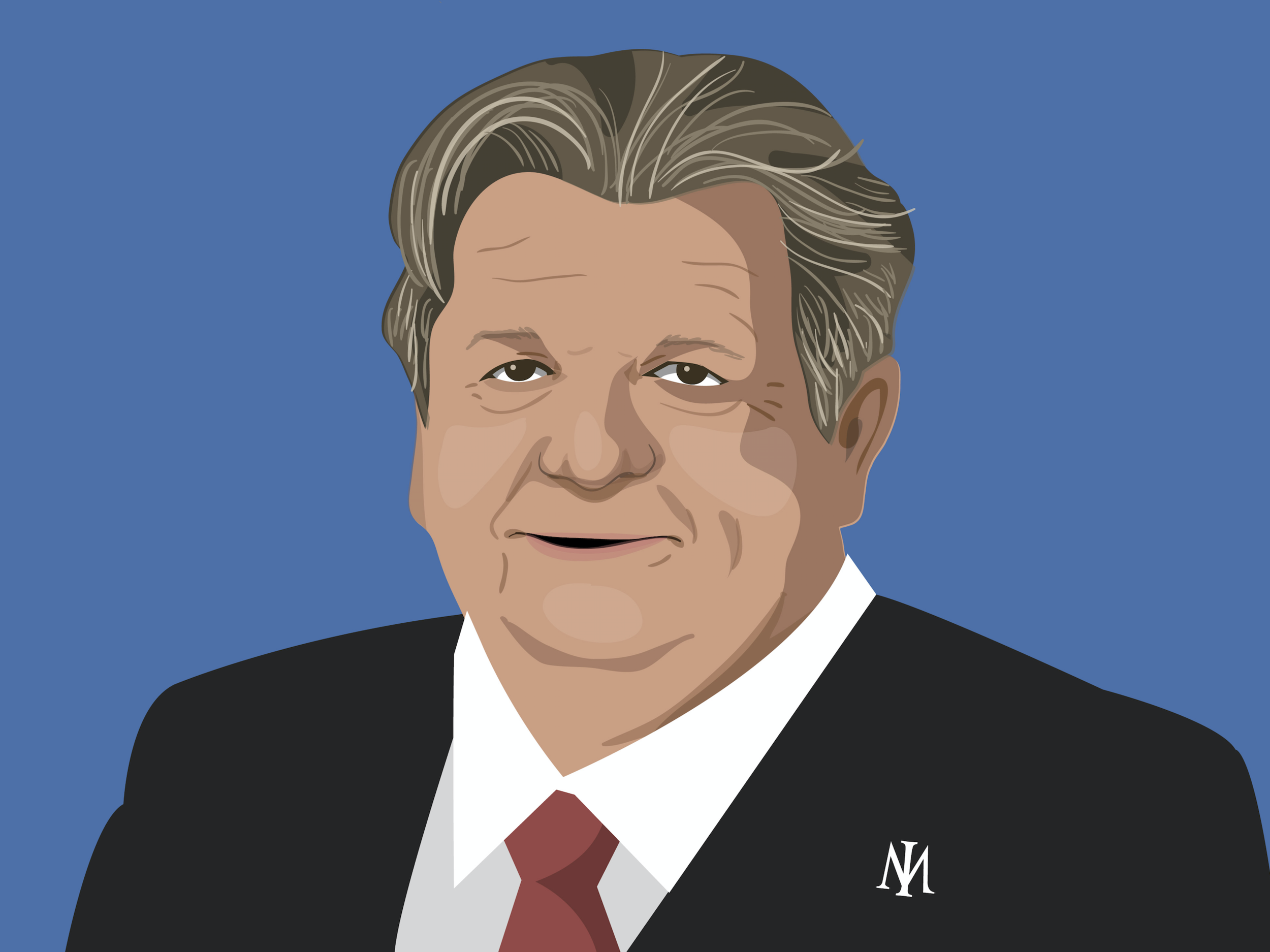
Company Issues Provide Opportunity

Investment Master - Chris Bloomstran

Investment Master - Chris Bloomstran

Usually company specific issues provide opportunities. My experience has been that when the whole market sells off and everything gets cheap, it’s hard to want to make changes because we already like what we own. We’ve also proven unwilling to trade down the quality spectrum during a rout like ‘08, even though you’re going to make way more during the recovery. That won’t change.”

Portfolio Turnover

“We’ve had on average about 15% turnover for the last 20 years. Our turnover in 2008 was probably 70%. We had about half of our capital in financials at the end of 2007 which included insurers. None of our holdings failed. In fact, some were rewarded for their conservatism with failed assets more or less given to them at fire sale prices.”

Thinking About Management

We have learned to think a lot more and spend a lot more time assessing management quality. We are spending a lot more time in the proxy statement than we used to. In our portfolio we only have about 20% of our businesses profits coming back to us in dividends which means management teams are retaining 80% of the profits. It is incumbent on us to work out how those people allocate capital. There are so many levers management can pull and we are very deliberate in assessing how well capital gets invested in the businesses we own.”

The Proxy Statement

We are spending more time with proxy statements. We try and tie in year to year changes. What we’ve learned by looking at the evolution of proxies over a period of ten or more years, by observing how compensation committees award and incentivise management, is that you can really ferret out underlying changes in the business.

As an example, General Mills’ bonus structure is tied to two yardsticks, none of which are capital related. One is organic sales growth and the other is free cash flow growth. Ten years ago they were using 3-4% organic sales growth as the hurdle for paying half the bonus. Over time that became 3%, then 2%, then 1.4% and in the last couple of years the hurdle has become negative. Think about that! Rev up the acquisition machine. Buy Blue Buffalo. You don’t count a deal in year one but if its a growing business you sure get your organic growth in the out years, regardless of profitability.

Many consumer packaged goods businesses are under-investing in their business and it’s evident in the free cash flow. It’s pretty easy to dial up free cash flow growth by cutting advertising and growth initiatives. I guarantee these people lay awake at night thinking about how to get supremely wealthy in the next five years and not how they are going to grow or protect the business over the next thirty years. If you don’t have a motivation to make decisions based on returns on assets or capital or equity you can get all kinds of nutso behavior. You might as well take a giant pile of money and light it on fire.”

The Macro

I wish we didn’t have to think about macro. We spend almost all of our time turning over rocks and looking at businesses, but, in my investing lifetime, we’ve seen aggregate debt levels systemically rise to levels we think are unsustainable. And that does enter our thinking. With on-balance sheet debt alone now at 350% of US GDP and 320% of global GDP, we don’t have room for a term structure of interest rates even remotely similar to where it was prior to the financial crisis. The days of 5-7% interest rates don’t work when debt is 350% of GDP.

The notion that debt levels are unsustainable and we are unlikely to grow our way out of what we think is excess leverage, lends to our thinking that interest rates will probably stay far lower for far longer than would be the case in a more normal, unlevered society. For that, you do allow for higher multiples somewhat than would have been the case historically. By contrast, we also think because the debt numbers are unsustainable we very much worry about long term stability in the financial system. The flip side of low rates driving higher multiples is that low rates are reflective of too much debt which goes hand in hand with disallowing growth. Therefore you can’t justify multiples that purely reflect low rates. Paying high prices for no growth won’t work out. Look at Japan for the past 30 years. We have small positions in two gold companies which are really just hedges against central banks doing bad things. Combined they are a mid to high single digit exposure.”

Anchoring - Mistakes of Commission

“Our single biggest error of commission was Ross Stores. We bought the position when small caps were cheap in 2000 for less than 10x earnings and 50% of sales. We loved the business and we loved the unit economics. We bought it as such a discount that during the 2000-2002 downturn which saw the S&P fall 50% we made about two and a half times our money over that period. When it traded for something like 20x we thought we could sell it at what looked like a full valuation and ease back into the shares at some point when valuations were a lot more attractive. I was probably anchored to having bought the stock at 10x earnings. It never traded at 10x again. It traded in the mid teens. After we sold the stock, it went on to be another twenty bagger. A gravely expensive mistake.”

Costco & Growth

“I learnt a lot about the growth component of the value equation by watching Ross Stores. A couple of years after we sold Ross we bought Costco, which has provided an invaluable education about how capital really works. Costco is the same deal as Ross Stores. We love the unit economics, we love the management. Costco had a similar number of stores to Ross when we first bought it. They’d just started paying a dividend. We bought Costco when their gross margin was about 14% and they were earning 11% on capital. We understood, having followed high quality businesses like Walgreens, Walmart and Home Depot for a lot of years, the embedded unit economics of Costco where lots of stores that have been opened recently and don’t reach maturity for six or seven years. Therefore the 11% return on capital was very much understated by the relative installed base compared to new stores that had been opened.

I paid 20x earnings. I was still a classic value guy and value guys don’t pay 20x for things. Fast forward today and Costco trades for over 30x, so you’ve made over 50% on the multiple expansion, but we’ve made over 10x our money on Costco because they’ve grown the store base profitably.

The gross margin has been driven down from 14% to 11%. Wall Street typically kills a company for shaving gross margin, however Costco has taken the scale and purchasing power of the business and they’ve passed their cost savings through to their customers. Returns on capital have gravitated upward towards to the high teens or higher if you account for the cut in tax rates [Costco will likely be one of the first companies to compete away the tax cuts]. Our returns over owning the business for a long time have gravitated toward the underlying return on capital of the business.”

Most Valuable Lesson

I look at the amount of money we made on Costco and we could have paid 35-40x earnings at the time. Everything they do as a retailer is best in class. You just can’t get anchored to classic valuation pricing methods even if you call yourself a value investor. This is probably the most valuable thing I’ve learned. The extension of that is, if you own a business that really is a true genuine compounder where you have a ramp to grow and particularly for re-investment at high rates of return, don’t sell it, and definitely don’t sell it all. I get cute with a lot of other things that aren’t your classic compounders but any time I’ve sold shares in one of the handful of businesses that I think we can own forever it has proven to be a mistake. ”

When Compounders Mature

The durability of compounders is really only obvious in arrears. There are very few that are knowable. The risk is when you own a compounder and it matures and starts to face its own competition. Walmart for example, having killed retailers in small towns started facing competition. First from Costco and the like and then internet retailing. Look at Coke for the last 20 years. The core business weakened at the same time it traded for a nosebleed valuation that was awarded because of a glorious past.”

Price Matters

A great business at the wrong price can be a disaster.

Long Term Focus

We have stocks that have some common threads. They have all suffered in one form or another. We’ve been able to look through the short term suffering which is just that, it’s short term. Richemont is a great example. We’ve owned it for a handful of years. Richemont owns Cartier and Van Cleef & Arpels in jewelry. They have ten or so very high end watch brands including Vacheron Constantin, IWC and Jaeger-LeCoultre. Then they own some one-off brands like Peter Millar and Purdey shotguns. The Ruperts, the family that founded the firm had South African tobacco holdings which they sold to BAT probably 30 years ago. Within a holding company structure, they started buying up luxury brands. They’ve done a marvellous job preserving the brands and building them out and growing them intelligently.

Richemont’s watch business, when you count watches sold by Cartier, comprise about half the revenue, experienced a huge growth curve on the back of Asian demand. Richemont grew their distribution by using the store inside a store concept. Retail outlets were located in the best zip codes in Hong Kong, Macau and the rest of the high end world. A few years ago two things happened - the Chinese cracked down on graft and travel visas which really put a dent in high-end watch sales. It gave us the opportunity to buy the stock.

We watched how the CEO, Mr Johann Rupert and the management thought about the long-term viability of the brands they own. Mr Rupert talks about being a temporary steward of Vacheron which was founded in 1855. When sales declined, management recognised an excess of inventory in the retail partner channel. The first thing retailers do when sales slow and they have excess inventory is mark it down. The last thing you want to see happen if your customer just paid $20,000 for a watch is to see it sell six months later on on the grey market for $15,000. Richemont approached their retail partners and bought back a whole bunch of inventory and in some cases physically melted down the precious metal content of the watches.

Richemont is a 65% gross margin manufacturer. Initially I presumed the value of a $20,000 or $200,000 watch was largely in the precious metal or jewel content. Far from it. The higher up the price point, the higher the gross margin. On a $200,000 watch the gross margin can be ninety percent plus. It’s the brand. So to preserve brand they destroyed watches.

They also didn’t want to be in a situation where retail partners could kill the brands so they built out more of their own distribution. They spent a lot of money building out their own bricks and mortar. They sacrificed operating margins for the durability of the brand. The watch business is a good business but will likely only grow 4-6% organically, above nominal GDP, but it’s the fashion jewellery business where the upside lies. Fashion jewellery is very early, it’s maybe 10% of all the jewellery sold and there is a long curve to teach wealthy families about the appeal of high end jewellery lines. Once you’re into a line you’re kind of hooked on it. They’ve now fully bought into the internet. Control of distribution is a common theme across several names in our portfolio.”

Disruption & Change

Disruption is happening at a much faster pace which makes investing that much harder. What looked to be a durable brand or franchise can get dislocated in a hurry. Things like cutting out wholesalers and middlemen and going direct to consumers, I think we are in the early innings of it.”

“If you get fundamental change on a compounder and you bought it at a high price, the combination of the fundamentals deteriorating and then the multiple revaluation downward can be lethal.”

Understand

There are reasons we will stop the investment process. We start with either unknowability of industries or industries we don’t like because the economics don’t work for us. They would be the easiest decisions (e.g. Electric utilities without growth and the complexity of pharmaceuticals).

When I think back to the branded pharma companies we’ve owned, despite making a bunch of money, we really didn’t know what we were doing. It’s the unknowability. We’re not scientists and I’m not sure the scientists inside those companies know what’s going to go through the FDA or the EMEA. We don’t have an edge. Being lucky is not a replacement for understanding.”

Business Fundamentals

“Once we get past knowability, it’s onto the blocking and tackling which is the business fundamentals, management quality and how they’re compensated, price & volume, the durability of product lines and all the myriad accounting adjustments we make.

If we have an edge it’s adjusting every business’ GAAP numbers. Most businesses overstate what they earn. We are very good at getting to economic earnings from GAAP or IFRS which is just the starting point.”

Waiting for Price

“We’ve built a working list over the years of c450 companies that we track peripherally. We try and update our thinking on them through the course of the year. We maintain a rough intrinsic value target. When we get a stock trading south of that number we might get interested. It’s a function of sitting around and waiting for price. In the meantime thinking about where you are wrong on the valuation or the fundamentals. Price is then kind of the last thing we look at. When we have done work for 20 years on a business and the price now makes sense it’s very easy for us to put 1-2% to work. To the extent we’ll have to do more work we’ll do it. If we get comfortable we’ll make the position size even larger.”

Circle of Competence

“I would tell my younger self, ‘your circle of competence is way more narrow than you think it is.’”

Independence of Thought

From a psychological perspective, you need independence of thought, but not to a fault. You need an understanding that the crowd at the extremes is wrong, but for a long time they can be right.”

Client Alignment

Client expectations are never aligned. Clients expect results and if you’re not racing ahead when markets are, nobody likes to get richer slower. We spend a fair amount of time with process over the years, and telling the same story. It still doesn’t make it any easier. Human nature doesn’t make it any easier. Most people wrongly view the stock market as a casino, and it’s not. It’s a joy and refreshing to find clients who get it, who think about the long term, that are realistic about expected returns and think about what can go wrong and right. It makes way more sense to focus on long-term business performance and not short-term stock price performance, but that’s really hard for most people. It’s easy to see the stock price. You have to work to understand the business.”

Free Cash Flow

We’re looking for businesses that have an opportunity to invest and build out capacity. We are looking for retail concepts that can grow units over time on an accretive basis and expand returns on capital. Can I build a plant or distribution facility and earn high returns on the investment? Free cash flow in that setting is a terrible concept. It’s a great yardstick if you are in a business that is mature and isn’t going to grow. There are all kinds of flaws with various pricing metrics. It would be easier if maintenance capex was a disclosed number. It’s not. So you’ve got to talk to management and get a sense of what it really takes to replace your capital stock.”

Listen to Transcripts

“We read the transcripts but we might also listen to the transcript to see the nuances, to hear how something is said. The value might be in the Q&A and listening to what was asked and how management has answered the questions.”

Value Line vs Broker Research

We read and see very little sell side research. We do read Value Line, both the large cap and the small and mid cap editions every week. It allows me to cover the gamut of a lot of companies and industries very efficiently. Thirteen editions. It’s not in-depth but you see each company and industry four times per year.”

Questioning Management

We don’t want to talk to management about quarterly earnings. We are trying to get to the durability of the business franchise. I want to understand why an insurance company can raise prices by 6.9% but not 7%. That answer is meaningful for me. It’s not something discussed in a SEC filing. But there’s value in knowing that stuff.”

Summary

Chris also suggested some book titles he has read and recommended to others. These include: Sol Price, Merger Masters by Kate Welling, Economics in One Lesson, Freedom’s Forge, The Forgotten Man, Shoe Dog, Railroader, and The Bare Essentials. He gives copies of The Richest Man in Babylon and The Intelligent Investor to lots of students. All of these tomes include fascinating and valuable insights into both business and investment worlds.

Chris is a Master. Even with more than twenty years of my own in investing, Chris still manages to teach me things that add value to my own thinking. He is humble and was very generous with his time, and I am grateful for the opportunity to have spoken with him.


Further Reading:
Chris Bloomstran: The New Super Investors - Investment Masters Class
Chris Bloomstran - Annual Letter [Part II] - Investment Masters Class
Chris Bloomstran – What Makes a Quality Company – Invest Like the Best - Podcast

Semper Augustus - Investor Letters


Join our Investing Community for daily insights on Twitter: @mastersinvest

TERMS OF USE: DISCLAIMER


Learning From Chuck Akre

One of the traits that sets the Great Investors apart is the ability to be grounded - to remain calm under pressure and sensible when things get hairy. All the Masters have it but none more so than Chuck Akre.

Grounded: Mentally and emotionally stable, admirably sensible, realistic, and unpretentious.

And ‘Grounded’ quite possibly is the perfect word to describe Chuck. If you’ve been an active reader of our blog over the last few years, I’m sure you’ll remember our post on Chuck Akre and his Three Legged Stool. Like Buffett, he prefers to work away from the noise of Wall Street. His office is based in a small Virginian town that boasts a single traffic light. His humility and expertise are synonymous with those we call Master Investors and Chuck has been kind enough to give of his time to us on a number of occasions. He is someone we follow avidly.

Screen Shot 2019-08-03 at 5.08.56 am.png

Chuck was recently interviewed on one of our favourite Podcast series: ‘Invest Like the Best’ with Patrick O’Shaughnessy. O’Shaughnessy typically has a great line up and as usual, he delivered big time on his recent talk with Chuck. Chuck’s explanations and investment approach are refreshing in their simplicity. Over more than fifty years of investing experience, Chuck has distilled the essence of great investing into three key criteria which he refers to as his ‘Three Legged Stool.’ And while Chuck might be reluctant to disclose insights into his favourite stock positions, he does share a key insight in the Podcast which took him decades to appreciate. The podcast gets to the core of what great investing is all about. The Podcast is replete with pearls of wisdom and anecdotes, all straight from the legend’s mouth. It’s the perfect mental detox to remove the daily noise we get caught up in as investors.

Following are some of our favourite quotes from the Podcast:

Read

I spend a lot of time reading. That’s how ideas bubble up in my universe. Mostly it is a serendipitous, non-quantitative approach.

Imagination & Curiosity

“In my career I’ve literally run across thousands of people who were very very bright, but not necessarily good investors. Pure knowledge, in and of itself, is not a ticket to being a good investor. Imagination and curiosity are what’s hugely important. We’ve discovered things over the years purely by being curious and continuing to keep involved in the search process to find these exceptional businesses.”

“I find that curiosity has been useful to me in searching for investments. Relating real life experiences allows me to pursue lines of thought to find a stock that might be interesting.”

Curiosity and imagination go hand in hand in being creative and identifying businesses.”

Education & Smarts

“I had no background whatsoever in the business world; I was an English major and I’d been a pre-med student and had no courses in business whatsoever. So I had a clean canvas and a willingness and a desire to learn and so my voyage was: ‘What makes a good investor, what makes a good investment?’”

Stocks Outperform Long Term

“I examined early on, and continue to do so, rates of return in all asset categories and made the observation that rates of return in common stocks over a long period of time was higher than anything else on an unlevered basis.”

Compound Returns

“Thomas Phelps, wrote the book, ‘100 to 1 in the stock market’ in 1972, and to this day it remains inspirational to me and fundamental to me in terms of thinking about the issue of compound returns.”

Return on Equity

A return in an asset will approximate the ROE [FCF return on owners capital] given a constant valuation and given the absence of any distributions. You get that from your quantitative background. There are no constant valuations so you work hard to have a modest starting valuation.

Screen Shot 2019-08-02 at 8.51.32 pm.png

If our goal is to have above average outcomes we need businesses to have above average returns."

“We try to identify businesses that have had high returns on the owner’s capital for a long time and we spend a lot of time trying to figure out why that’s so and what caused that. What’s does the runway ahead of them look like? Is it broad and long? Do they still have the opportunity to earn above average returns on capital?”

“Rate of return is what drives us. Did I understand that implicitly thirty years ago or fifty years ago? No! Stuff that is right in front of your face sometimes doesn’t reveal itself in terms of its importance for a long time. I carry a coin in my pocket that says, ‘I am a chartered member of the slow learners.’ And that’s in fact the case.”

‘Three Legged Stool’

Screen+Shot+2018-08-04+at+9.53.56+AM.png

“Leg one [of the three-legged stool approach to investing] is the quality of the business enterprise. Leg two is the quality and integrity of the people who run the business and the third leg is, what is their record of reinvestment and what is their opportunity for re-investment? Once we have those in place, we say we’re just not willing to pay very much for these businesses. Those are the three legs of the stool.”

Disclosing Positions

We try not to talk very much about the companies in our portfolio and we certainly never talk about ones that are coming in and going out.”

In March of 2010, Chuck added their first position to MasterCard. Due to regulatory concerns, MasterCard and Visa were selling at 10 or 11 times. In regards to return on capital, Chuck noted “there isn’t a word in the English language superlative enough to talk about them. You could cut the margins in half twice and you’d still be above average for an American business. So clearly something extraordinary is going on there. It also tells you there is a big target on their back; everybody wants some of that. It tells you they are probably jamming everything they can in the income statement to try to reduce how good the margin is they are showing. We think we know what causes that and we’ve quit talking about it. If you read any research from Wall Street, and we read very little, there is no-one who talks about rates of return they are earning on their capital. Because Wall Street, in general has a completely different business model than we have. Our business model is to compound our capital. Wall Street’s business model, generically, is to create transactions. What is the best way to create transactions? Create false expectations, they are earnings estimates. We call it ‘beat by a penny and miss by a penny.’ That gives us opportunities periodically.”

Keep it Simple

Everything should be made as simple as possible. Lots of very bright people can build really intriguing complicated ways to find out why something is cheap or expensive. We try to keep things as simple as possible.”

Management

“[The managers we have owned] don’t have a screen in their office showing them the price of their stock. And lots of them do. Sometimes you find it in the lobby of a company and sometimes you find it on the CEO’s desk. That doesn’t interest us. Their focus is on the wrong thing, in our judgement.”

“We have an expression, ‘Our experience is that once a guy sticks his hand in your pocket, he’ll do it again.’ So we just have no reason to go there. We constantly find people’s behaviour which is antithetical to our interests.”

Post-Mortems

“We explore, we learn and we observe; we think a lot about the businesses we have sold. Was that the right decision? We’ve concluded in a number of cases is was not. But who does it perfectly?”

Right Once or Twice + Long Runway

“Here’s an important notion: You only need to be right in your investment decisions once or twice in a career. The challenge is how do you identify that? Typically you want something that’s small.”

Collect Data, Form Judgements

“A pre-med major, an English major, someone involved in the investment business - they’re all the same. They are about collecting data points and forming judgements around them. It’s all the same.”

Not Selling Exceptional Businesses

If we own exceptional businesses, one of the hardest things in the world is to not sell them. All businesses have hiccups in their business operations and all businesses have things occur that are unplanned for. Nothing is perfect. Not selling maybe is one of the hardest things to do. Maybe one of our greatest assets is our ability to not sell.”

Read Biographies

Reading business biographies you learn about people’s behaviour. Sometimes you see it through the eyes of a biographer who has a rose tint to the glasses, sometimes you see it through pure actions.”

Career Advice

Follow your passion. That’s the most important thing. And read like crazy and be curious about everything. It’s relating real life experiences.”

Pricing Power

I’m always looking for ways to understand pricing power because pricing power is key. What is the source of their pricing power? Think about MasterCard and Visa; we have our notions and we don’t talk about it anymore. And you’ll notice the company never talks about it.”

It’s Not all Quantitative

If this business was susceptible to purely quantitative approach, they wouldn’t need me and you would just a punch a button and it would solve for all your problems. That hasn’t happened.”

A Question for CEO’s

“One of the questions we like to ask [the CEO particularly] is, how do you measure if you’ve been a success managing this business? As you might expect some say the price of the stocks goes up, or we hit our earnings target, or we delivered on all the things the board asked of us. It’s a rare occasion that the CEO articulates an idea that shows he understands the idea of compounding the economic value per share. Why is that so? Because they’re trained to run businesses. They’re not trained to think about compounding the intrinsic value per share, which is really the single most important thing.”

Learning

Whilst Chuck has continued to out perform the Index for many years, it is interesting to note that his recent above average performance has been done entirely without any of the FAANGS. Many of the Masters cannot say the same; the likes of Google and Apple and Amazon feature in many of their portfolios. Chuck says it was simply because he ‘wasn’t smart enough or quick enough to figure them out.’ Humility indeed. But that said, it doesn’t say he’s not open to considering them.

Everyday is a learning day and we have to figure out which of those businesses [FAANGS], if any of them are truly attractive, and not subject to rapid changes in technology or governmental intervention or retaliatory issues relating to different countries in different parts of the world.”

Curiosity and Reciprocation

Chuck tells the story of how curiosity, observation and imagination led him to a tyre company with a history of very high returns on capital, a company called ‘Bandag’, which had done well for a long period of time. Chuck arranged a meeting with the company and when he walked into the CEO’s office, the CEO had his feet up on the desk and was eating an apple … “we got a different feel right off the bat,” Chuck noted.

Bandag’s returns were three or four times the competitors. Chuck’s goal was to go meet them and figure out what business they were actually in. Bandag was a tyre company that dealt with independent tyre dealers who retreaded Bus and Truck tyres. Bandag had taken the savings generated when key input costs fell and distributed the windfall to their dealers on the basis the dealers had to use the money in their business, ‘They couldn’t buy new Cadillacs, but they could buy a new store.’

As all the Bandag stores were franchised, each was an independent dealer who worked long hours compared to the competition. In contrast, employee dealers had no share in the profits and worked shorter hours. Bandag very wisely shared the wealth with their dealers instead of passing it all onto their shareholders. As a result they built a huge loyalty network of independent dealers, who continued to use the Bandag products instead of the national tyre companies. This resulted in much higher returns on capital than other tyre companies.

Summary

Just like successful athletes develop strategies to mentally prepare for the emotional rigour of a race or big game, investors can do the same. I find setting aside some time early in the day to re-visit insights from the great investors, be it Akre, Munger, Buffett, Lynch or others, keeps me grounded and mentally prepared for when volatility strikes.

Chuck’s ‘Three Legged Stool’ criteria for identifying great investments is beautiful in its simplicity. His lessons and mental models on other aspects of business and finance are incredibly handy to have at your disposal.

You don’t have to have a major in business to succeed, nor it seems do you need to be the quickest of the mark. It’s Chuck’s innate curiosity and imagination that have allowed him to spot great companies that quite often others have missed. We’re glad to have him in our community of Master Investors and we look forward to many more inspiring lessons.


Berkshire Meeting: Omaha 2019

Berkshire Meeting: Omaha 2019

Source: Invest Like the Best’ Podcast. Chuck Akre interview with Patrick O’Shaugnessy. 2019. Apple Podcasts.

Further Reading: Chuck’s Three Legged Stool’, Investment Masters Class.


Join our Investing Community for daily insights on Twitter: 
@mastersinvest

TERMS OF USE: DISCLAIMER


Guesses & Forecasts

If successful investing was as easy as acting on the headlines of the financial press or the latest stockbroker bulletin, we’d all be wealthy indeed. Very wealthy and very successful. Imagine how easy it would be to simply read headlines such as: ‘USD to rise’, ‘Gold to Break $2,000’, ‘Stock Market Crash Imminent’, ‘Company XYZ a BUY, Price Target $152’, and then upon taking action, turn those forecasts into success. Every single time. Sound too good to be true?

Unfortunately it is.

Forecasting is an art, not a science and as such, its incredibly hard to be accurate 100% of the time. Actually, when you think about it, its hard to be right even part of the time. Forecasting, at best, is just a considered guess, and when you look at the actual definitions of those two words, you’ll see there’s actually not much difference:

Forecast: “predict or estimate (a future event or trend)”.

Guess: estimate or conclude (something) without sufficient information to be sure of being correct.”

In the end, they’re both estimates, yet we’re often led to believe that the person making the estimate must have some foresight we don’t. Unfortunately the truth is, ordinarily they don’t.

“The rules of the investment profession seem to require that its members describe their views about the future using high-sounding terms like “analysis,” “assessment,” “projection,” “prediction” and “forecast.” Rarely do we see the word “guess.”)” Howard Marks

If investors demanded those publishing the forecasts to include their track record, life would be much simpler. I’m not suggesting forecasting is easy, but the confidence and precision portrayed by so-called experts reminds me of the charlatans who peddled their ‘miracle cures’ before medicine became a science.

“We always read ‘I think the stock market's going to go up.’ We never read ‘I think the stock market’s going up, (and 8 out of my last 30 predictions were right) or ‘I think the stock market's going to go up (and by the way I said the same thing last year and was wrong).’ Can you imagine deciding which baseball players to hire without knowing their batting averages? When did you ever see a market forecaster's track record? “ Howard Marks

"The greatest folly is to accept expert statements uncritically" Garrett Hardin

In over a quarter of a century in the finance industry, I’ve pretty much seen it all. Consider this recent forecast in Barron’s … 'Tesla is headed to $10 a share under a bearish case—or $391 under a bullish one, wrote [an] analyst this week’. The stock was around $200 at the time. I thought to myself, $391, that’s rather precise. No rounding required? Maybe $400? And the downside as low as $10? Yet that outcome seemed unlikely. Not because it was too bearish, but a glance at the debt load suggested to me that if the bearish case developed, the light will bypass yellow and go straight to red from green. And the analyst range of $10 to $391? I’m not sure how to make money out of that one, but given the possibility of losing everything, maybe it’s a stock to avoid?

The above statement can be best described as a guess. When we look into the future that’s what we’re all really doing. Guessing.

William Stewart, the founder of Stewart Asset Management, has bettered the S&P500 by a remarkable 4.3%pa net for 40 years! In a recent Graham & Doddesville interview he proffered:

“This is not a science but more of a guessing game. We try to make the best guesses we can.” William Stewart

“What you’re really doing is laying out your decision tree and adjusting it. You can come back saying, I think I got this a little high, or that a little low. It’s not fixed. In essence, we’re always operating with the best guess we can make. If it changes weekly, it changes weekly. It doesn’t usually change weekly, but it could. Nobody’s got a lock on what’s right, a model is only a model and it’s not fixed in stone. Sometimes, nothing’s changed but you changed your mind. That’s good. The purpose of the process is to bring out our best guesses. Everything we do is guessing. I think we all get a little carried away with the science of the matter, because there are lots of formulas, whereas you’re essentially making a guess.” William Stewart

Because we don’t have perfect information and because we can never know the future, a model capable of predicting an exact target price is fiction; even a 5,000 line spreadsheet model! Because businesses are unpredictable, some more so than others, asset price targets or intrinsic values can’t be set in stone; regardless of what their makers and promoters hope to convey.

We won’t know if a stock price was a reasonable reflection of a company’s value until some future date. So today, a stock price is just a fictional analog of the underlying company it represents.

The benefit of approaching investing with a ‘guessing’ mindset is that it removes the shackles of perfection. It provides for the possibility of being wrong and in doing so, it helps avoid confirmation and commitment biases.

"You need humility to say 'I might be wrong'.'' Seth Klarman

"Every day I assume every position I have is wrong." Paul Tudor Jones

William Stewart‘s quote took me back to one of my favourite books, ‘Super-Forecasting’, by Philip Tetlock. Tetlock’s observation about ‘guesses’ is an apt one.

“Probability judgements should be explicit so we can consider whether they are as accurate as they can be. And if they are nothing but a guess, because that’s the best we can do, we should say so. Knowing what we don’t know is better than thinking we know what we don’t.” Philip Tetlock

I’ve included some of my favourite quotes from Tetlock’s book below. I hope they’ll help guide you the next time you’re presented with an ‘expert’ forecast, or even if you’re attempting to develop your own.

Check The Forecasters’ Record

“Every day, the news media deliver forecasts without reporting, or even asking, how good the forecasters who made the forecasts really are.

Many have become wealthy peddling forecasting of untested value to corporate executives, government officials, and ordinary people who would never think of swallowing medicine of unknown efficacy and safety but who routinely pay for forecasts that are as dubious as elixirs sold from the back of a wagon.”

“The list of organisations that produce or buy forecasts without bothering to check for accuracy is astonishing.”

“Consumers of forecasting will stop being gulled by pundits with good stories and start asking how their past predictions fared - and reject answers that consist of nothing but anecdotes and credentials.”

“Far too many people treat numbers like sacred totems offering divine insight. The truly numerate know that numbers are tools, nothing more, and their quality can range from wretched to superb.

Most Forecasts Are Quickly Forgotten

Old forecasts are like old news - soon forgotten - and pundits are almost never asked to reconcile what they said with what actually happened.”

More often forecasts are made and then .. nothing. Accuracy is seldom determined after the fact and is almost never done with sufficient regularity and rigor that conclusions can be drawn. The reason? Mostly it’s a demand-side problem: The consumers of forecasting - governments, business, and the public - don’t demand evidence of accuracy. So there is no measurement.”

Forecasting is Often Impossible

“It’s misguided to think anyone can see very far into the future.

“It’s a rare day when a journalist says, ‘The market rose today for any one of a hundred different reasons, or a mix of them, so no one knows’.”

Uncertainty is real. It is the dream of total certainty that is an illusion.”

Limits on predictability are the predictable results of the butterfly dynamics of non-linear systems.”

“If you have to plan for a future beyond the forecasting horizon, plan for a surprise.”

“The past did not have to unfold as it did, the present did not have to be what it is, and the future is wide open. History is a virtually infinite array of possibilities.”

Stay Open-Minded, Curious and Self Critical

Super-forecasting demands thinking that is open-minded, careful, curious, and - above all - self critical. It also demands facts. The kind of thinking that produces superior judgement does not come effortlessly.”

“The strongest predictor of rising into the ranks of super-forecasters is perpetual beta, the degree to which one is committed to belief updating and self-improvement. It is roughly three times as powerful a predictor as its closest rival; intelligence.”

Seek Dis-Confirming Evidence

“Scientists must be able to answer the question “What would convince me I am wrong?” If they can’t it’s a sign they have grown too attached to their beliefs.”

We rarely seek out evidence that undercuts our first explanation, and when that evidence is shoved under our noses we become motivated skeptics - finding reasons, however tenuous, to belittle it or throw it out entirely.”

People can be astonishingly intransigent - and capable of rationalizing like crazy to avoid acknowledging new information.

“Social psychologists have long known that getting people to publicly commit to a belief is a great way to freeze it in place, making it resistant to change. The stronger the commitment, the greater the resistance.

“Super forecasters may have a surprising advantage; they’re not experts or professional, so they have little ego invested in each forecast.”

Beware High Confidence

Declarations of high confidence mainly tell you that an individual has constructed a coherent story in his mind, not necessarily the story is true.”

Screen Shot 2019-07-17 at 8.55.59 pm.png

People trust more confident financial advisers over those who are less confident even when their track records are identical.

Intuition is Pattern Recognition

“There is nothing mystical about an accurate intuition .. it’s pattern recognition. With training or experience, people can encode patterns deep in their memories in vast numbers and intricate detail - such as the estimated fifty thousand to one hundred thousand chess positions that top players have in their repertoire. If something doesn’t fit a pattern, a competent expert senses it immediately.”

Wrong Outcome Doesn’t Imply Wrong Forecast

“If the forecast said there was a 70% chance of rain and it rains, people think the forecast was right; if it doesn’t rain, they think it was wrong. This simple mistake is extremely common.”

& Vice Versa

“People often assume that when a decision is followed by a good outcome, the decision was good, which isn’t always true, and can be dangerous if it blinds us to the flaws in our thinking.”

Words, Numbers and Time Matter

“Study after study showed people attach very different meanings to probabilistic language like “could”, “might,” and “likely.”

“Forecasts must have clearly defined terms and timelines. They must use numbers.”

Fuzzy thinking can never be proven wrong. And only when we are proven wrong so clearly that we can no longer deny it to ourselves will we adjust our mental models of the world - producing a clearer picture of reality. Forecast, measure, revise: it is the surest path to seeing better.”

More People ≠ Better Forecasts

“Aggregating the judgments of many people who know nothing produces a lot of nothing.

Models are Models

No model captures the richness of human nature. Models are supposed to simplify things, which is why even the best are flawed.”

Forecasts Are To Foresee

“The point of making forecasts is not to tick all the boxes on the ‘how to make forecasts’ checklist. It is to foresee what’s coming.”

Sample Size & Randomness Matter

“Someone beats the market six or seven years in a row, journalists profile the great investor, calculate how unlikely it is to get such results by luck alone, and triumphantly announce that it’s proof of skill. The mistake? They ignore how many people were trying to do what the great man did. If it’s many thousand, the odds of someone getting that lucky shoot up.”

You Can Get Caught by Stories

It’s natural to be drawn to the inside view. It’s usually concrete and filled with engaging detail we can use to craft a story about what’s going on. The outside view is typically abstract, bare, and doesn’t lend itself so readily to storytelling.

Test & Debate Views

Super forecasters constantly look for other views they can synthesis with their own. There are many different ways to obtain new perspectives. What do other forecasters think? What outside and inside views have they come up with? What are the experts saying? You can even train yourself to generate different perspectives.”

“For super forecasters, beliefs are hypotheses to be tested, not treasures to be guarded.”

“If forecasters can keep questioning themselves and their team mates, and welcome vigorous debate, the group can become more than the sum of its parts.”

Assume You’re Forecast is Wrong

“Researchers have found that merely asking people to assume their initial judgement is wrong, to seriously consider why that might be, and then make another judgement, produces a second estimate which, when combined with the first, improves accuracy almost as much as getting a second estimate from another person.”

Practice Forecasting

Learning to forecast requires trying to forecast. Reading books on forecasting is no substitute for the experience of the real thing.”

“Our expectations of the future are derived from our mental models of how the world works, and every event is an opportunity to learn and improve those models.”

Revisit Forecasts

“To learn from failure, we must know when we fail.”

“Unfortunately, most forecasters do not get high-quality feedback that helps meteorologists and bridge players improve. There are two main reasons why. Ambiguous language is a big one. Vague terms like ‘probably’ and ‘likely’ make it impossible to judge forecasts. The second big barrier to feedback is time lag. When forecasts span months or years, the wait for a result allows the flaws of memory to creep in.”

Hindsight Bias

“Once we know the outcome of something, that knowledge skews our perception of what we thought before we knew the outcome; that’s hindsight bias.”

Stay Humble

Underlying super-forecasting is a spirit of humility - sense that the complexity of reality is staggering, our ability to comprehend limited, and mistake inevitable.”

Summary

The front pages of yesterday’s financial papers and brokerages bulletins are littered with stock recommendations that resulted in permanent loss of capital. Why? Because for most forecasters, it doesn’t matter. It’s wasted ink not money. New Price target 50% of Old Price Target. Has the model been changed? The old model didn’t work?

When you don’t have a position, you just have an opinion. It’s for this reason I prioritise information from investors with skin-in-the game and long track records of success.

The next time you’re presented with a forecast, take the time to consider the forecasters track record of success, and also why they might be making such claims. Remember, if their guess is right, they’re seen as a guru; if they get it wrong nobody remembers anyway.

I’ll let Morgan Housel have the last word on this topic:

“You don’t get on TV, or invited to industry conferences, or big book deals for predicting average outcomes. Pundits get paid for sitting three standard deviations away from sane analysts.”


Source:Superforecasting: The Art and Science of Prediction’ Philip Tetlock, Dan Gardner, Broadway Books, 2016.

Further Reading: Investment Masters Class Tutorial - ‘Forecasting


Join our Investing Community for daily insights on Twitter: 
@mastersinvest

TERMS OF USE: DISCLAIMER


Learning from Sol Price

Walmart, Costco, Home Depot. You’ve heard of them no doubt? Together, they’re recognised as the world’s largest retail and hardware chains and believe it or not, all three owe a great deal of their legacy to the same man.

Sol Price.

Walmart’s founder, Sam Walton, noted in his biography, "Most everything I've done I've copied from somebody else." Later he divulged, "I guess I've stolen - I actually prefer the word 'borrowed' - as many ideas from Sol Price as from anybody else in the business."

It’s the same story for Costco. It’s founder, Jim Sinegal, had one mission: ‘clone’ Sol Price’s retail business. Jim also had the credentials to do so. At the age of 18, Sinegal started his retail career as an employee of Sol Price and three decades later he left to start Costco. A reporter once asked Jim: “you worked for Sol for so many years, you must have learnt a lot?” To which Jim replied “No, that’s inaccurate, I learned everything from Sol Price.” Sol Price was his mentor and as he put it: ‘The smartest businessman I ever met’.

'Sol Price was a very intelligent man.' Charlie Munger

Similarly, there’s every chance that Home Depot wouldn’t exist today if not for Sol Price. Home Depot’s co-founder, Arthur Blank, went to see his friend Sol after he was fired from a hardware chain called Handy Dan Home Improvement. In that meeting, Sol encouraged Arthur to forget about suing his ex-employee and instead start a retail business. Which he did.

TCzwx6T.jpg

As the son of immigrant parents, Sol Price grew up in the Bronx, before relocating to San Diego, where he met his wife Helen. While pursuing a career as a lawyer, Sol’s father-in-law passed away leaving a property which needed to be dealt with. Sol ended up trading the property for a vacant retail property in need of a new tenant. Sol sought advice from a good friend and client who’d opened a few jewellers stores in San Diego. The friend explained how the jeweller’s highest volume account was a business called Fedco, a membership retail store which catered to federal employees in Los Angeles. As a not-for-profit corporation, Fedco was doing a brisk business with customers coming from as far away as San Diego.

Sol tried to convince Fedco to join with him to open a Fedco at his vacant property. Fedco declined. Henceforth, FedMart was born. Fedmart was started as a ‘membership’ retailer, allowing the business to circumvent the strict Fair Trade Laws applicable at the time; laws which gave manufacturers the right to set minimum selling prices for their products.

Ultimately Sol sold FedMart to a European retailer, and remained in the business. Before long the new owners clashed with Sol and fired him. Sol wasted no time moving on. Sol started a wholesale cash and carry business he named the The Price Club. Unfortunately, it wasn’t all smooth sailing to begin, with initial sales well below budget. In response to lagging sales, Sol decided to open the business to a wider customer base. Sales grew rapidly. The Price Club concept grew into a 94 store enterprise before it merged with Costco.

While you’ll find references to Sol Price in Sam Walton and Arthur Blank’s biographies, Robert Price has written a biography about his father entitled Sol Price - Retail Revolutionary and Social Innovator. Once again, you’ll find many of the characteristics embodied in Sol in the other Master CEO’s we’ve covered; it’s no surprise, many took a leaf straight out of Sol’s book. Here are some of my favourite insights from the book.

Retail Innovation

‘As a retail revolutionary, Sol’s brilliance changed the way we shop, first with FedMart in 1954, the retail format copied by Walmart, Kmart and Target in 1962; and then, with the Price Club, the warehouse club format adopted by Costco and Sam’s Club in 1983.”

“Fortunately, most of us had backgrounds that were alien to retailing. We didn’t know what wouldn’t work or what we couldn’t do.” Sol Price

Look After Customers

“Our first duty is to our customers. Our second duty is to our employees. Our third duty is to our stockholders.” Sol Price

“[Sol] was never driven by the need to have the most stores or the most money, but by the desire to give the customer the best deal and to provide fair wages and benefits to FedMart’s employees.”

And Employees

“Employees [in San Antonio] were paying their employees 50 cents per hour. Sol knew that people could not live on 50 cents an hour. He decided that the wage rate at FedMart would be $1.00 per hour. Of course, everyone wanted to work at FedMart.”

“Sol’s approach to FedMart employees mirrored the relationship he had with FedMart members. He felt a responsibility -a fiduciary duty - to provide excellent wages, benefits, and working conditions for employees.”

In a bulletin to FedMart employees, Sol said: ‘We believe that you should be paid the best wages in your community for the job you perform. We believe that you should be provided with an opportunity to invest in the company so you can prosper as it prospers. We believe you should be encouraged to express yourself freely and without fear of recrimination or retaliation.'”

Innovate to Keep Prices Down

“Because Fair Trade Laws impacted so many products, including such staples as Tide detergent and name-brand liquors, FedMart developed a line of private label merchandise. FedMart purchased these products with specifications and standards as nearly equivalent to the national brands as possible and stocked the FM brand to demonstrate the savings.”

“FedMart’s low price merchandise, limited selection, yet breadth of product offerings had a major impact on the retail world.”

“According to Sol, FedMart was not a discount store. He described FedMart as a ‘low margin retailer.’”

“FedMart priced merchandise starting with the cost of the product and taking as small a markup as possible - consistent with covering expenses and a small profit while giving the customer the best price.”

“The trusting relationship with members was reinforced by FedMart’s unique merchandise selection - limited selection and large pack sizes. Sol proved it was possible to do more sales with fewer merchandise items [stock keeping units - SKUs). He pioneered large packing size as a way of lowering prices.”

“The typical grocery or discount store carried about 50,000 different items compared to Price Club’s 3,000 items.”

“Price Club was different from other retailers - charging a $25 annual fee with large package sizes and extremely limited selection.”

“[Product] sampling increased sales both because members liked the products and because of the ‘reciprocity rule’, people’s subconscious desire when receiving something for free.”

‘The Intelligent Loss of Sales’

“One of the intriguing questions is: why does limited selection result in higher sales? Part of the answer lies in what Sol called ‘the intelligent loss of sales.Conventional wisdom in retailing is to stock as many items as possible in order to satisfy every customer’s needs and wants. The ‘intelligent loss of sales’ turns that theory on its head, postulating that customer demand is most sensitive to price, not selection. And low prices are possible only if there is integrity in the pricing combined with being the most efficient operator.”

“Because payroll and benefits represent approximately 80% of a retailer’s cost of operations, pricing advantage follows labor productivity. Put simply, the cost to deal with 4,500 items is a lot less than the cost to deal with 50,000 items.”

Empower Staff

Sol taught by example and he taught by engaging people in challenging discussions, demanding that they use their brains.”

“In return for providing a great workplace for FedMart employees, Sol asked only two things of his employees: that they work hard and that they think.”

A Customer Fiduciary

“Sol’s business philosophy was simple:

1) Provide the best possible value to the customers, excellent quality products at the lowest possible prices.

2) Pay good wages and provide good benefits, including health insurance to employees.

3) Maintain honest business practices.

4) Make money for investors.

Sol believed in building long term relationships with his customers. He described his business philosophy as the professional fiduciary relationship between the retailer and the customer. In his words; ‘If you recognize you’re really a fiduciary for the customer, you shouldn’t make too much money.’

The underpinnings of this fiduciary were consistently high quality merchandise and consistently low prices. Sol infused FedMart’s employees with the belief that they were representing the interests of the customer.”

Refund Policy

“Sol’s sense of duty to FedMart members was punctuated by FedMart’s refund policy: ‘Everything we sell is guaranteed unconditionally. We will give an immediate cash refund to any customer not completely satisfied with a purchase made at FedMart. No questions asked.’”

Pristine Ethics / Tone at The Top

“Sol’s business ethics extended to all facets of his business world. FedMart employees were prohibited from taking any form of gratuity from suppliers, even a free lunch. But suppliers were to be treated fairly.”

“Sol believed that fairness was a moral imperative. He would say that rich people would often think they gained their wealth on their own when, in fact, their success was the product of their teachers, along with government workers, service providers, and the employees in their companies.”

Membership Model Benefits

“There were a number of reasons for charging a membership fee of $25, a significant amount of money compared to the rather nominal $2 membership fee that members of FedMart paid. The most important reason was to use the membership money to lower prices by including the fee in the calculation of gross margins.”

“The $25 membership fee also operated as an incentive for the member to purchase more as a way to leverage the membership fee as a percent of purchases. In addition, the membership concept helped reduce operating expenses for the business because the membership psychologically tied the member to Price Club and eliminated the need to advertise.”

Summary

One of the things I find particularly interesting with Sol is that, as with Warren Buffett, many people have benefited from one man’s insights. Thousands of investors have benefited from all the lessons shared by Warren Buffett. They’ve recognized his success and copied it. Berkshire Hathaway itself has copied others.

“All Berkshire does is copy the right people.” Charlie Munger

The same can be said for Walmart, Costco and Home Depot. Even Jeff Bezos’ Amazon Prime membership model draws on the innovation of Sol Price. If the world’s largest retailers and hardware chains have all been influenced by the one man, and even further have emulated his practices in their own businesses, its hard to refute that the man was a genius.

Sol was a true Master.


Join our Investing Community for daily insights on Twitter: 
@mastersinvest

TERMS OF USE: DISCLAIMER

Disclosing Positions

disclose.JPG

Not many investors have been likened to Warren Buffett in their investment career. Besides numerous other aspects, you would need to have an incredible track record for one, and most of the Investment Masters, despite having enviable track records themselves, have found it difficult to match Buffett and his long history of success.

UK based Neil Woodford has been likened to Buffett in the past, and for a while enjoyed both the financial success and the celebrity that came with it. Right up to the point where he didn’t. The recent demise of The Woodford Fund has been well-publicised and well-analysed, with a lot of reasons for its downfall.

‘The glittering career of Neil Russell Woodford, touted as the UK’s answer to legendary American investor Warren Buffett, lies in tatters. The UK financial regulator has turned on him, long-standing investors have collectively pulled billions of pounds from his funds, and a reputation built over four decades of front-line investment management has been ripped to shreds.” Barrons, June 2019

One factor that likely contributed to the downfall was Mr Woodford’s decision to publicly disclose all his positions. Now it has to be said that taken by itself, his disclosure would not have led to the downfall of the fund, but after the dust settled, it seems disclosure added to its woes.

“Woodford will publish only the top 10 holdings of his three funds while redemptions from the LF Woodford Equity Income Fund are halted, the firm said in a statement on Monday. The move is an abrupt shift from a longstanding commitment to provide transparency about investments; the fund previously disclosed all holdings at the end of each month.” Bloomberg, June 2019

Many managers release their letters publicly. While a letter’s purpose is to inform a fund’s investors, it can also be used to help clarify the manager’s own thinking. In many cases the letters are a marketing tool to help attract new funds. At times, managers use letters to explain how and why the fund’s performance differs from others. Some manager’s hope the information conveyed in their letters will encourage others into the investment, a catalyst to close the gap between an under-priced stock and its fair value.

Despite the many who do disclose, some choose not to publish letters, or if they do, they’re very hard to find. Others choose to disclose little about the positions that make up the fund.

Why is this so?

Front Run - Squeeze

Without doubt, The Woodford Fund’s woes were exacerbated by the market’s knowledge of the positions. For those unfamiliar with what transpired, the ‘star’ UK fund manager stopped redemptions after facing a multitude of problems; a cocktail of illiquid assets, poor performance, riskier assets and questionable management actions. This resulted in a mass exodus by investors. Market knowledge of the stock positions attracted predatory shorts which moved ahead of, or front-ran, the unwind of the fund. The UK’s FT noted:

“Mr Woodford’s ambition for full transparency on his holdings may have been enlightened, but recent weeks have shown the risks of such openness. Short sellers have been able to exploit his difficulties, driving down the prices of investments they know he will be under pressure to sell.

It’s one reason managers can be reluctant to disclose positions.

“Our Fund is concentrated in relatively few large positions and greater disclosure than that required could make it more difficult to deal when we are building or divesting from positions in the Fund, and enable other market participants to “front run” our dealing activity to the detriment of the prices we can achieve.” Terry Smith

And size positions appropriately.

“Being too large in an activity enables the rest of the market to pick you off or ‘gun’ for you. We once did an option trade that was so compelling that we built much too large a position. We found that as market participants sensed the size of our positions, they ‘ganged up’ on us. The options that we bought at cheap prices just got cheaper and cheaper, people anticipated our ‘rolls’ from one option to another, and every trading action we took seemed to increase our losses. As soon as we unwound the position to stem the losses, prices rebounded to near normal levels. It was quite an expensive lesson for people who were used to trading quietly in the market, rather than being the focal point for attack.Paul Singer

I suspect Bill Ackman knows that feeling all too well. In 2012, with much fanfare, he announced a $1 billion short position in Herbalife. Ackman opened the attack publicly with a three hour, 342-slide presentation at the New York Sohn Conference. Like a red rag to a bull, hedge funds, including Dan Loeb’s Thirdpoint, piled in on the long side, squeezing Ackman. Soon after, billionaire activist Carl Icahn whaled into a 25% stake, predicting at the time Ackman’s investment could produce the “mother of all short squeezes.” In 2017, when Ackman finally capitulated and closed the position, he’d dusted $500m.

Ackman survived the ordeal. But one of the most infamous funds that faced a ‘run on its positions’ and didn’t survive was Long-Term Capital Management. It almost took the US financial system down with it. Once highly secretive, as liquidity problems emerged, the fund was forced to seek capital, requiring a higher level of disclosure. Roger Lowenstein’s brilliant book, ‘When Genius Failed’, noted:

“As it scavenged for capital, Long-Term had been forced to reveal bits and pieces and even the general outline of its portfolio. Ironically, the secrecy-obsessed hedge fund had become an open book. Markets, as Vinny Mattone might say, conspire against the weak. And thanks to Meriwether’s letter, all Wall Street knew about Long-Term’s troubles. Rival firms began to sell in advance of what they feared would be an avalanche of liquidating by Long-Term. ‘When you bare your secrets, you’re left naked’.”

Knowledge of Long-Term’s portfolio was, by now commonplace. Salomon was, and had been, pounding the fund’s positions for months. Deutsche Bank was bailing out of swap trades, and American International Group, which hadn’t shown any interest in equity volatility before, was suddenly bidding for it. Why this sudden interest, if not to exploit Long-Term’s distress? Morgan and UBS were buying volatility, too. Some of this activity was clearly predatory. The game, as old as Wall Street itself, was simple: if Long-Term could be made to feel enough pain - could be squeezed - the fund would cry and buy back its shorts. Then anyone who owned those positions would make a bundle.”

It’s little wonder many managers are careful about publicly disclosing positions, especially shorts.

“As you are aware, we are guarded in disclosing our shorts to anyone.” Andreas Halvorsen

"The danger is you get squeezed on that short. Bob Wilson, a very famous short seller, famously said that nobody ever gets rich publicising their shorts. You want to get rich quietly. I don't go on CNBC trying to talk a stock up." Leon Cooperman

Commitment Bias

Ackman’s nemeses in Herbalife weren’t confined to the hedge funds that squeezed him. The enemy was also within. The fact he was on the record in a big way [342 pages!] and had committed tens of millions in research and publicity costs meant he was all-in. While Ackman recognised the ‘commitment bias’ in Wall Street analysts he may have missed his own short comings.

When one shares an investment thesis publicly, it can be more difficult to change one’s mind because the human mind has a tendency to ignore data that are inconsistent with a firmly held view, and particularly so, when that view is aired publicly. That is likely why Wall Street analysts continued to rate MBIA a buy until it nearly went bankrupt. And, I believe it is why analysts will likely keep their buy ratings until Herbalife is shut down by regulators or the company faces substantial distributor defections.” Bill Ackman

Many of the Investment Masters understand the risks of sharing positions, ideas and thoughts on the record. Talking up a big position can make it harder to change one’s view when contradictory evidence emerges.

“The more public you become with your positions the harder it is for your ego to let go of a position. You can’t let your ego slow you down when the facts change. Don’t talk openly about your positions until you are strong enough to change your mind in front of the crowd.” Ian Cassell

“When you pound out an idea as a good idea, you’re pounding it in.Charlie Munger

“I avoid letting my trading opinions be influenced by comments I may have made on the record about a market.” Paul Tudor Jones

"I hated discussing ideas with investors - because I then become a Defender of the Idea, and that influences your thought process. Once you became an idea's defender, you had a harder time changing your mind about it.” Michael Burry

Competition

Great ideas are few and far between. Disclosing positions can lead to unwanted competition, meaning higher prices or potentially better performance by a competing fund. Funds management is a competitive industry and most funds are seeking to attract capital, not give their competitors a leg-up.

Despite Buffett’s openness with regards to his investment philosophy, business and industry insights, you won’t find him talking about the specific stocks he’s buying and selling.

We cannot talk about our current investment operations. Such an “open mouth” policy could never improve our results and in some situations could seriously hurt us.  For this reason, should anyone, including partners, ask us whether we are interested in any security, we must plead the ‘5th Amendment’.” Warren Buffett, Partnership Letter 1964

"Despite our policy of candor, we will discuss our activities in marketable securities only to the extent legally required. Good investment ideas are rare, valuable and subject to competitive appropriation just as good product or business acquisition ideas are. Therefore, we normally will not talk about our investment ideas. This ban extends even to securities we have sold (because we may purchase them again) and to stocks we are incorrectly rumored to be buying. If we deny those reports but say “no comment” on other occasions, the no-comments become confirmation." Warren Buffett 1983

"If we decide to change our position, we will not inform shareholders until long after the change has been completed. (We may be buying or selling as you read this.) The buying and selling of securities is a competitive business, and even a modest amount of added competition on either side can cost us a great deal of money… For this reason, we will not comment about our activities in securities - neither to the press, nor shareholders, nor to anyone else - unless legally required to do so." Warren Buffett 1984

"Our never-comment-even-if-untrue policy in regard to investments may disappoint "piggy-backers" but will benefit owners: Your Berkshire shares would be worth less if we discussed what we are doing." Warren Buffett 1998

Buffett’s not alone in this regard.

“The less definition offered, the less positions revealed, the less statistics applied – all the better for the portfolio that aims for these supra-normal returns. Hence, the fund’s individual positions may not be revealed except at the discretion of the manager.”  Michael Burry

“We will publicly discuss our transactions in marketable securities only when we believe such disclosure will be to your advantage. Good ideas are scarce, and the output of our research efforts is your exclusive property.” Frank Martin

“I follow Buffett’s perspective. He has said that specific investment ideas are rare and valuable and they’re like intellectual property and subject to being lifted. Therefore he only discloses them to the extent required by law. That’s pretty much what we follow.” Mohnish Pabrai

“One reason we don’t disclose our holdings is that we don’t want competition.  If the stock goes lower, which is quite possible, we’ll want to buy more.” Walter Schloss

“While I was at Graham-Newman, a man called up and said he’d like to speak to Mr. Graham. Because he was out of town that day, I asked if there was anything I could do in his stead. He said, “I just wanted to thank him. Every 6 months Graham-Newman publishes their portfolio holdings. And I’ve made so much money on the stocks that he had in his portfolio, I just wanted to come by and thank him. That was one of the reasons I decided never to publish our holdings. We work hard to find our stocks. We don’t want to just give them away. It’s not fair to our partners.” Walter Schloss

“I don’t want to disclose things pertaining to what positions we’re going into and why.” Ray Dalio

"I really don't like to give out ideas." Bruce Berkowitz

We do not disclose information that would create a competitive disadvantage for the funds unless we are legally required to do so.” Bill Ackman

“We try not to talk very much about the companies in our portfolio and we certainly never talk about ones that are coming in and going out.” Chuck Akre

“If I figure out something really clever, I’m not going to go out and tell anyone, I’m not even going to tell my clients. I’m just going to do it in privacy and tell them later, “Hey, we made a bunch of money.” Maybe I’ll tell them what it was if the opportunity falls over.” David Abrams

“Given our larger AUM and the ease of disseminating our letters across the internet, we think it’s risky to detail our thesis about our scarce ideas. I’ll do my best to provide commentary without tipping our hand or revealing future intentions” Allan Mecham

“I think, as any businessman, you’d rather keep proprietary what you’d like to keep proprietary and only tell you what you have to or choose to. It’s one of the odd paradoxes why the money management industry has not fought back on the SEC’s disclosure rules for long investors who are not in an activist campaign or not in a corporate control campaign because there were all kinds of people that follow investors in their portfolios. And for investors who don’t turn their portfolios over a lot, they’re, in effect, giving away their intellectual property for free.” Jim Chanos

“We have discussed the dysfunctional of disclosing specific investment ideas. The problems are mainly psychological and include the locking in of an idea, the desire to seem consistent, the wish to seem prudent in other people’s eyes and so forth. There is then the effect of copy-cat investing, brokers trading against us and, as Walter Schloss found out, dealing with nervous-Nellies and so on.” Nicholas Sleep

‘Book Talking’

The process of talking up your investments is often referred to as ‘book talking’. Some managers see it as a way to attract interest in a name once it’s purchased, a catalyst to closing the gap between the stock’s trading price and ‘fair value’.

Unsurprisingly Buffett takes an unconventional view on this particular activity. While he doesn’t talk individual stocks, theoretically, he’d be more inclined to talk them down than up.

"We get asked questions about investments we own, and people think we want to talk them up. We have no interest in encouraging other people to buy the investments we own. We or the company are likely to be buying stock in the future. Why would we want the stock to go up if we’re going to be a buyer next year, and the year after, and the year after that?

But the whole mentality of Wall Street is that if you buy something — even if you’re going to buy more of it later on, or if the company is going to buy its own stock in — the people seem to think that they’re better off if it goes up the next day, or the next week, or the next month, and that’s why they talk about “talking your book.

If we talked our book, from our standpoint, we would say pessimistic things about all four of the biggest holdings we have, because all four of them are repurchasing their shares, and, obviously, the cheaper they repurchase their shares, the better off we are. But people don’t seem to get that point.” Warren Buffett

Conclusion

Without the benefit of the many investor letters I’ve read over the years, I’d be less than half the investor I am today. Notwithstanding this benefit, there are risks that can arise from disclosing too much information. When you combine the market knowledge of a portfolio of illiquid or very large positions with redemption requests, things can quickly turn from manageable to disastrous. Just as telegraphing short positions can be asking for trouble.

It’s important to not let the public disclosure of positions blind you to evidence that you may be wrong. The courage to admit a mistake in the face of public disclosure is quite often difficult if not downright impossible for many investors.

Ultimately, like most things when investing, it really comes down to common sense. Remain open-minded and consider worse case scenarios.

Don’t let your disclosures get the better of you or your fund.

Join our Investing Community for daily insights on Twitter: @mastersinvest

TERMS OF USE: DISCLAIMER


Learning From David Abrams

What if I told you that there was a guy who has a degree in History, who, when he started his career in investing not only did not know the difference between a stock and a bond but also hadn’t a clue as to what they actually were, has worked in Risk Arbitrage with Seth Klarman and currently runs a fund that has over $9 billion under management. He’s generated consistent returns of at least 15% since the fund’s inception in 1999 and he’s also been labelled ‘The Wealth Machine’ by the Wall Street Journal. Do you know this investor?

His name is David Abrams.

It’s no surprise if you haven’t heard of David Abrams. He keeps a pretty low profile, so I was pleasantly surprised to see a recent interview with him on Columbia Business School’s ‘Value Investing with Legends Podcast series. I’ve included some of my favorite quotes below. You’ll notice many of them relate to topics that are common to the Investment Masters, but it was David’s commentary about the need for growth that particularly struck out at me: it’s no accident that Buffett has often stated his preference for businesses with growth:

"It’s pretty hard in a declining business to buy things cheap enough to compensate for the decline." Warren Buffett

Let’s start with that one…

The Need for Growth

“If we buy things with what we call a ‘hard catalyst’, an event that is going to close the gap between where we bought it and what it’s worth, we don’t need that much growth. We need to buy it cheap and get out. Where there is no catalyst, we absolutely need growth. The growth can come in all kinds of ways, it doesn't have to come through increased revenues, although a lot of times it does. It can come from running operations more efficiently, from acquisitions, or from buying back shares cheap. But if there is no catalyst, we absolutely need growth.”

Raising Money

“The best times to invest are the hardest times to raise money and the worst times to invest are when it’s easiest to raise money.”

Understand

“In all cases we do want to understand the fundamental economics because it’s easy to tell what has been, it’s easy to tell what is today, but as an investor we are always trying to deal with what’s going to be tomorrow, in two years or five years from today. To understand the dynamics of what’s going on has a lot to do with who has power in the relationship, what people’s alternatives are, what is the value to the customer or to the employees. So you try to understand that as opposed to just taking historical numbers and projecting them forward.

Pricing Power

We like to find businesses with pricing power. But to say that something has pricing power and to leave it there is really an incomplete line of thinking because nobody has unlimited pricing power.”

Think

A lot of times the analysis [on companies] is as much just thinking it through. There are plenty of times when there is information and data you can get, but in the end you’re trying to form a judgement about something and I don’t think the judgements are going to be found on an excel spreadsheet. It is about thinking those things through as much as anything.”

Change

“You have to live with qualitative analysis. There’s uncertainty, there’s competition and I think what’s obvious to everyone, particularly in the last ten years, is that capitalism is very competitive and there is a lot of change. And there is change going on every day, all around us.”

Humility

You always need to approach markets and business with a lot of humility, and as a generalist, even more so.”

People’s Thinking

“We are trying to determine what [other] people think, not by reading reports but really by understanding the economics of the business and by comparing it to the securities prices. And that will really tell you what people are really thinking.”

Consider Alternate Scenarios

“You’re trying to think about the multiple paths that could happen. There is not one path that can happen in the future. When you look back there is one path that happened but that doesn’t mean going forward there is only one path. In the future there’s multiple paths. You need to have the range about what that could be.”

Management Ownership

We have a bias to liking companies where the management owns a lot of stock and has created value. The idea is fairly simple, people who have created value have a way of figuring out what will do more of it in the future. If you have a management team whose primary economics are coming through salary and bonus you can be at odds versus being a shareholder.”

Unknown

“The hard part about stocks is the future is unknowable. Is a five year track record the beginning or is the end. You won’t know that until you are in year ten.”

Stock List

We have a list of things that we are always updating, adding and subtracting to it businesses we’d like to buy or people we’d like to invest it with. A lot of our research takes many years, sometimes more than a decade before we first look at something to buying it.”

Ideas

I try to keep a lot of things coming into the intellectual funnel. I try to have a pretty good screen so I can sort through it. I invest in a wide range of things. Most of my money is invested in the fund. I put small amounts of money into VC funds that got me more in the flow of what’s going on in Silicon Valley. I travel and I try to expose myself to people thinking really differently. Sometimes it’s people with more positive or negative views of the world. Sometimes getting out around the world gives you a different perspective. Even within the US, travelling to different places gives you different perspectives.”

Position Sizes

“We try to put more money into the things that we have more conviction about. We’ll tend to top out stock positions at cost around six or seven percent. We can hold them if they go up but we tend to top them out around that cost. We look at industry concentration. We loosely keep an eye on it. We want to be fairly concentrated. I don’t target industry diversification, I keep an eye on it to make sure we are not getting too concentrated in a particular industry.”

Risk

“I’m not a huge fan of [hedging risk in positions with other instruments], I think sometimes the strategy can make people enter them with the idea they’re reducing risk but they actually maybe increasing risk. I always say, if we’re not comfortable with the risk the best and easiest way [to manage risk] is not taking that risk.

Leverage

“We don’t use leverage in the portfolio. That is a basic philosophical decision on my part. I don’t want to have to meet a margin call at the wrong time. We try to study financial disasters and when you study all the people who had huge financial issues and you said ‘what was the reason they had those huge issues?’ Leverage was one reason that would probably capture 90% of all the disasters. In that sense, it seems fairly easy and straightforward to stay away from the one thing that causes most of the distress. Buffett said ‘If you’re smart you don’t need it and if you’re dumb you don’t want to use it.’ I think that captures the idea too.”

Win-Win

Companies are responsible to all their constituents. If you don’t have a good product or good service you won’t have any customers. If you don’t treat you’re employees well, they are going to leave. If you don’t do all of that, you won’t make any money and you won’t attract any capital and you won’t have the investors. It’s not perfect, there are a lot of issues but it works pretty well. It’s better to let people, companies and individuals figure that out than mandating it like they do in Germany with works councils. There is not a lot of new business formations and innovation in Europe and there is a big reason for it. Our country has been a home for risk taking and innovation and if anything it’s picked up speed. But there are proposals out there that could dent that.”

Quant

“We do get closer to the companies and the people and I think it is certain the human relations and the human factor is not something a computer is ever going to dis-intermediate. I’m not overly concerned about quants. You don’t want to be Polyannish about it, or arrogant, nor in denial about these changes as they are really important. People have been looking for black boxes for investing since the day I got on Wall Street and well before. They will always look for it. The reason why its very unlikely to really happen is behind every pool of money there’s people. Whether endowments or foundations, the quants are interesting and shouldn't be ignored but they can only grow in popularity when they are working in the moment. If they haven’t produced good results in the short term people are going to throw them out.”


Summary

What I appreciate about David Abrams and the other Investment Masters is their willingness to teach and share their wisdom. With the plethora of podcasts, videos and investment newsletters that are available from the Investment Masters, it’s possible for all of us to learn new investment precepts from the best in the game. And once you have the new concepts, you can then apply enhanced investment skills to your own money management. I’ve always said I’d much rather learn from those with great long term track records and skin in the game and Abrams, whilst largely unknown, remains one of the best.

Source: ‘Value Investing With Legends Podcast’ with Tano Santos, Columbia Business School.

Join our Investing Community for daily insights on Twitter: @mastersinvest

TERMS OF USE: DISCLAIMER


How Buffett Manages Risk

Screen Shot 2019-03-09 at 1.41.51 PM.png

Investing involves risk.

No surprise there and virtually every investor will agree. When there’s the chance of losing your capital, and by that I mean permanent loss of capital, then it’s something to be concerned about. You’re exposing yourself to danger and that in essence is the definition of risk. Interestingly though, whilst we’re all on the same page that investing involves risk, if we asked different investors what they actually think risk is, we’d end up with some different answers.

So what is risk to a long term investor?

OK, if your answer is ‘Share Price Volatility’, then you’re incorrect. Risk in investment parlance is not volatility.

Share prices are naturally irrational; emotional participants, and more frequently today, computer algorithms, can drive share prices to nonsensical levels. Of course there is a degree of risk in this, however that risk can be mitigated by two simple factors - the first of which is having a long-term horizon on your investment portfolio, rather than trying to buy this morning and sell this afternoon; and the second is having a deep understanding of the businesses which you own. Too many investors know little about the businesses they invest in, and therefore live or die based on what the stock price does. If you know the company has intrinsic value, a good runway, deep moat, strong management and a healthy culture for example, then the daily rise and fall of the stock price should not be of concern to you. It is not where risk lies for an investor.

Warren Buffett understands this.

For over 60 years he has navigated market cycles, macro forces, technology changes, sharp salesmen and geopolitical currents, and in the process has left a track record of returns few could match. If you want to understand risk, study Buffett.

Prevention

Buffett’s approach to risk management is simple. It’s also common sense. It’s not some esoteric risk management system built with complex formulas, in fact it’s more prevention than anything else.

Wisdom is prevention but very few people do much about it.” Charlie Munger

“The biggest thing is to have something in the way you’re programmed so that you don’t ever do anything where you can lose a lot. Our best ideas have not been better than other people’s best ideas, but we’ve never had a lot of things that pulled us way back. So we never went two steps forward and one step back. We probably went two steps forward and a fraction of a step back. Avoiding the catastrophes is a very important thing.” Warren Buffett

Before we delve into Buffett’s risk management toolkit, it’s worth taking a step back to understand how Buffett approaches investing. It’s certainly not conventional. But it’s important to understand so we can put his risk management framework into context.

Ever since Buffett picked up Ben Graham’s book, ‘The Intelligent Investor’, Buffett’s defining principle has been that the shares he owns are simply the fractional ownership of the underlying businesses. If he pays a reasonable price for those fractional pieces, and provided the businesses do well, over the long term, the share prices will also do well.

“You are not buying a stock, you are buying part ownership in a business. You will do well if the business does well, if you didn't pay a totally silly price. That is what it is all about." Warren Buffett

Buffett recognises that in the short term, share prices are often irrational. Given his long term investment horizon he doesn’t concern himself with short term price fluctuations. Buffett has an advantage here, he’s got the luxury of permanent capital, which allows him to take a long term view.

We do define risk as the possibility of harm or injury. And in that respect we think it’s inextricably wound up in your time horizon for holding an asset. I mean, if your risk is that if you intend to buy XYZ Corporation at 11:30 this morning and sell it out before the close today, in our view that is a very risky transaction. Because we think 50 percent of the time you’re going to suffer some harm or injury. If you have a time horizon on a business, we think the risk of buying something like Coca-Cola at the price we bought it at a few years ago is essentially so close to nil, in terms of our perspective holding period. But if you asked me the risk of buying Coca-Cola this morning and you’re going to sell it tomorrow morning, I say that is a very risky transaction.” Warren Buffett

"We look to business performance, not market performance. If we are correct in expectations regarding the business, the market will eventually follow along."  Warren Buffett

Most people don’t think about risk in this way and it’s certainly not the way it’s taught in most business schools. The typical finance textbook defines risk as ‘share price volatility’. In contrast, Buffett sees heightened volatility as opportunity. He can choose to buy shares at cheaper prices or simply ignore them. Buffett actually rejoices when share prices decline as most of the companies he owns are buying back their own stock, effectively increasing his entitlement to the company’s future earnings without him lifting a finger.

“In business schools, volatility is almost universally used as a proxy for risk. Though this pedagogic assumption makes for easy teaching, it is dead wrong: Volatility is far from synonymous with risk. Popular formulas that equate the two terms lead students, investors and CEO’s astray." Warren Buffett

Ultimately, Buffett views Risk as that which gets in the way of compounding; the permanent loss of capital. Or more specifically, the permanent loss of purchasing power over the holding period.

"The riskiness of an investment is not measured by beta (a Wall Street term encompassing volatility and often used in measuring risk) but rather by the probability – the reasoned probability – of that investment causing its owner a loss of purchasing-power over his contemplated holding period." Warren Buffett

Know What You Own

Buffett doesn’t panic out of stocks he owns if their share prices decline because he understands what he owns, he knows what he’s doing. He doesn’t let share prices tell him whether he’s right or wrong.

"Risk comes from not knowing what you're doing." Warren Buffett

Business Risk

Given Buffett’s objective is to own companies whose earnings will be higher in the future, his primary concern is Business Risk; how will a companies earnings manifest themselves over time?

“Should we conclude that the risk in owning a piece of a company - its stock - is somehow divorced from the long-term risk inherent in its business operations?  We believe [this] conclusion makes [no] sense and that equating beta with investment risk also makes no sense.” Warren Buffett

When we look at businesses, we try to think of what can go wrong with them. We try to look [for] businesses that are good businesses now, and we think about what can go wrong with them. If we think there’s a lot that can go wrong with them, we just forget it. We are not in the business of assuming a lot of risk in businesses.Warren Buffett

“We think of business risk in terms of what can happen — say five, 10, 15 years from now — that will destroy, or modify, or reduce the economic strengths that we perceive currently exist in a business.” Warren Buffett

Like all investors, Buffett’s not infallible. And when he has stumbled in the past, it’s usually because he’s mis-assessed the fundamental economic characteristics of the business. Think Dexter Shoes, Blue Stamps, Department Stores and the original Hathaway Textile business.

“What costs us money is when we mis-assess the fundamental economic characteristics of the business.” Warren Buffett

“We’ve made mistakes on judging the future economics of the business[es].Warren Buffett

Filters, Base Rates and Pattern Recognition

Buffett deploys a concise filtering system when considering investments and he’s collected a huge repertoire of ‘base rates’ he applies to avoid risk. Furthermore Buffett has a well developed pattern recognition system drawing on his accumulated knowledge which he uses to identify potential risks and opportunities.

Filters

One of Buffett’s most powerful risk mitigation and prevention tools are his Filters.

“We do care about being right about the economic characteristics of the business, and that’s one thing we think we’ve got certain filters that tell us in certain cases that we know enough to assess.” Warren Buffett

“We have a bunch of filters we’ve developed in our minds over time. We don’t say they’re perfect filters. We don’t say that those filters don’t occasionally leave things out that should get through. But they’re very efficient.” Warren Buffett

Every investment needs an edge and it’s impossible to have an edge if you don’t understand an investment or other people have a better understanding than you. Buffett’s first filter is understanding what he owns and it relies on a strong appreciation for the boundaries of what he knows and what he doesn’t - his circle of competence.

“Different people understand different businesses. And the important thing is to know which ones you do understand and when you’re operating within what I call your “circle of competence.Warren Buffett

If a potential investment falls outside of that circle or he won’t be able to get it within that circle it is discarded immediately. Buffett doesn’t venture outside of the circle.

“The first filter we probably put it through is whether we think — and we know instantly — whether it’s a business we’re going to understand, and whether it’s a business that — if it passes through that, it’s whether a company can have a sustainable edge.” Warren Buffett

“We do have filters, and sometimes those filters are very irritating to people who check in with us about businesses, because we really can say in ten seconds or so “no” to 90 percent-plus of all the things that come in, simply because we have these filters. We have some filters in regard to people, too.” Warren Buffett

Buffett doesn’t compromise his filters, they’re black and white. He doesn’t raise his discount rate to overcome his risk concerns, the filters work as a strict go/no-go valve.

We look at riskiness, essentially, as being sort of a go/no-go valve in terms of looking at the future businesses. In other words, if we think we simply don’t know what’s going to happen in the future, that doesn’t mean it’s necessarily risky, it just means we don’t know. It means it’s risky for us. It might not be risky for someone else who understands the business.” Warren Buffett

"Don't worry about risk the way it is taught at Wharton. Risk is a go/no go signal for us - if it has risk, we just don't go ahead." Warren Buffett

Base rates

Base Rates are one of Buffett’s most useful filters to mitigate risk. An example of a base rate would be the history of successful pharmaceutical drug tests as a percentage of the total population of trials. In this case, it’s a very small number. Needless to say Buffett has weeded out a plethora of investment categories with low base rates such as this.

“People who have information about an individual case rarely feel the need to know the statistics of the class to which the case belongs.” Daniel Kahneman

Examples of common investment categories with ‘base rates’ too low for Buffett include: start-ups, turnarounds, new issues, declining businesses, highly leveraged entities, low ROE businesses, low quality management, unpredictable or quickly changing industries and/or business with headwinds as opposed to tailwinds.

“If it’s got a lousy past but bright future we’ll miss it.” Warren Buffett

"Start ups are not our game." Warren Buffett

“Charlie and I haven’t bought an IPO since 1955.” Warren Buffett

“If you really think a business is declining, most of the time you should avoid it. The real money is going to be made by being in growing businesses, and that’s where the focus should be.” Warren Buffett

“We have to stay away from businesses that have low returns on equity.” Warren Buffett

"We do not wish to join with managers who lack admirable qualities, no matter how attractive the prospects of their business." Warren Buffett

“We favor businesses and industries unlikely to experience major change.Warren Buffett

"I would say anybody that's investing in something they consider opaque should just walk away" Warren Buffett

“One of the lessons our management has learned - and, unfortunately, sometimes re-learned - is the importance of being in businesses where tailwinds prevail rather than headwinds.Warren Buffett

"We don’t play big trends. We don’t think about demographic trends or anything of the sort.... Big trends, they just don’t mean that much. There’s too much money to be made from year to year to think about things that take decades to manifest themselves." Warren Buffett 

Pattern recognition

Buffett relies on a vast mental database of information which he employs to identify patterns which help him manage risk.

"Pattern recognition is one of [Buffett’s] primary skills and perhaps his greatest skill. So in terms of data points, unlike many people who learn by seeking information on an as-needed basis, Warren is always looking for fuel for pattern recognition before he needs it." Alice Schroeder

Having studied and been exposed to a vast array of businesses and business problems over decades, Buffett utilises his vast filing cabinet of knowledge to identify potential future business risks.

“There is nothing mystical about an accurate intuition .. it’s pattern recognition. With training or experience, people can encode patterns deep in their memories in vast numbers and intricate detail - such as the estimated fifty thousand to one hundred thousand chess positions that top players have in their repertoire. If something doesn’t fit a pattern, a competent expert senses it immediately.” Philip Tetlock

“Charlie and I have seen, and we’re not remotely perfect at this, but we’ve seen patterns. Pattern recognition gets very important in evaluating humans and businesses. And, the pattern recognition isn’t 100 percent, and none of the patterns exactly repeat themselves, but there’re certain things in business and securities markets that we’ve seen over and over, and that frequently come to a bad end, but frequently look extremely good in the short run.” Warren Buffett [on Valeant blow-up]

“If you focus, you do see repetition of certain business patterns and business behavior. And Wall Street tends to ignore those, incidentally. I mean, Wall Street really doesn’t seem to learn, for very long, business lessons.” Warren Buffett

Margin of Safety

In complex adaptive systems like markets and business environments, the future is inherently uncertain. Not all things will work out as expected. One way Buffett mitigates this uncertainty is by seeking a margin of safety in his investments. This means buying at a discount to a conservatively estimated intrinsic value.

"We insist on a margin of safety in our purchase price.  If we calculate the value of a common stock to be only slightly higher than it's price, we're not interested in buying.  We believe this margin of safety principle, emphasised by Ben Graham, to be the cornerstone of investment success"  Warren Buffett

No Intolerable Outcomes

Buffett always looks down before he looks up. And while an investment may have significant upside, Buffett won’t invest if the consequences of a bad outcome to his entire portfolio are intolerable, no matter how remote those consequences might be. Buffett is happy to compromise upside for the ability to sleep soundly at night.

If we can’t tolerate a possible consequence, remote though it may be, we steer clear of plantings its seeds.” Warren Buffett

“I put heavy weight on certainty .. if you do that, the whole idea of a risk factor doesn’t make any sense to me. You don’t do it where you take a significant risk.  But it’s not risky to buy securities at a fraction of what they are worth.” Warren Buffett

“I would rather be, you know, a hundred times too cautious than 1 percent too incautious, and that will continue as long as I’m around.” Warren Buffett

“We are perfectly willing to trade away a big payoff for a certain payoff. And that’s the way we’re put together.” Warren Buffett

Think About Worst Case Scenarios

To avoid intolerable outcomes, you need to get a handle on what those may be in the future. Buffett spends his time thinking about what those scenarios may look like. These tend not to be the things that fall out of a spreadsheet model.

“We think in terms of not exposing ourselves to any mistakes that could really hurt our ability to play tomorrow. And so we are always thinking about, you know, worst-case situations … we have to think about whether we’re doing anything really big that could have really terrible consequences.” Warren Buffett

“We don’t have any formula that evaluates risk, but we certainly make our own calculation of risk versus reward in every transaction we do.” Warren Buffett

“The best way to minimize risk is to thinkWarren Buffett

Summary

You can see that Buffett doesn’t follow the daily irrationality of share prices. And he certainly doesn’t view what they teach in most business schools as the correct definition of Risk. He has long talked about being a business owner rather than a stock owner, and the underlying principle of this is that he understands the businesses within which he owns stock. If he doesn’t understand them, then he simply doesn’t own them.

We will never buy anything we don’t think we understand. And our definition of understanding is thinking that we have a reasonable probability of being able to asses where the business will be in 10 years.” Warren Buffett

He further mitigates risk by ensuring he avoids fundamentally risky ventures. He doesn’t go into IPO’s, he’s not interested in turn-around businesses, and you won’t see him going anywhere near companies with dangerously high leverage or low returns on capital.

Ultimately, Buffett is trying to avoid Business Risk. He does use three simple tools to assist him with all of this. Base Rates, Filtering and Pattern Recognition. True, he’s had a lot longer at this than most of the rest of us, however that simple fact alone, probably coupled with his outstanding track record over those same years makes it very hard to refute his beliefs in all of this.

So who are you going to believe?

Join our Investing Community on Twitter: @mastersinvest

TERMS OF USE: DISCLAIMER

Further Reading:
Investment Masters Class Tutorials:
Volatility, Risk, Permanent Loss of Capital, VAR


Merger Masters - The Art of Risk Arb

If you’ve worked in investing for a while, or even if you’re a private investor, I’m sure you will have come across the term Arbitrage. It comes from the French, and in investing its definition is ‘the buying and selling of securities, assets or commodities in different markets to take advantage of differing prices for the same asset.’ Quite simple really.

When we talk about Risk Arbitrage however, we’re referring to something slightly different. Risk Arbitrage, which is also known as Merger Arbitrage, is ‘an investment strategy that speculates on the successful completion of mergers and acquisitions.’ In reality this is not as simple, and as the name suggests it is arbitrage with the added element of RISK. Quite often a lot of it.

Make the Assumption There Can be No Assumptions

These profound Eight Words were written in thick black pen on a post-it note which I stuck to my computer monitor sometime in late 2007. At that time my job was advising Global Hedge Funds on risk arbitrage, and the words served as a daily reminder to me right through the Financial Crisis until I left that job to join another bank in 2010. I can’t tell you how much money those words saved my clients along the way, but I can say they helped us avoid recommending plenty of deals that broke. And broke ugly.

In late 2007, the world’s largest commodity company, BHP Billiton, announced it was going to take out its largest rival. China’s massive stimulus program had ignited a frenzied rally in commodity prices and the race was on for commodity companies to lock down more supply. BHP lobbed an audacious scrip-based bid for it’s iron ore arch rival RIO Tinto. The ink had only just dried on RIO’s own acquisition of Alcan, a large aluminium producer. At the time, many saw RIO’s bulking up as a defensive tactic to ward off potential bidders. There had been speculation that RIO was in the cross-hairs of numerous acquirers including the Chinese.

Once the dust had settled and BHP’s bid was live, the common assumptions that surfaced were: BHP would be willing to divest any assets required for competition authority approval; BHP’s initial bid was an opening gambit and given the significant synergies available, was sure to be raised; BHP was taking a long term view and wouldn’t be swayed by weaker commodity prices; a counter-bid from the Chinese or another miner was possible and finally; even should the deal break, BHP and RIO would trade back to the stock price ratio consistent with that prior to the bid.

BHP RIO Share Price Ratio [Source: Bloomberg]

BHP RIO Share Price Ratio [Source: Bloomberg]

Those assumptions ended up costing the hedge fund industry hundreds of millions of dollars. In actual fact, commodity prices weakened, BHP couldn’t extract the required synergies, debt markets closed and BHP abandoned the takeover. On the day the deal broke, BHP’s shares rose 15% while RIO’s shares collapsed nearly 40%. The prior ratio did not hold. Expensive assumptions, indeed.

I think you would all agree that learning investment lessons from others is far preferable to doing so with your own money.

Recently I read a wonderful book on Merger Arbitrage entitled, ‘Merger Masters - Tales of Arbitrage’ by Kate Welling and Mario Gabelli. Kate and Mario have done an incredible job of bringing together many excellent tales of merger arbitrage via interviews with the world’s Risk Arbitrage Masters, and have identified the learning insights we can take from each.

The book is a must read if you’re considering adding merger-arb to your investment toolkit and it’s a useful adjunct for all investors. Like the Investment Tutorials that form the Investment Masters Class, you’ll notice some themes common to successful risk-arb practitioners. I have included a number of the pertinent points and quotes raised in the text below.

Free Calls

“Focus on finding a free call. If you were risking a really small sum of money but there was a chance for the bid to be increased, we liked to load up.” Martin Gruss

“What you’re trying to do in a deal is put yourself in a position to win the call option.” Drew Figdor

Market Downturns

“All boats- yachts and rowboats-go down together in a severe market decline. And if you’re highly leveraged, you’ll be carried out.” Martin Gruss

Arb stocks get pounded in extreme market situations. And that’s true whether it’s your basic cyclical crash, as ‘87 proved to be, or crashes that are actual harbingers of recessions and economic crisis, like more recent examples.” Michael Price

“Sometimes everything is correlated - but that’s not anything you’ll get away from.” Clint Carlson

“I hate a merger agreement with a market escape clause - I hate it.” Karen Fineman

“Almost every long position is correlated, if the downturn is bad enough.” John Bader

Meeting Mario Gabelli at BRK 2019

Meeting Mario Gabelli at BRK 2019

Leverage

“You can’t always get it right. If you have leverage when you slip, it takes you down.” John Paulson

“If you’re running a very concentrated portfolio, you need to bring the leverage down… The wrong strategy is, ‘My arb spreads are tight so now I’m going to lever up. No, you lever up when arb spreads are wide and the opportunity is really good.” Clint Carlson

Why The Deal?

My first and most important thought process when a new deal emerges is why is there a deal? Why does this deal make sense? Michael Price

“The first question is not the obvious, what’s the spread? Or what’s the rate of return? It is why? What’s the motivation, Why are they doing this? Second question, What’s the valuation? Does it make any sense? Is it cheap? Is it expensive? I’d much rather invest in a deal - even if nobody comes in and tops the bid - if it’s on the low side of fair value because (a) there are that many more chances that something good will happen and (b) there’s that much less downside.” John Bader

“There’s one key element that’s going to make or break your investment and you’ve got to focus on getting that one big thing right. That’s why, to this day, my first question is, ‘Does this deal make sense? Should both parties be wanting to do this?’” Clint Carlson

“[We do] lots and lots of fundamental research work on the acquirer and the target, as well as on the industry involved trying to understand why they’re doing the deal, what they see, who the people are, and what the incentives are.” Jamie Zimmerman

I always try to figure out: What is the industrial logic for this deal? Why are they doing it? Is it accretive, dilutive? I do a lot of valuation work and try to understand the business - because if I didn’t understand them, I wouldn’t know what risks could stand in the way of completion of the deals.” Clint Carlson

“When assessing deals, the most important factor for us - is whether there is strategic merit to the combination. Is there a strategic reason why these people are getting together? Or is it just a financing deal or a tax deal or some other motivation, which is not as strong or not as good?” George Kellner

“A deal should be a big opportunity for the buyer or a big opportunity for the seller.” Michael Price

I’m always leery of tax-driven deals as opposed to deals driven by real business reasons.. Another red flag is a lot of debt financing. Another is sketchy earnings. You look through the products, you look through the people.” Michael Price

Avoid politicized deals, which seem to have a tendency not to work out well.” John Bader

“Avoid the spreads where the buyer has a get-out-jail-for-free card.” James Dinan

Deals Break

“There’s risk in even ‘sure things.’” Michael Shannon

“There’s no such thing as a ‘sure thing’ and deals can break for a whole host of reasons - which can’t be foreseen. What’s more, my experiences also taught me that the insiders very often don’t know how it will turn out. Deals get done by human beings, and human beings can be fickle. Attitudes can turn on a dime. So much so that maybe a degree in psychology would be good preparation for merger arbitrage.” Martin Gruss

“There’s no such thing as a safe deal. That’s why it’s called risk arbitrage.” Clint Carlson

“No matter how sure you are that something will happen, there’s always a bit of uncertainty.” James Dinan

“I learned about risk management in the tails by experiencing very real pain.. If there is one thing I have learned - and really learned it in this business - it is that the losers are what kill you in the merger arbitrage space.” James Dinan

Inevitably there will be broken deals. There will be fraud at a company, there may be a natural disaster - anything can happen… We deal with that by limiting our position sizes and properly diversifying.” Roy Behren

You always have to be thinking, ‘What could go wrong'?’ Finally you need a high degree of skepticism - bordering on cynicism. You can’t take anything at face value.” Clint Carlson

Broken Deals

“If the deal breaks, you’re not losing a rate of return, you’re going to lose money.” Drew Figdor

“We hold to a general philosophy that making valuation bets on companies is not our business. So, if a deal breaks, we work our way out of related positions, ideally, methodically and carefully.” Michael Shannon

“Hoping is a terrible strategy. I try to be very disciplined about it - as in, ‘I’m here for an event. It didn’t happen. We’re out’. That is a pretty firm rule for me, and it’s painful, but how many times do you see that your first sale was your best sale? My biggest losers always started out as a smaller losses.Karen Finerman

“There’s often real value to be found in playing the busted arb deals.” James Dinan

Knowing where intrinsic value is means you can take advantage of the technical selling pressure from arbs unwinding - it can create opportunity. But you have to have done the work first.” Clint Carlson

“You have to have a sense of what you think the risk/reward is for holding or covering.Jamie Zimmerman

Humility

Hubris and bravado have no place in arbitrage.” George Kellner

“There’s a set of mind that is an absolute requirement. If’ your’re not a person whose starting point is “What am I missing?” rather than “How frickin’ great am I?” you are missing something essential to survival. “What am I missing?” is like oxygen. If you’re asking, “How great am I?” you’re the Night of the Living Dead.” Paul Singer

If you think you’re smarter and right on deals, you’re going to go down the tubes too often. My approach is always trying to control risk by not assuming I’m right versus the market.” Drew Figdor

“Being taken to the edge and being forced to look down, it taught me something very important.. I learned that you’re not as smart as you think you are - and bad things can happen totally unexpectedly.” George Kellner

Capital Preservation

The real key is avoiding losers.” James Dinan

Capital preservation is the key to the risk-arb business.” Drew Figdor

I don’t want to lose money, ever, with no excuses. My goal with investors is a combination of under promising and over delivering whenever I can. And I try not to be benchmarked. We just try to make moderate returns - as high as possible - given that our goal is not to lose money.Paul Singer

We always spend a lot more time trying to figure out what the downside could be than we do on the upside - and continuously update the downside calculation over time to track how the values are changing.” Clint Carlson

“The way you get really rich in this country is you live a really long time and don’t lose money - keep it compounding.” Joe Gruss

“Any young MBA can do the math. But you need judgement, experience to know when to get involved. Even then, no one is right all the time, so part of risk arb - and all investing - is managing losses, and that goes first to position sizing.” Michael Price

“The downside of the business is that when you’re wrong, it’s very painful. So you can’t be too wrong, too frequently - which makes avoiding busted deals the name of the game. Figuring out what that risk is and the probability of that risk - which is not a science, it’s a little bit of an art - is the key.” George Kellner

Skills

“I actually think the technical skills are secondary. The important stuff is creativity and a little intelligence.” Paul Singer

“The whole business, at least on the senior level, is very much an art form and it pays to be able to draw upon history.” Peter Schoenfeld

Hard Work & Channel Checks

You’ve got to be 100% focused… The way you get or find things is by 100% focus and constant digging, finding information, and understanding the relevance of that information - because when you look back, there are always clues. You want to find those clues before the event happens.John Paulson

“We actually go visit companies. They’re like, ‘Why are you here? Why aren’t you just asking questions on the conference call? But risk arbitrage is like the insurance business. We’re taking on the risk the deal won’t close. If you’re writing a life insurance policy on someone, wouldn’t you want to take a look, make sure they’re healthy?” Michael Shannon

“We travel to directly meet with companies, competitors, regulators.Drew Figdor

“Start with the documents, read the merger agreement, go through the 10-K. There are no short cuts. But don’t get lulled into thinking, as some people do, that nothing else matters ‘if the merger agreement is airtight’… You can’t rely on an ‘airtight’ merger agreement.Clint Carlson

Cyclicality

“It’s not a business for all seasons.” Paul Gould

Diversify

“We were quite risk-averse and very conscious of avoiding concentrating our positions in industries or sectors or with a specific investment banker.” Paul Gould

“If you only sell ten life insurance policies and one guy dies, it wipes out all the premium. You can’t do it, you have to be more diversified. Michael Shannon

“Unusual things happen. That’s why you have to diversify Jeffrey Tarr

Market Neutral

“The important thing for us is to squeeze out any directional exposure. Our goal in managing the merger-arbitrage portfolio is to create a market-neutral vehicle to provide absolute return for our investors.” Roy Behren

“The great thing about these strategies is that you can be market-neutral or uncorrelated to the market.” Jamie Zimmerman

Common Sense

“The core of a good risk-arb strategy has always been and remains, even today, despite all the computers, just common sense about where the risks are and how they correlate and don’t correlate - things that machines can’t necessarily tell you. The analysis of deal dynamics and of people’s motivations.” Paul Gould

Resilience

“As an investor, you need tenacity, resilience. Everybody makes mistakes - sometimes big - and you have to have resilience to come back, survive, make decisions amid ambiguity.” Paul Singer

“You have to remember these are essentially bets; you’re not always going to get them right. What’s more, when you’re wrong about a position, you can’t let it get in your brain so it defeats you. You have to pick yourself up and do the next deal.” Jamie Zimmerman

Low Risk and Last Mile Trades

Nor will we play what we call ‘Last Mile Trades,’ which involve taking positions in deals that are almost certain to happen - ones with four or five days to closing that you can maybe make a nickel in. To us, the asymmetric optics of buying a position to make a nickel when - God forbid - something could go wrong and you’d lose $8.” Roy Behren

We’ve always been highly selective. I’m not a fan of investing in vanilla, low risk-mergers. In that game, you get nine right and then you give it all back with the tenth. The merger business we tend to do is stuff that’s complicated; has hair on it.Paul Singer

“We get involved in deals that have different characteristics, where we can trade effort for risk or complexity for risk - and that’s why our pattern of returns is so different than others.” Paul Singer

“Embrace complexity. Complexity is your friend. For the simple reason it is where you can add value.” James Dinan

“We’re not a buy and hold merger-arb spread shop. Instead we focus on being a complex, trade the events, creative shop.Drew Figdor

Position Size

Position sizing in arbitrage really matters because that’s what determines your success. You’ve got to be right, but if you have tiny positions in the deals than happen and a big position in one that doesn’t, you’re done. You’re toast.Michael Price

“Before you put yourself into a position to get lucky if a bidding war or whatnot breaks out, you first have to decide, ‘How do I size this?’.. Its always tempting to look at the potential rewards but it’s much more disciplined to look at what could go wrong; what do I lose if it goes wrong; The last thing you want to do is kill yourself. You have to live to fight another day. If you size yourself appropriately and something goes wrong, you can go and make the money back somewhere else.” Jamie Zimmerman

“We basically limit our positions to 2 percent of the portfolio. So our basic metric in the worst case we can anticipate, we’re not going to lose more than 2 percent of our capital. Over the many years that worked pretty well for us. George Kellner

'“The game plan is not to be the Babe Ruth of the business. In other words, I want to have a 0.300 batting average wherever possible, but I don’t need to hit sixty-one home runs, or whatever Roger Maris hit, to break the Babe’s record. Consistently hitting singles and doubles is just fine.George Kellner

People

“You have to know the cast of characters.Michael Price

“Its crucial to assess who is pulling the strings and to understand what assumptions they are operating under and to assess whether they are realistic or not.” Peter Schoenfeld

“All the probabilities built into your best models - they don’t apply when it’s just one person, one decision.” James Dinan

I also care who the lawyers and bankers are. I care if it’s the A-team, because the A-team get deals to the finish line.” Karen Finerman

“We should always want to think about: Does the CEO have his board behind him?John Bader

“I've long considered management-led leveraged buyouts to potentially be the most egregious form of insider trading. If management participates in a buy-out group, you know they have hidden jewels.Mario Gabelli

Watch what the smart guys do. Today, that might be Jeff Immelt or Seth Klarman, Warren Buffett or Charlie Munger.” Michael Price

Summary

You can see that many of the principles of value investing are present in Risk Arbitrage as well. No one has a clean batting record; all of us will, and do, fail from time to time. Acknowledge your mistakes and pick yourself up and get on with it. Spread yourself rather than place all your eggs in one basket. Focus on the downside first.

Mario’s comment that if ‘management are involved in a buy out group, you know they have hidden jewels’ is a valuable insight. Look to the people involved for the real clues as to whether the merger has legs. All the research in the world won’t necessarily give you insight into people’s intentions, and the ‘why’ of the matter is crucial to success in this field. Why are they merging, indeed.

As the name suggests, Risk Arbitrage is fraught with peril. Never make the assumption there are no risks. And while things can go wrong, risk-arb can provide attractive returns if you use common sense, work hard and manage risk appropriately.

“There’s no way anyone could get bored with this business.” Paul Singer

Knowledge is the key, as it is with all investing. The information you glean from reading and meeting and talking and analysing makes all the difference in the world. I’ll let Mario have the last say:

“You don’t have to have good hand-to-eye co-ordination to be a good investor if you have the benefit of accumulated and compounded knowledge.” Mario Gabelli

Further Reading:
Merger Masters: Tales of Arbitrage - Kate Welling & Mario Gabelli. (Columbia Business School Publishing)
Investment Masters Class -
The Arbitrage Series - Part 1
Investment Masters Class -
The Arbitrage Series - Part 2


Follow us on Twitter: 
@mastersinvest

TERMS OF USE: DISCLAIMER


Buffett on Recessions, IPO's, Capitalism & the Media Sector

buff.JPG

Knowledge is cumulative.

That’s a known fact. As human beings we accumulate new knowledge every day; from reading and listening, experimenting and exploring and from observing others in what they do. And if you’re interested in learning, then the world has a limitless supply of information ready for you to absorb.

It’s one of the things I’ve always admired about the Investment Masters, and in particular, Warren Buffett. Even at 88, and with more than 70 years of investing experience behind him, you’d think he would have already learnt everything there it to know. But it’s not the case. He still has lessons to give, and I am always on the hunt for any new gems that fall from the fertile tree of his mind.

Warren was recently interviewed by Becky Quick on CNBC. During that interview, he spoke about his thoughts on recessions, investing (or not investing) in IPO’s and about the media landscape. All are topical conversations in the investment world currently and I found his thoughts on each subject compelling.

Here are the highlights from that interview:

Recessions

“[Recessions] are part of a capitalistic system. We will have them and it won’t change anything Berkshire invests in. It may offer us more opportunities in marketable securities or businesses. If we see a good business and everybody in the world is bearish and [thinks the yield curve] inversion is going to 100 basis points, we are going to buy it and buy it enthusiastically.”

Interest Rates and Stock Prices

The lower interest rates are, basically, the better the option stocks are, because stocks are going to produce whatever they are over the next 20 or 30 or 40 years. But if you buy a 30 year bond, you’re going to get that rate. So when the 30 year is at 2.8-2.9% and the Federal Reserve’s intent is to have 2% a year inflation, and you pay tax on that 2.8-2.9% that you receive, your net is around 2%. Your’e essentially saying ‘I’m willing to go with a profitless investment for 30 years’. I don’t get excited about that. You can buy good businesses that may earn 14-15% on taxable equity and they’ve done it in aggregate for a long, long time. You have to think about these good businesses and how they’ll compound over time. You can start with [stock] yields that are higher than the bonds give you and the odds are that a diversified group [which are effectively] bonds with ascending coupons [will do better]. Because that’s all a stock really is, it’s a bond with a whole bunch of coupons that go out to infinity, you just have to [effectively] print the amount on the coupons yourself [because they are not fixed]. The one thing you know is the numbers on stocks as a whole are going to be way greater than 2.8%. The lower bond yields go, the more attractive stocks are as a long term investment.

The Auto Industry

The auto industry is not a static industry and if you keep doing everything the same way you did it in that business, if you aren’t thinking many years ahead, you’re making a very big mistake. Every footprint that an auto company might have had 10 or 30 or 50 years ago is going to be obsolete at some time. And the ones they are putting in now are going to be obsolete. It’s the nature of it.”

Change

Capitalism is described as creative destruction. Change is part of a capitalist system. If you don’t believe it, you’re going to be doing some very dumb things.”

Free Trade

“I’m 100% for free trade. I think is has benefited this country enormously and will continue to benefit it. But the benefits of free trade are invisible. You don’t think about the fact your shoes or underwear or whatever cost ten percent less. You’re benefiting all the time in ways totally invisible. There’s nothing at Walmart that says you’ve just saved 8% because we bought this somewhere other than an American manufacturer. So you have this huge national benefit, unseen, but you ruin the economic lives of people who are 50 or 55 and are not going to be re-trained or re-located. A rich country can take care of those people if they follow policies that benefit all of us and take care of the relatively few who are dislocated. I think that’s the obligation of a rich country.

IPO’s and LYFT’s $25b Market Capitalisation

“I certainly wouldn’t buy [the] business for $25b. I always think in terms of buying the whole business. I look at what I’m getting as a part owner of a business and I don’t know why, with all the things you could buy for $25b in this world, that you would pick a business that really has to be earning $2.5-$3b pre-tax in five years [versus losses now] to even be on the same radar screen as things you can buy right now. I’ve never been a big buyer of IPO’s. Charlie and I haven’t bought an IPO since 1955.

I don’t think buying new offerings during hot periods in the market is anything the average person should think about at all.

“[Question from Becky Quick - But IPO’s always could be opportunities, e.g. Google and Amazon?] You can go around making dumb bets and win. It’s not something you want to take as a lifetime policy though. I worry much more about the things I do than I don’t do. I’ve missed all kinds of opportunities in my life. You just want to make sure you’re on the side of the house when you bet, rather than bet against the house.”

Media is Too Tough

“Entertainment is a big game with big players in it and they are playing for keeps. One problem they all have is that everybody has just two eyeballs and they’ve got x hours discretionary time, maybe they have 4 hours a day. Obviously there is disruption going on in delivering various things. People are always going to want to watch sports. They’ll want to watch the Olympics; the question is how much it’s worth. You’ve got some very, very big players who are going to fight for those eyeballs. The eyeballs aren’t going to double. The time isn’t going to double. It’s a relatively fixed market and then you get the size of certain players and disruption from Netflix which no-one predicted ten years ago. We’ll see how it plays out but that’s not an easy game to predict because you have very smart people with lots of resources trying to figure out how to grab another half hour of your time. I would not want to play in that game myself, that’s too tough for me.

“Ten years from now when we look at entertainment delivery, it will be what people want. It will be in the form they want, it will be whatever the creativity comes up with. It’s going to be a very hotly contested game and the one thing I can guarantee you, is the public will be the winner.

Companies and Mistakes

“I’d love to see Apple succeed [in media]. That’s a company that can afford a mistake or two. You don’t want to buy stock in a company that has to do everything right. In the mining business, they say any mine being dug should be able to stand a certain amount of bad luck because you get into different things as you get 5,000 feet down. There’s some businesses that are quite predictable. Berkshire’s made lots of mistakes over the years; my mistakes. We started with a textile mill and we had two businesses that failed. You’re gonna make mistakes and you don’t want to make them with too big a portion of your capital and you want to recognise them when you make them. You want to basically hang onto your winners. Apple should do some things that don’t work.”

Addressing Bad Acts

The only thing I worry about Berkshire Hathaway [is bad acts of one or a few people reflecting on the business]. I don’t worry about our financials or earnings. I recognise we have 390,000 people and somebody’s doing something wrong. Probably fifty or a hundred people are doing something wrong at any given time. The only thing I have to remember is an ounce of prevention isn’t worth a pound of cure; an ounce of prevention is worth a ton of cure. So anytime you have anything unpleasant you’ve got to attack it immediately. It’s so easy just to shove it off or hope somebody down the line solves it. You pay a huge price for that.

Summary

It’s clear that even after those 70 years, Buffett still thinks in simple terms.

He sees recessions as opportunities, doesn’t invest in hot IPO stocks or businesses he doesn’t understand, but he does want the businesses he invests in to make the odd mistake now and then. That’s how innovation comes about - from stumbling on occasion and learning from the error.

Investing is about connecting the dots. This also is a known fact. But if you want to succeed in investing, its important that you actually have dots to connect. In reality, the dots are information, disparate pieces of knowledge that we accumulate through learning from others, such as Buffett. And I for one am glad that the man still has ‘dots’ that the rest of us can learn from.

Source:Becky Quick interviews Warren Buffett at The Gatehouse” CNBC.

Follow us on Twitter: @mastersinvest

TERMS OF USE: DISCLAIMER


Learning from Jim Simons

Screen Shot 2019-03-21 at 10.21.42 PM.png

To be an Investment Master, one must be innovative, humble, open to learning, and, above all, have an outstanding track record of success.

And when it comes to investment track records, few, if any, come close to those of Jim Simons.

Unlike most of the investors we’ve covered in the The Investment Masters Class, Jim is an anomaly. He’s a Quant, in fact I’d go so far to call him the undisputed King of the Quants. His firm, Renaissance Technologies, is also an outlier. Instead of hiring business or finance graduates, they recruit scientists, programmers, physicists, cryptographers, computational linguists, and mathematicians. These critical thinkers are tasked with sifting through vast amounts of data to profit from the world’s financial markets.

These atypical investors focus on developing algorithms that exploit market inefficiencies, uncovering profitable patterns to trade across the globe.

Jim’s story of how he came to investing is unconventional, to say the least. He’s a math genius who worked as a codebreaker for the U.S. government and only dabbled in the stock market on the side. It doesn’t get more unconventional than that. He then left codebreaking to start an investment fund, initially adopting a fundamental investment approach. When this failed, Jim decided to use his math skills to apply quantitative processes to exploit inefficiencies in the market, and when he did, the results were remarkable.

‘Dr. Simons received his doctorate at 23; advanced code breaking for the National Security Agency at 26; led a university math department at 30; won geometry’s top prize at 37; founded Renaissance Technologies, one of the world’s most successful hedge funds, at 44; and began setting up charitable foundations at 56.’ William Broad, NYT

Over the years, I’ve always enjoyed reading about Jim’s firm, Renaissance Technologies. The firm’s methods are shrouded in secrecy, and employees sign a lifetime non-disclosure agreement. I recently enjoyed listening to an interview with Jim, part of a three-lecture series on ‘Maths, Money and Making a Difference’, where the second lecture focused on his experience in the markets. While Jim was careful not to reveal Renaissance’s methods, he did share a few valuable investment insights. Needless to say, it seems the scientists at Renaissance have built an amazing money-making machine.

‘There are times that go by where we don’t make money in a month. It’s very rare we don’t make money in a month. But once in a while that happens. But it’s always come back.’ Jim Simons

I’ve included some highlights from the interview below:

Continuous Change

‘In a business like this you have to just keep making things better. Improving the system. Because other parts of the system will wear out after a while. People will catch onto it. Like any business you’ve got to try and make things better and better and better, because that’s what everyone else is trying to do. We try and hire the best scientists we can.’

‘You have to keep running. People will discover some of the things you’ve discovered and they’ll get traded out so you just have to keep coming up with more and more things.’

Change Causes Inefficiencies

Efficiencies eventually do get traded out if they get discovered. But the market is not static, it’s dynamic; things change. Therefore I think there’s room for new inefficiencies to materialise. I think it’s never going to be that all inefficiencies are out with nothing new to discover. So far our returns have been more or less stable for a long time. We keep finding new things and throwing out things that are no longer working.’

Hire Smart People & Work Collaboratively

‘The model has been, first hire the smartest people you can. Work collaboratively. Let everyone know what everyone else is doing. We have one system and once a week there is a research meeting. If someone has something new it gets presented. It gets chewed up and looked at. The code is there, everyone can look at the code and see what they think, does this really work? It is a very collaborative enterprise and I think that’s the best way to accelerate science.’

‘Just hire great young people into the business, it’s the best thing you can do.’

Fees & Size Limitations

After years of very high returns, the management decided to close the firm to outside capital and return any external capital to outside partners. The firm’s Medallion fund continues to manage only the staff’s capital. The original fee card was likely one of, if not, the highest in the world.

‘First we raised fees to 5 and 36 and the investors complained but wanted more exposure. And then we raised them to 5 and 44 and it was still a good return at 5 and 44. We realised there was a limit to how much we could manage. The system could manage a certain amount but not huge, huge amounts, not hundreds of millions or trillions. So we decided first no new investing from outsiders and then we decided to buy in the outsiders in 2003. By 2005 we had bought in all the outsiders.’

Madoff Experience & Understanding

Interestingly, Jim explained how he had invested in Madoff’s ponzi scheme. He also explained how he got out of it because he did not understand it. After Madoff’s fund blew up, the SEC investigated Renaissance’s fund, given the firm’s secrecy and consistent, exceptional track record. As Jim noted, at this time they were only running internal capital in the fund. External capital was the missing input for a ponzi scheme.

‘We had had money invested with Madoff for a very long time: Not the firm, but relatives of mine, and our foundation had an investment with Madoff, and I knew him a little bit. He was really amazing. He kept coming up with these very very steady returns, come rain or shine. At a certain point I said ‘this guy has to know something that we don’t know’. I had all the trade confirmations going back years so I asked one of the guys to analyse these trades he was doing and tell me what you learn, what’s his secret. So this guy went to work and here was his conclusion: ‘when they put on a position and are buying something they generally get a very good price, maybe the low of the day if they are buying or the high of the day if they are selling. He said, ‘that accounts for maybe ten percent of their profit’. They claim they have T-bills sometimes so there was also interest, but eighty percent of the profits were a complete mystery.

They would put on a big position according to the tickets, with stock that would approximate the S&P index, and then buy a put or call to protect themselves from outside moves. From what we understood they had huge amount of money under management so you would think when they put on the puts or calls it would actually move the market. But we could see no evidence of that. I thought, let’s get out of this.

Even Medallion [Fund] had a little bit. We sold it and nothing happened. Several years went by and my relative called and said ‘do you still like Madoff?’ I said, ‘I can’t tell you to take your money out because he’s been going for a long time and he keeps on going. He must know something’. I said ‘I took my money out’. I couldn’t advise someone to take their money out. It never dawned on me it was a Ponzi scheme. I didn’t know what the heck he was doing, I just didn’t like the looks of it. That’s why we got out. Five years later the crap hit the fan and he was outed. It was the craziest thing in the world.’

Fundamental Investing

[Fundamental investing] is a perfectly legitimate way to invest. Look at Warren Buffett, I don’t think he has a computer on the premises, except maybe to count his money.’

‘I think there is a world of difference between being a good fundamental investor and a good quant. A good fundamental investor wants to evaluate the management, have a sense of the human beings running it, a sense of where the market might be going. It’s a set of skills. And some people are very good at it. Quantitative stuff is a different set of skills.’

Source: Bloomberg

Source: Bloomberg

Luck Helps

‘Luck plays quite a role in life; we’ve been lucky.’

Work Hard

‘Work hard, hire good people.’

Summary

Jim Simons doesn’t practice fundamental investing, which makes him stand apart from most of the other masters we’ve reviewed. As Jim notes, Buffett prefers to assess a company’s management, culture, and market position before making an investment. In contrast, quants rely on computer algorithms to identify inefficiencies first, then base their investment decisions on that data. Despite these differences, both approaches can deliver impressive track records.

While many investors favor the fundamental approach, Jim is not as isolated in his quantitative style as one might think. Like Ed Thorp, he recognized that his unique skill set was best suited for a quant strategy and pursued it relentlessly. Interestingly, despite their different methods, quants and the other Investment Masters share a common trait—they all apply deep, analytical thinking to achieve exceptional returns.

‘I like to ponder. And pondering things, just sort of thinking about it and thinking about it, turns out to be a pretty good approach.’ Jim Simons

It’s clear there are multiple paths to success in investing. Whether fundamental or quant, both strategies have their place in the market. Jim’s remarkable success is a testament to that truth.


Source:

Maths, Money and Making a Difference” S. Donald Sussman Fellowship Award Fireside Chat Series. MIT Management Sloan.

Further reading:

The Secret World of Jim Simons” by Hal Lux
Jim Simons, the Numbers King” by DT Max. The New Yorker.
Inside a Moneymaking Machine Like No Other” by Katherine Burton. Bloomberg.
The Mathematician Who Cracked Wall Street” TED Talk.
“Seeker, Doer, Giver, Ponderer - A Billionaire Mathematician’s Life of Ferocious Curiosity” by William Broad. New York Times.
James H. Simons, PhD: Using Mathematics to Make Money,” Journal of Investment Consulting, Vol. 22, 2023.
A conversation with Renaissance Technologies CEO Peter Brown,” Goldman Sachs Exchanges: Great Investors, 2023

Follow us on Twitter: @mastersinvest

TERMS OF USE: DISCLAIMER


Learning from Aldi

Much of our time at Masters Invest has been spent on reviewing a couple of key things - Good Companies, and Investors and Business people who have stood out from the crowd; those few who have made a name for themselves through their innovative investment strategies or business practices, and the enviable track records they have created because of them.

And standing out in Retailing is as difficult as it is in the Airline Industry. Few have done it, and even less have consistently done it well, but one of those is a brand name that’s known globally.

Aldi.

I recently read a fascinating story on ALDI authored by Xan Rice in the British newspaper, The Guardian. The Aldi name, which is short for ‘ALbrecht DIscount’, was the brainchild of two German brothers - the late Karl and Theo Albrecht. From humble retailing beginnings in 1946, the brothers, through trial and error, developed one of the most successful retailers in the world. The company has an estimated worth approaching $50b.

What stood out to me in the article were the similarities between ALDI and the other great companies we have studied; a decentralised structure, above market wages for employees, a win-win mentality, continuous innovation, promotion from within, a long term horizon and a strategy based on simplicity. In fact it should be no surprise to you to learn that so many of the unconventional characteristics that define ALDI are also found at Berkshire Hathaway. These include things like simplicity, rigorous decentralisation, no annual budgets, no consultants, minimal head office, freeing up subsidiaries to focus wholly on the business [as opposed to appeasing shareholders] and a philosophy of treating others as you wish to be treated.

The article talks of the advantages of taking a long term view; a competitive advantage public companies often can’t compete against.

“Aldi, which is still family owned and unburdened by the short-term pressures for profits faced by its stock-market listed rivals, has changed the way we shop.”

“The best way to fight Aldi early on is to slash prices, but few bosses of public companies are happy to accept lower profits, and thus lower bonuses, by pursuing long-term strategies.

Most other companies don’t have a 30-year view – or even a five-year view.

Xan Rice’s article referenced a book called Bare Essentials - The Aldi Way to Success, written by Dieter Brandes. In the book Mr Brandes, a 14 year ALDI veteran and member of the company’s administration board, reveals how this highly secretive company has achieved such phenomenal success over the last 50+ years. Eager to learn more about ALDI, I ordered the book and read it over a weekend.

At the beginning of the book Mr. Brandes makes an important observation:

Quantitative data can form only a limited basis for comparing companies and is not very helpful. It should be much more important for competitors to think about the purpose and goals of their own businesses.”

Having finished the book, I realised it’s largely the qualitative factors that define ALDI’s success. The keys to ALDI’s prosperity won’t be found in a spreadsheet.

ALDI’s success is driven by its DNA, which is wholly unconventional in nature. Without the benefit of Mr. Brandes book, gaining an understanding of such a business demands the curiosity to keep asking ‘why?Channel checks and taking the time to think are prerequisites.

With my newfound knowledge of the business, I could see why ALDI’s supermarket competitors, with their much wider and more expensive branded product range, lower product turnover, relatively inefficient operations and inconsistent focus struggle to compete. Over the years, ALDI has crept up on them. ALDI is all in. And unless ALDI’s competitors are prepared to start afresh, which isn’t feasible, their future is likely to be challenged.

I’ve included some of my favorite quotes below. You’ll be familiar with most of the sub-titles from previous posts on other success stories we’ve analysed.

Keep it Simple

“Those imitators who tried to copy ALDI apparently ran into the problem described by the poet Marie Ebner-Eschenbach: ‘Most imitators are attracted by what cannot be imitated.’ The problem was that ALDI was much more than just a marketing concept. It was founded on simplicity.”

“The case for customer orientation appears to be self-evident and simple - customers’ needs are the obvious focus for company strategy. The problem is that few people are good at sticking to what is simple.

“ALDI was and remains a success because of its focus on simple issues.”

“The success of ALDI in inseparably linked to the simple design of systems and processes. The path of ‘fanatic simplicity’ is always the more intelligent one.”

“ALDI never had a mission statement and never needed one. The reason, in my opinion, is as clear and simple as the company’s goals themselves; the goals of lowest prices and best quality are simple, understandable and sensible.”

The simpler an organisation is the better it can perform. Simplicity requires less management capacity - at least in terms of quantity.”

ALDI won its enormous competitive lead with its principle of simplicity, with its rigorous approach, and its work on details. ALDI was able to make use of the time which competitors kitted themselves out with rigid organisational structures, looked down arrogantly on the newcomer, and maintained and expanded their complexity.”

“One can only repeat ‘back to the basics’, or ‘keep it simple’. An independent corporate culture with good organisational and business principles, focused on the core question ‘Why should the customer shop in my store?’ will deliver solutions and positive developments.”

Commitment to Principle

The original concept remained, in essence, the same over the decades - changes were confined to incremental adjustments made in response to a wide range of internal and external developments.”

Commitment to principle is the quality that provided the foundation for Aldi’s expertise.

Customer Focus

bare-essentials-aldi-way-of-retailing-1.jpg

“The customer pays for and finances everything. He pays the salaries, he pays the suppliers’ bills, and he pays taxes. In addition, he also - it is to be hoped - contributes to profits so that owners and shareholders can get some ‘fun’ out of their efforts.”

Improve value to the customer instead of merely concentrating on increasing profits”

ALDI’s success is based largely on simple and committed customer orientation. I do not remember seeing anyone, in all my years at ALDI, put profits or operational efficiency above the interest of the customer.”

“ALDI adheres to the principle of offering good or even the best quality at the lowest possible price. Customers can trust the offer. They come to know shopping around for a better price would be pointless.”

“ALDI is something of a customer trustee. It never wants to mislead the customer: what you see is what you get.”

“As a principle, ALDI takes back anything that the customer does not like or that is not in perfect condition.”

“ALDI’s commitment to its goals - all of which are underpinned by a strict faith in customer orientation - is consistent down to the smallest details. That is why it is different from the opposition.

Close-to-customer procedures are much more important than the painful exercises which take place at headquarters in an effort to get control over the reams of data.”

ALDI’s success is not ultimately based on purchasing - as many competitors believe - but on the selling-out side, on its sales and customer orientation strategies.

ALDI puts together its product range based on its own considerations and, primarily taking into account its own customers’ needs. Suppliers’ terms and conditions do not play any role at all in the product range strategy, while at their supplier-orientated competitors they are often the only ‘strategy’ they have.”

Touch the Business

What does the customer want? How can we find out? For a start, the senior manager has to come down from his Ivory Tower and visit his own stores. Market research and Nielsen are not very helpful. Tests, surveys, listening, observing and sensitively stepping into customer’s shoes - being one’s own customer - are what help.”

Low Prices

“Customers are not supposed to believe ALDI is low-price. ALDI is low-price.

“The company’s inbuilt principle is to sell products at the lowest prices possible. It was never a goal to get the highest possible prices allowed by the competitive environment.”

Every price is a long-term price. The prices of our items only change in response to changes in the purchase prices.”

“Our only consideration in pricing a product is how cheaply we can sell it. Not how much people will pay for it.

Culture

The contribution ALDI’s corporate culture has made to its success should not be underestimated.

Corporate culture is the key to success. ‘What is essential is invisible to the eye’. This observation by Saint-Exupery is probably the best way of summing up ALDI’s secret. What is visible - store decorations, product ranges and prices - have been easily copied by competitors. It is the invisible that has determined ALDI’s success. To understand the company, you must understand the essential defining characteristics that lie beneath the surface.”

“A
corporate culture feeds on examples and role models, on the special ‘characters’ of the company, especially the founders and owners. Theo and Karl Albrecht are just such ‘characters,’ standing for the corporate culture they endorse. ALDI is decisively shaped by its founders, and this is probably why attempts to copy the company have been doomed to failure.

Owner operated companies generally start small and take many years to mature. A culture which is largely determined by an owner cannot be easily copied.”

Unconventional

Screen Shot 2019-03-22 at 5.03.22 PM.png

“If anyone were to ask why ALDI’s competitors still have not decoded ALDI’s secrets: Everything which ALDI did contradicted the assumptions and convictions of German retail managers. ALDI does everything differently from all the others.

“Although ALDI always kept an eye on the competition, the competition were never a source of ‘benchmarks’ for ALDI’s own practice. ALDI has always set its own course.

No Budgets

“There is hardly a manager or corporate executive today who can imagine working without annual or departmental budgets. Yet budgets and forecasts are not necessary. ALDI has proven it.”

Tone at the Top

To reinforce a specific culture in a company, the role models and the examples set by owners and managers are very important.

Theo Albrecht is known by everyone as someone who turns off the light when he enters a room to save on electricity if - in his opinion - there is enough light without it.”

“There has never been any attempt to ignore or evade statutory regulations. How can you expect your employees to behave correctly if you set a poor example?

Consultants & Experts

ALDI never spent any money on market research. ALDI people thought about their customers needs and then pursued a suck-it-and-see-policy. They acted on their feel for what customers might like, and never paid for expensive research.”

“Given that, like Einstein, the Albrechts preferred to ‘grope their way forward’, it is no surprise that ALDI operates completely without consultants - there are no management consultants, no market researchers, no advertising consultants.”

Innovation & Experimenting

Trial and error is the ALDI way.

“The ALDI strategy was the result of a dynamic process, driven by intuition and decisions whose consequences were not always foreseeable.”

ALDI has developed a system that allows three pallets to be transported simultaneously by forklift trucks, In a co-operative effort with suppliers, ideal box sizes were established, eliminating the frequent need to cut boxes.”

ALDI required its suppliers to apply the bar-code to the packages at three or four different places, enabling scanners to register the items faster.”

Each effort, each solution is a manifestation of the guiding principle and an endorsement of the corporate values of the company, waste avoidance and extreme cost consciousness.

ALDI people are doers. Everything is tried out as fast as possible; they don’t get tied down in endless, in-depth analysis. There could hardly be a better driver of the innovation so frequently lacking in business than opening up the opportunity to invent and try absolutely everything that could serve the company’s objectives.”

New products are piloted in ‘three stores’. This avoids burdening the whole organisation with a possible flop.

A by-word at ALDI is the ‘three store test’. These tests are used to try out the potential success of new items or changed package contents and the like. This kind of test tells you fairly accurately nearly everything you need to know, and at the lowest possible effort.”

“Companies need to ask the kind of simple questions children do. Asking ‘Why?’ clears things up. The more frequently ‘why’ is asked, the question about the sense and purpose of things, measures and ideas, the clearer and simpler the answers become.”

“ALDI has benefited above all from the fact that no generally valid rules were established as is the practice at many other companies.”

“Shelves, aisle widths, and if possible - even the length and width of the store itself are determined solely in terms of logistics (box size, pallet size, the maneuvering need for forklifts and similar matters.)”

Accept Mistakes & Learn From Them

If something flops, the result - the insight which is gained in the process - is the centre of attention rather than the question: ‘Who is to blame?’ There are very few decisions that are right or wrong. Using the ‘trial and error’ method ALDI succeeded in avoiding major catastrophes and mistakes.

Quality & Product Range

Screen Shot 2019-03-22 at 5.47.29 PM.png

Reliable, uniformly perfect quality was and remains decisive for ALDI’s success - more important than any distribution system. A distribution system can be watched, analyzed and copied. Such a fanatic and no-compromise quality policy, however requires a specific corporate culture.”

“Even starting from 2000 [products versus ALDI’s c650], and certainly when the range goes up to 20,000 items, managers at other retailers must resort to generalised methods of quality assurance and product range management.”

“One of the most admirable achievements for ALDI’s business policy, of a strong culture, that it has not succumbed to the temptation of widening its product range.

Decentralisation & Maintaining Smallness

Decentralisation - a core principle of the ALDI corporate management.”

“The ALDI organisation is a model of decentralisation. Only central cash management, purchasing and ‘a little bit’ of data processing are brought together in centralised functions. ALDI has learnt by experience that it is not centralising functions that cut costs, but breaking them up!

“Each ALDI company operates approximately 40 to 80 stores. When they become large enough to require two sales managers, a kind of cell division generally takes place.”

Decentralisation enables methods, experiences and results to be compared and creates the freedom to make decisions for or against based on these comparisons.”

“As soon as a certain number of stores has been reached (60-80 stores) .. a split-off in the form of a new company is created. The new entity is complete in itself, including separate bookkeeping, a separate balance sheet and all the functions found in the former company. The increasing competition between ways of handling daily details has frequently led to costs being reduced in absolute terms across all ALDI’s decentralised units.”

Small units are more flexible and more adaptable. Several small errors are easier to weather than one ‘large error’ which can be made by one powerful leader.”

“Experience generally shows that mistakes and problem areas involved are more easily isolated in a decentralised system.”

Decentralised companies give more authority to their local employees who are in direct contact with customers.

The secret of success is that decentralisation turns many employees into entrepreneurs inside the enterprise, ‘intra-preneurs’. I consider this principle of leaders and organisation to be the dazzling recipe for success at the ALDI organisation.”

Head Office

“If you compare the cost of managerial staff and offices at competing companies that earn a fraction of the profits, the cultural differences appear even more stark. I think this one factor - if not the biggest factor - behind the differences in the annual statements.”

Key Variables

“At ALDI the number of statistics is so few they can nearly be counted on one hand. They are simple, manageable and comprehensible, and not a bit scientific. Only the vital data are prepared for the internal auditing and information systems.”

“[ALDI’s focus is] ‘not too many numbers and analysis’, rather, think about the concrete inter-relationships and about how one can achieve higher sales to customers.

At ALDI they only work with very few figures, but with key figures, focusing on the most important business processes. And these are not budget figures, but true and actual figures which can be easily established and understood, and which result in transparent conclusions.”

Win-Win

Retailers should treat their suppliers as they wished to be treated themselves.”

“A company’s core cultural value - fairness towards others, especially suppliers.

ALDI was just as correct in its relationship with suppliers - many of which have continued for decades - as it was in its treatment of customers.”

“Every company can only survive in the long term if its profit margins are big enough - so it simply does not make sense to drive a partner into insolvency or - one step short of that - to kill his appetite for business.”

“The ALDI companies are seen by everyone as partners who know that they need good capable suppliers that have to be allowed to survive, i.e. to earn money.”

Employment Policy

“To ALDI, the right character is generally more important than, say, a degree from Harvard: none of our executives are from McKinsey; no one boasts any other kind of exclusive background.”

Promote-from-Within

“Self-discipline is also a necessary and typical quality of ALDI executives - one that promotes the company’s core cultural values and rules of frugality, publicity shyness and fairness towards others, especially suppliers. Practising this type of asceticism day on day is no small feat, and there are some who completely fail at it. This has always provided cogent arguments for recruiting trainee managers from within the company. ALDI’s executives, in general, have come up through the ranks, through the various departments in sales and supply chain management. Among today’s regional managers, for example, you can find former district managers, sales managers, administrative managers, distribution centre managers and even store managers. These trainee managers know the organisation, the ‘front line,’ and have been initiated into the corporate culture early on.”

Correct Incentives

Correct practices also include the rejection of bribery. A bottle of champagne at Christmas may seem like an innocent enough gift but the giver has an ulterior motive. There is no such thing as a free gift.”

Quiet Success

Competitors were blind to the development of ALDI. To this day, even trade journals barely know who the members of the company’s management are.”

The principle for dealing with the public, especially the trade journals, was: what we do, we do for our customers. For this purpose we do not need journals that are read by curious competitors.”

Listen To Ideas

The collective knowledge of employees is greater in every company than is generally assumed. To unearth the treasure trove of information, facts, ideas, experiences and insights one needs an organisational framework, a corporate culture, in which employee input is encouraged. A genuine culture of success is one where employees make suggestions on their own initiative and even implement them on their own.”

Value Employees

“ALDI achieves its best values for prices by cost-cutting in all areas - with the exception of wages and salaries which generally are among the highest but, due to the high productivity of staff, nevertheless generate the lowest personnel costs.”

Lowest Costs

“With a powerful ability to come up with simple solutions that repeatedly lead to extremely low costs, ALDI is many years ahead of the competition. It has developed what Cuno Pumpin has called ‘strategic success factors’. This ability cannot be developed easily and is impossible to copy.”

“An utterly uncompromising stand has given ALDI a cost advantage on store rents. Its motto is: a low rent - even in the best locations - or no rent. It would rather do without a unit than pay a high price for it.”

“The targets set by ALDI are extraordinarily simple. The only concern is lowest costs, or rather maximum performance and productivity in all areas, lowest possible sales prices and best quality. This is understood by every cashier, and by every packer in the warehouse. These are goals that can be applied and implemented in all departments by any employee on an ongoing basis. Differentiating between short, medium and long-term goals is unnecessary, nor is there any need for hierarchy of objectives from the top executives to the lowest ranking employees in the stores.

“ALDI was never stiff-necked or short-sighted in the sense that it gave an ‘order’ to reduce cost category X by a certain percentage. Cost reduction was never forced. The basic concepts of value analysis played more of a role.”

By not having an enormous selection we are in a position to order enormous quantities of each individual item at the best possible price.

None of our employees needs to unpack individual packages or put up decorations for the merchandise.”

Summary

Aldi has succeeded where so few retailers have in the past. And there have been many well known brands that have come and gone, or those who have remained but who don’t create the same incredible business results to be found in the German giant.

Even Buffett bought into Tesco and then later sold it when he realised it had been a mistake.

“I bought Tesco in the UK and I got my head handed to me.” Warren Buffett

Buffett had mis-assessed the fundamental economic characteristics of the business. Charlie Munger was asked about this at the 2014 Daily Journal Meeting…

Tesco owned the world for a long time. It looked inevitable. They had a formula that really worked. Then one day it stopped working so well… Tesco got in trouble when Aldi came in one side and other people came in on the other. It got tougher. How many big companies stay totally on top forever? Basically, the normal result is what happened to Tesco. Listen, Aldi is a tough competitor. Ruthlessly low cost, limited assortment, all private label. It's terribly efficient.” Charlie Munger

Simplicity is an art form. It’s hard to create, but even harder to emulate. Aldi has done this well.

Follow us on Twitter: @mastersinvest

TERMS OF USE: DISCLAIMER

Further Reading:

Bare Essentials: The ALDI Way of Retailing’ by Dieter Brandes.

The Aldi effect: how one discount supermarket transformed the way Britain shops - The Guardian -by Xan Rice.

The Aldi effect: how one discount supermarket transformed the way Britain shops – The Guardian [Podcast].


Daily Journal Meeting Notes 2019

What makes a Master Investor? We have covered many of them over the last couple of years, and you would have to agree that every single Master we have reviewed has their own special qualities. Whether its Buffett, Dalio, Rochon, or Akre, et al; all are impressive in their own right and I have learnt from every single one.

Now whilst I have learnt from them all, one of the questions I have often asked myself is: “Which of them would I like my kids to learn from?” Which of these inspiring investors’ footsteps would I wish my children to follow in? And whilst the answer could be indeed them all, there is one that I have always felt would be able to teach my kids more than any other.

Charlie Munger.

At this year’s Daily Journal AGM, Charlie Munger once again shares his wisdom and some of the secrets to Berkshire’s success with the audience. The man is a veritable master when it comes to understanding both business and investing, and he’s a genius in articulating the psychological aspects that makes an investor successful. He’s also built a framework for living a successful and content life. And its this stuff I want my kids to heed. What he talks about, more than anything, I believe is absolutely fundamental to anyone’s success not only in the investment world, but in life in general.

I’ve included some of my favourite quotes below.

Try to Do Less

“At a place like Berkshire Hathaway, or even the Daily Journal, we’ve done better than average and now there’s a question why has that happened? The answer is pretty simple. We tried to do less. We never had the illusion we could just hire a bunch of bright young people and they would know more than anybody about canned soup and aerospace and utilities and so on and so on. We never thought we could get really useful information on all subjects like Jim Cramer pretends to have. We always realised that if we worked very hard, we could find a few things where we were right and the few things were enough and that that was a reasonable expectation. That is a very different way to approach the process [of mutual funds]. And if you would have asked Warren Buffett the same thing that this investment counselling did, give me your best idea this year. And you just followed Warren’s best idea you would find it worked beautifully. But he wouldn’t try to know a whole heap, he would give you one or two stocks, he had more limited ambitions.”

Traits That Help

“I think personal discipline, personal morality, good colleagues, good ideas - all the simple stuff. I’d say if you want to carry one message from Charlie Munger it’s this: if it’s trite it’s right. All those old virtues work.”

Know Something Better

“The whole trick of the game is to have a few times when you know that something is better than average and invest only where you have that extra knowledge. And then if you get a few opportunities that’s enough. What the hell do you care that you own three securities and J.P. Morgan Chase owns 100. What’s wrong with owning a few securities. Warren always says in a growing town if you owned stock in three of the best enterprises in the town that’s diversified enough. The answer is of course it is.”

Diversification vs. Excellence

“The whole idea of [wide] diversification when you’re looking for excellence is totally ridiculous. It doesn’t work. It gives you an impossible task. What fun is it to do an impossible task over and over again?”

Fees Are a Big Toll

“People don’t realise, because they’re so mathematically illiterate, is that if you make five per cent and pay two of it to your advisers, you’re not losing 40 percent of your future. You’re losing 90 percent because over a long period of time that little difference becomes a 90 percent disadvantage to you. So it’s hugely important for somebody who is a long term holder not to be paying a big annual toll out of performance.”

Get Rich Quick Books

“If you take the modern world where people are trying to teach you how to come in and trade actively and stocks - well I regard that as roughly equivalent to trying to induce young people to start off on heroin. It is really stupid. And when you’re already rich do you make your money by encouraging people to get rich by trading? Then there are people on the TV and they say I have this book that will teach you how to make 300 percent a year and all you have to do is pay for shipping and I will mail it to you. How likely is it a person who suddenly found a way to make 300 percent a year will be trying to sell books on the internet to you? It’s ridiculous.”

You Don’t Need Many Great Decisions

“If you actually figured out how many decisions were made in the history of the Daily Journal Corporation or the history of Berkshire Hathaway it wasn’t very many per year. They were meaningful. It’s a game of being there all the time and recognising the rare opportunity when it comes and recognising that a normal human life does not have very many. Now there is a very confident bunch of people who sell securities who act as though they’ve got an endless supply of wonderful opportunities. Those people are the equivalent of the racetrack tout. They’re not even respectable. It’s not a good way to live your life to pretend to know a lot of stuff you don’t know, and pretend to furnish opportunities you’re not furnishing. My advice to you is avoid those people, but not if you’re running a stock brokerage firm. You need them. But it’s not the right way to make money.”

Find Costco’s, Not Stocks to Sell

“I’m no good at exits. I don’t like even looking for exits. I’m looking for holds. Think of the pleasure I’ve got from watching Costco march ahead. Such an utter meritocracy and it does so well, why would I trade that experience for a series of transactions? I’d be less rich not more after taxes. The second place is a much less satisfactory life than rooting for people I like and admire. So I say find Costco’s, not good exits.

Under Spend Your Income

“This business is of controlling the costs and living simply. That was the secret. Warren and I had tiny little bits of money. We always underspent our incomes and we invested it. You live long enough, you end up rich; it’s not very complicated.”

Scramble Out of Mistakes & Change Your Ways

“There is a part of life which is, how do you scramble out of your mistakes without them costing too much? We’ve done some of that. If you look at Berkshire Hathaway, think of its founding businesses: a doomed department store, a doomed New England textile company and a doomed trading stamp company. Out of that came Berkshire Hathaway. We handled those losing hands pretty well and we bought into them very cheaply. But of course the success came from changing our ways and getting into better businesses.”

Avoid Difficult Things

“It isn’t that we were so good at doing things that were difficult. We were good at avoiding things that were difficult, and finding things that were easy.”

Only Do Things If They Are Better

“If we’ve got one thing we can do more of, we’re not interested in anything that’s not better than that. That simplifies life a great deal. It’s amazing how intelligent it is to spend some time just sitting. A lot of people are just way to active.”

Don’t Expect too Much from Human Nature

“I like those old Stoics. Part of the secret of a long life that’s worked as well as mine is not to expect too much of human nature. There’s almost bound to be a lot of defects and problems and to have your life full of seething resentments and hatreds; it’s counterproductive. You’re punishing yourself and not fixing the world. Can you think of anything much more stupid?”

Recognise Good Ideas Can be Overdone

“A problem thoroughly understood is half solved the minute you point out there’s a big tension between good ideas yet over done so much they’re dangerous, and good ideas that still have a lot of runway ahead. Once you have that construct in your head start classifying opportunities into one category or the other. You’ve got the problem half solved. You’ve already figured it out. You’ve got to be aware of both potentialities and the tensions.”

Less Bureaucracy is Better

“One of the reasons that Berkshire has been so successful is there is practically nobody at headquarters. We have almost no corporate bureaucracy. Having no bureaucracy is a huge advantage. The people who are running it are sensible people.”

Bureaucracy and successful bureaucracy breeds failure and stupidity. How could it be otherwise? That’s the big tension of modern life and some of these places that go into a stupid bureaucracy and fire a third of the people in place works better.”

Reduce Your Return Expectations

“My advice for a seeker of compound interest that works ideally is to reduce your expectations, because I think it’s going to be tougher for a while and it helps to have realistic expectations - it makes you less crazy.” 

Opportunities in China

Some very smart people are wading in [to China] and in due course I think more will wade in. The great companies in China are cheaper than the great companies in the United States.”

Have a Too-Hard Pile

Part of our secret is that we don’t attempt to know a lot of things. I have a pile on my desk that solves most of my problems - it’s called the ‘too-hard pile’ and I just keep shifting things to the too hard pile. Every once in a while an easy decision comes along and I make it. That’s my system.”

Look at Qualitative Aspects

“We pay attention to the qualitative metrics and we also pay attention to other factors. Generally we like to pay attention to whatever is important in a particular situation and that varies from situation to situation. We’re just trying to have that uncommon sense. And part of our common sense is to refer a lot of the stuff in the too-hard pile.”

Companies Tend To Buy Back Stock at the Wrong Time

When it was a very good idea for companies to buy back their stock they didn’t do very much. And when the stocks got so high - that is frequently a bad idea they’re doing a lot. Welcome into adult life. This is the way it is. It is questionable at the present levels whether it’s smart.”

The Trouble with Economics

“A great philosopher said: 'A man never steps into the same river twice, the man is different, and so is the river when he goes in the second time.' That's the trouble with economics. It's not like physics. The same damn recipe done a different time gets a different result.”

Humour

“Humour is my way of coping.”

Why Buffett is Richer Than Munger

“He [Warren] got an earlier start. He probably was a little smarter, he worked harder. There are not a lot of reasons. Why was Albert Einstein poorer than I was?

Investment Products

I tend to be suspicious of all investment products created by professionals, and I tend to go where nothing is being hawked aggressively or merchandised oppressively or sold aggressively.”

Bank Worry

All intelligent investors worry about banks because banks present temptations to their managers who do dumb things. There are so many things you can easily do in a bank that looks like a way of reporting more earnings soon where it’s a mistake to do it, long term considerations being properly considered. As Warren puts it, the trouble with banking is there are more banks than there are good bankers.”

How to Sleep Better

“Now I actually deliberately blank out my mind and go to sleep rather easily and I recommend it to all of you. It really works. I don’t know why I didn’t get to it before 93.”

Indexing

I do think that index investing, if everybody does it, won’t work, but for another considerable period index investing is going to work better than active stock picking where you try and know a lot.”

Summary

Munger is a genius. Even at 95, the man is still so intellectually active and has so much to teach. You can see he’s made his life as simple as possible, which has to be an invaluable lesson to us all. You don’t get to his age without gaining some knowledge along the way, and given his track record of success, I for one, and my kids, too, I hope, will gladly listen to what he’s got to offer.

Follow us on Twitter: @mastersinvest

TERMS OF USE: DISCLAIMER


Further Reading:
2019 Daily Journal Annual Meeting [
Video]
2019 Daily Journal Annual Meeting [
Full Transcript] - ValueWalk
Poor Charlie’s Almanack - Peter Kaufman
CNBC Becky Quick
Munger Interview at Daily Journal Meeting 2019


Thinking About P/E Ratios

Screen Shot 2019-01-25 at 8.26.21 PM.png

When it comes to work, everyone likes a short-cut to success; in investing it’s no different. And the one short-cut investors use a lot of the time is the ‘Price to Earnings’ or ‘P/E’ ratio. Using this, you make an estimate of what the company’s earnings per share will be in the forthcoming year, and then divide that into the current share price. Hey presto, you’ve got a ratio you can compare against other companies and a tool for picking stocks. Great, huh?

It’s a nice way to think but in reality its not that simple.

Needless to say relying on the P/E ratio can be problematic. There are a few issues with it - here are some of the more obvious ones…

While the ‘Price’ component in the P/E ratio is pretty foolproof (assuming you can get volume there,) relying on the ‘Earnings’ can cause some problems. Sometimes the earnings of a company don’t reflect the cash available to management and shareholders; lots of capex could be required or revenue is accrued rather than received in cash, etc.

Alternatively, a company’s earnings could be depressed by short term investments which will yield high returns in coming years, thus understating the current earnings power of the business.

“As a measure of undervaluation for me, P/E may not be terribly useful, as I may hope the company spends aggressively to exploit their nascent franchise advantages in markets and the spending may reduce current income. [For example] Berkshire has done a tremendous amount of investment that destroys current income so you can't really use P/EThomas Russo

Complicating matters further, the P/E ratio doesn’t take into account the capital structure; is a lot of debt required to produce the earnings? These are all considerations that need to be made.

But it’s also the level of the P/E ratio that can send the wrong signal.

When most people think of ‘value investing’, there’s a natural tendency for them to think of stocks on low P/E ratios. I certainly started out my investment career in that camp. I was always looking out for ‘cheap’ stocks; low multiple companies that could benefit from multiple expansion and an improved earnings outlook. I deemed high P/E stocks as the antithesis of value investing - far too dangerous.

Over time, my appreciation for what makes a value investment has dramatically changed. While investing in high P/E stocks can be dangerous, I now place far less emphasis on low P/E ratios, and more on the quality of the business and it’s ability to continue to grow. I’ve learnt from Buffett and Munger and many of the other Investment Masters about the true power of compounding and its ability to diminish the importance of the P/E ratio over time. I’ve also witnessed the capital destruction that sometimes results from chasing low P/E stocks.

This essay draws on some of those insights…

There Is No Single Metric

First things first, there is no single formula that leads to investment success.

"I don’t think price-earnings ratios, determine things. I don’t think price-book ratios, price-sales ratios — I don’t think any — there’s no single metric I can give you, or that anybody else can give you, in my view, that will tell you this is a great time to buy stocks or not to buy stocks or anything of the sort. It just isn’t that easy." Warren Buffett

“I wouldn’t look for a single metric like relative P/Es to determine what, or how to invest money.” Warren Buffett

‘Value Investing’ Is Not Buying Low P/E Stocks

Many investors confuse the term ‘Value Investing’ with buying stocks on low multiples. It’s not. Value Investing is buying a company for less than it’s intrinsic value. In layman’s terms it means you’re going to get back more than you outlaid. You’ll get an attractive return on your money and if your assumptions are out, you’ve still got a decent chance of doing okay because you allowed yourself a margin of safety.

“Whether appropriate or not, the term ‘value investing’ is widely used. Typically, it connotes the purchase of stocks having attributes such as a low ratio of price to book value, a low price-earnings ratio, or a high dividend yield. Unfortunately, such characteristics, even if they appear in combination, are far from determinative as to whether an investor is indeed buying something for what it is worth, and is therefore truly operating on the principle of obtaining value in his investments. Correspondingly, opposite characteristics - a high ratio of price to book value, a high price-earnings ratio, and a low dividend yield - are in no way inconsistent with a "value" purchase." Warren Buffett

The ‘value/growth dichotomy’ is false - at least, to a true value investor, whose aim is not to buy stocks which are ‘cheap’ on accounting measures (P/E, price to book, etc.) and to avoid those which are expensive on the same basis, but rather to look for investments trading at low prices relative to the investor’s estimate of their intrinsic value.” Marathon Asset Management

High P/E Stocks Can Be Value Stocks

Of course, everyone would like to buy high quality companies on low P/E ratios. Unfortunately that’s often not possible. History suggests that high quality companies that compound capital at high rates of return could have been purchased at very high multiples and still delivered attractive returns. Stocks that look ‘optically expensive’ on traditional ‘value metrics’ can still be great investments, provided they deliver earnings growth, even in the event of future P/E compression.

A recent Investment Insight note by Lindsell Train’s Nick Train, looked at the history of McDonald’s:

“... by the start of 1990 McDonald’s was now trading at over $8 – an 8-bagger since 1980. Historic earnings were $0.48, for a P/E of 18x. I imagine in early 1990 there was prolonged discussion in institutional investment meetings about what the right P/E should be for McDonald’s and whether 18x wasn’t a bit rich – especially for a stock that had already done so well. Of course – with hindsight – we can now be sure that any debate about the valuation of McDonald’s in 1990 was more or less irrelevant. It could have been valued on over 50x and even at that rating it would still have performed in line with the S&P 500 through to today. (The S&P rose 7.5x between 1990 and 2018 and McDonald’s 22x – nearly 3x as much. Therefore McDonald’s could have been nearly 3x more expensive in 1990 and still performed in line.) And any quibbling about the valuation that actually encouraged a sale of the stock was downright ruinous.

Yet we all know that the credibility of the investment professional who argues that such and such stock is overvalued on 18x is often higher than that of the investor who counters along the following lines. “I don’t know what the right rating or price is for McDonald’s today, I just think the business has a lot of growth ahead of it and that we should hang on and just ignore the valuation, except in extremis.”

Terry Smith, in Fundsmith Equity Fund’s 2013 letter, looked back on the performance of Colgate and Coke;

“We examined the relative performance of Colgate-Palmolive and Coca-Cola over a 30 year time period from 1979-2009. Why 30 years? Because we thought it was long enough to simulate an investment lifetime in which individuals save for their retirement after which they seek to live on the income from their investment. Why 1979-2009? We wanted a recent period and in 1979 it so happens that Coca-Cola was on exactly the same Price Earnings Ratio (“PE”) as the market – 10x and Colgate was a little cheaper on 7x. The question we posed is what PE could you have paid for those shares in 1979 and still performed in line with the market, which we took as the S&P 500 Index, over the next 30 years?

We found the answer rather surprising - it was 36x in the case of Coke and 34x in the case of Colgate when the market was on 10x. Another way of looking at it is that you could therefore have paid a PE of 3.6x the market PE for Coke and 4.9x the market PE for Colgate in 1979 and still matched the market performance over the next 30 years. The reason is the differential rate of compound growth in the share prices (to a large extent driven by growth in the earnings) of those companies over the 30 years. They compounded at about 5% p.a. faster than the market. You may be surprised that this differential can have such a profound effect upon the outcome. It’s the magic of compounding.

… Coke & Colgate’s total returns grew at about 5% p.a. faster than the market over the period 1979-2009, this 5% differential multiplied their share prices four times more than the market over that period. Of course, the next 30 years may be different to the 1979-2009 period.

It is also fair to point out that quality stocks may indeed not be too expensive relative to the rest of the market but that both will prove to be expensive, particularly when interest rates rise. But even so, I suggest you consider how you might have reacted if someone had suggested that you invest in Coke or Colgate at say twice the market PE in 1979. In rejecting that idea you would have missed the chance to make nearly twice as much money as an investment in the market indices over that period which included some periods of very high interest rates. Of course, capturing this opportunity would have required you to have the fortitude to sit on your hands during those periods of high interest rates and poor performance. As at 31st December 2013 they were trading at PE’s slightly above the market – our portfolio was on a PE of 20.6x versus 17.4x for the S&P 500, which doesn’t sound quite so expensive when you look at their historical performance and quality.”

And finally Polen Capital’s September 2018 Insights titled ‘Wonderful Companies at Fair Prices’ looked at the relationship between strong growth and P/E ratings and the implications of future P/E de-ratings …

“We spend far more of our time understanding the earnings potential of a business rather than trying to determine its fair value. Strong earnings growth is not only indicative to us of a potentially great business, but of a business that may be able to protect investor capital through a range of financial and economic circumstances. The charts in Figure 1 illustrate this point.

Screen Shot 2019-01-28 at 9.31.53 PM.png


The chart on the left shows the effect of four different scenarios of earnings growth, P/E multiple compression and the resulting annual rate of return on a $100 investment in the same company. The first scenario (top line) is the most straightforward: assuming a company’s EPS grows 15% per year for five years (with no dividend payments) and its valuation doesn’t change, the investor’s annual rate of return over the five-year period will be 15%. In the second and third scenarios, the company’s EPS growth remains at 15% per year but the P/E of the company’s stock decreases by 10% and 20%, respectively, over the five-year period. In these two scenarios, though the valuation works against you, the investor still realizes annualized returns of 12.6% and 10%, respectively because the EPS growth remained strong. In the last scenario (bottom line), the company’s EPS growth is once again 15% but the valuation compression is more significant with a P/E ratio reduction of a full 50% over the five-year period, yielding a 0% annualized return for the investor. While not ideal, it is still worth pointing out the obvious: the investor didn’t lose money. Thus, even in the scenario where one arguably invested in an overvalued business, the underlying EPS growth provided a buffer and helped to prevent capital loss.

Screen Shot 2016-06-27 at 9.05.37 PM.png

The chart on the right in Figure 1 presents the effects on the resulting annual rate of return for a $100 investment in the same company in a scenario where both the EPS growth of the business decelerates and the P/E ratio compresses. In this dynamic, over a five-year period the earnings growth could slow from 15% to 10% and the P/E multiple could contract by nearly 40% - yet the worst outcome would be flat returns. Put another way, EPS growth and valuation projections would need to be overestimated by more than 33% for an investor to lose money over the five-year time horizon.

This is how we approach valuation. It’s not overly complex nor is it meant to be. If, after thorough analysis, we have high confidence in a company’s ability to deliver attractive investment returns over a sustained period, then it becomes a business worth considering for our portfolios. projection Importantly, this return may very well assume that the stock’s P/E multiple compresses over our time horizon.

The Polen article provided the examples of Visa and Alphabet where despite P/E contractions, the stocks delivered outstanding long run returns. In the case of Alphabet, the stock delivered 25% annualised returns, significantly outperforming the market, despite a near 60% PE compression.

“Perhaps the most notable thing about the Alphabet example is that the 25% annualized return was achieved despite the stock’s valuation compressing significantly. Alphabet’s forward P/E ratio was over 70x at one point in 2004 but then steadily declined to as low as 12.5x by 2012 (an 80% decline in valuation) before steadily recovering. Even with that recovery, Alphabet’s P/E declined by nearly 60% over the entire period and yet that significant P/E multiple compression did not prevent the investor from achieving outstanding long-term returns.”

The reason Alphabet could sustain such a significant PE compression was because earnings growth dwarfed the impact of the PE de-rating on the stock price. Finding companies with high earnings growth provides protection against a PE de-rating.

“If you have an asset that’s growing earnings at 20%, your money is doubling roughly every 3 ¼ years.  If you could have a five year time horizon and let’s say your money goes up 3 fold and you buy at a reasonable price, there is literally no way you lose money. If its cashflows grow 3 fold and you bought it at a reasonable price there is no scenario where you lose money. If the multiple gets cut in half or by 75% you still win assuming you bought it reasonably. I am not assuming you bought it at 500X or something like that. Having underlying growth of the cashflows solves so many problems so I always look for things that actually are generating some form of growth. I don’t know what the multiple will be in 2 years, but I know I underwrote it well.” Jason Karp

A recent excellent post by Morgan Housel summarised why over time a company’s earnings growth has a larger impact on a stock’s value than the multiple. It’s about compounded earnings.

Valuation changes have a majority impact on your overall returns early on because company earnings are likely the same or marginally higher than when you made the investment. But as earnings compound over time, changes in any given year’s valuation multiples have less impact on the returns earned since you began investing.Morgan Housel

Source: Collaborative Blog, Morgan Housel

Source: Collaborative Blog, Morgan Housel

Over time the impact of purchase multiples fade while earnings growth and ROE determine long term returns.

“While valuation multiples matter a lot in the short-term – they drive stock performance tremendously in years one through three – in years three and beyond, the impact of a change in multiples, unless extreme, fades when it comes to long-term capital compounding.Yen Liow

Buffett and Munger have long recognised the benefit of buying wonderful companies at fair prices, as opposed to fair companies at wonderful prices.

“Our goal is to find an outstanding business at a sensible price, not a mediocre business at a bargain price.” Warren Buffett

Over the years, they’ve shown a reluctance to part with high quality companies despite high multiples. They’ve even recognised the benefits of such companies buying back their own shares at high multiples, implying they believe intrinsic values are higher than those prices.

“The last bit of Coke Warren bought in 1990 was bought at 25X trailing earnings. So it wasn’t  cheap by traditional metrics, but on many fronts they considered it a no-brainer.” Mohnish Pabrai

"In GEICO, we paid 20 times earnings and a fairly sized multiple of book value." Warren Buffett

"If you’re right about the companies, you can hold them at pretty high values." Charlie Munger

"We really have a great reluctance to sell businesses where we like both the business and the people. So I don’t think I’d count on seeing many sales. But if you ever attend a meeting here, and there are [holdings at] 60 or 70 times earnings, keep an eye on me... You can really hold them at extraordinary levels if you’ve got [wonderful businesses]." Warren Buffett 

"Looking back, when we’ve bought wonderful businesses that turned out to continue to be wonderful, we could’ve paid significantly more money, and they still would have been great business decisions. But you never know 100 percent for sure." Warren Buffett

“When we own stock in a wonderful business, we like the idea of repurchases, even at prices that may give you nose bleeds. It generally turns out to be a pretty good policy.” Warren Buffett

“The really great companies that buy [back stock] at high price-earnings, that can be wise.” Charlie Munger

Buffett makes the point above “you never know 100 percent for sure”. And therein lies the difficulty. The problem is, the future is never knowable. The key is to get comfortable such businesses have longevity and will continue to compound into the future. Ordinarily such businesses display a track record of performance, high and sustainable returns on equity, and excellent management. As few businesses can sustain high earnings growth over a period of ten to fifteen years most don’t deserve premium multiples. And when companies on high PE multiples stumble due to high earnings growth expectations that didn’t transpire, the results can be brutal; a double de-rating as earnings and the P/E ratio get marked lower. Paying high multiples for speculative stocks with limited track records is gambling not investing. It’s very, very dangerous.

“Most investors usually confer the highest price-earnings ratios on exotic-sounding businesses that hold out the promise of feverish change. That prospect lets investors fantasize about future profitability rather than face today's business realities. For such investor-dreamers, any blind date is preferable to one with the girl next door, no matter how desirable she may be. Experience, however, indicates that the best business returns are usually achieved by companies that are doing something quite similar today to what they were doing five or ten years ago.” Warren Buffett

Focussing On Low P/E’s Can Lead You Into Value Traps

Screening for low P/E stocks, unsurprisingly, can lead you into low quality businesses. It’s one of the reasons that many of the Investment Masters focus on business quality first and valuation second.

“Many of our value competitors start the process of identifying likely investments by starting with price. Looking at a screen. We don’t believe in those screens. Cheap looking stocks will end up on screens. They will be either the lousiest competitors in an industry or operating in industries which are overly competitive. What makes us want to investigate a stock idea? - it’s not that it looks cheap - but if there seems to be something unique or superior about it. It may not optically look cheap.” Charles De Vaulx

"I’ve found that when valuation is the overriding driver of interest, I’m prone to get involved in challenging businesses or complicated ideas and liable to confuse a statistically cheap price with a margin of safety." Allan Mecham

"When you find a “cheap” stock, you can easily convince yourself that the long-term prospects of the company are great. That is why I try not to look at valuation at the beginning of the process. Cheap is not cheap when you hope for an increase of the P/E ratio in the short-run even though the long-term economics may be poor." Francois Rochon

“We try to avoid value traps by not making valuation the first, second, or third thing we look at. We never base our thesis on valuation alone... When you are analyzing your portfolio and opportunity costs, if the only thing your thesis rests on is ‘it's cheap,’ then it is time to move on.” Dan Davidowitz

Too many investors focus on price first and business quality later, if at all. While every asset has a price, there are many we wouldn’t touch at any price, or with a ten-foot pole. Price is not value.” Chris Bloomstran

"I used to spend a lot of time screening the market according to typical value criteria such as price to book or P/E, but I now do this a lot less often. I find that these types of screen naturally direct you to cheap stocks, whereas what I am looking for are value stocksThe two things are not the same. I much prefer to make the first cut according to whether a company has a wide moat as the time is unlikely to be wasted." Robert Vinall

“We want to avoid value traps like the plague. That’s when you get down to the execution of value investing. Value investing works really well when it is well executed. But you can’t be superficial. You can’t just say it’s got a low PE, or a high dividend yield. Those are dangerous things.” CT Fitzpatrick

"Starting out I was a Graham and Dodd investor, focused on low price/ earnings ratios, good balance sheets and high dividend yields. The problem with that is you can get caught in too many value traps. I concluded I was better off focusing primarily on two key variables in weighing investment attractiveness: company valuation and business quality." David Herro

Summary

It should be clear that simply picking a stock based on the P/E level is a not sound investment strategy. Whilst some of the early indicators may suggest that a stock is a steal because of favourable ratios, it has been proven time and time again that it will more than likely end up being a value trap.

I’ll leave you with some final thoughts on this topic from some very wise people…

“In the evaluation of any business, we believe investors are best served by taking the time to fully understand the enterprise before giving appropriate consideration to its valuation. Dan Davidowitz

“If you plan to hold a share for the long term, the rate of return on capital it generates and can reinvest at is far more important than the rating you buy or sell at.” Terry Smith

“We think, that the parameters that circumscribe ‘cheap’ and ‘dear’ in investors' minds are much too narrow. Investors are ‘anchored’ to the top and bottom ends of a valuation range in a way that is not economically rational and is, therefore, inefficient. It can be hugely rewarding to buy a value-creating, strategically-advantaged company on 20.0x earnings and hugely damaging to your wealth to buy a supposedly “cheap” stock, in a value-destroying company on 10.0x.” Nick Train

“The idea that value investing means buying a company with a low p/e makes no sense. A company with a 20% incremental return on equity and is trading at 20X earnings, but can retain that return on equity for a long period of time because it has competitive advantages, is a way better value than a company trading at 10X earnings that has an 8% return on incremental capital. You can graph it out and over time those lines cross.” Chris Davis

“The funny thing with the investing business is that sometimes you can buy something at 20 times earnings and it can be cheap depending on the moat and the runway.”  Mohnish Pabrai

“We believe buying companies solely because they are cheap on a traditional price to earnings or price to book basis is a fool’s errand. Additionally, selling a stock solely based on a company being deemed ‘too expensive’ on that same basis is also a fool’s errand.” Rajiv Jain

“On my time horizon, the calibre of a company is much more important than its value. You can be wrong about value in the short term, but still have a great investment over time. My worst errors have come from overestimating a company's business model, not overestimating the worth of a fine company.” Nick Train

Further Reading:
How growth became value and value didn’t,’ Terry Smith, Fundsmith.